NASA Says ISS Air Leaks Have Stabilized as Crew-11 Prepares for Launch
The long-standing air leaks in a transfer tunnel on the Russian segment of the International Space Station have stabilized after recent Russian repairs. A NASA official said on Thursday that the leak rate now is “very small.” Testing to confirm the status of the leaks delayed the launch of the Axiom-4 private astronaut mission by almost two weeks last month. Axiom-4 is preparing to come home now as NASA’s Crew-11 gets ready to launch. At the briefing NASA also indicated they are leaning towards putting only cargo, not crew, on the next launch of Boeing’s Starliner to the ISS.
During a news conference about the upcoming launch of Crew-11, Bill Spetch, NASA ISS Operations Integration Manager, was asked about the status of the leaks and why they caused a delay of Axiom-4’s launch from June 12 to June 25.
The leaks were first identified in 2019 and various attempts to plug them over the years met with mixed success. The tunnel, PrK, connects the end of Russia’s Zvezda service module with a docking port for Russian cargo vehicles. Hatches can close off the tunnel when it’s not in use. NASA and Roscosmos have continued to launch crews and cargo to the ISS throughout these years because the leak rate was not concerning. Even after it increased from one to two pounds a day in February 2024, it was still considered not to be an imminent threat to crew safety.
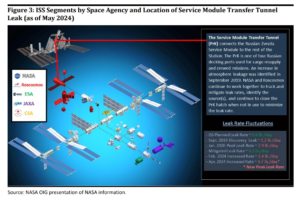
The leak is in the Russian segment so Roscosmos is responsible for dealing with it, but the U.S. and Russian segments are interdependent so NASA has a strong interest. The two space agencies have a joint commission that meets semi-annually to discuss ISS safety. As of April 2025, they were not in agreement as to the risks and underlying causes of the leaks, but outside experts were being brought in to assess the situation.
Neither agency shared any more information about efforts to resolve the leaks until June 12 when NASA delayed the Axiom-4 launch. Ax-4 had been scheduled to launch on June 10, but was postponed first due to weather and then so SpaceX could fix a liquid oxygen leak on the Falcon 9 rocket. On June 12, shortly after SpaceX said the rocket was ready to go, NASA delayed the launch because it wanted to assess the success of the leak repairs. June 19 and June 22 were potential new dates, but in the end Ax-4 didn’t lift off until June 25. The four-person international private astronaut crew had to remain in quarantine throughout that period. They are now aboard the ISS with undocking targeted for Monday, July 14.

Spetch provided few specifics about what repairs the cosmonauts made and the testing that caused the Ax-4 delay, but indicated the leaks now have stabilized and are “very small.”
Prior to the Ax-4 launch we did have some operations going on from our Roscosmos colleagues in PrK that resulted in, I’ll tell you, a leak signature difference that we saw. And so as data changes on orbit, we want to assess and go look at that. What it looked like it had done is, it had stabilized the leak rate such that we didn’t have a great leak rate coming out of the PrK at that point in time. But we wanted to look at it because we actually have hatches in between the ISS and the PrK. We wanted to make sure that we understood, were there any other factors that could have played into that, which is why we had the discussions that we did and the delays we did.
Roscosmos did some troubleshooting on the hatch. And then we had to go look at a couple of different pressure levels in the PrK to confirm … that the leak across that hatch had been resolved, which it has, and since then the PrK has been holding, actually, its pressure has been very steady. It’s a very small leak rate, hard to tell you an exact number because we’re at low pressure, and it’s pretty steady, pretty small, sorry.
In terms of causes, we continue to work very closely with the Roscosmos experts across industry, both on their side and our side, to continue to understand what’s going on. I think the teams continue to make great progress in working towards that and we continue to work with them on a weekly basis to talk through new data results, testing that is ongoing, and continue to share results. — Bill Spetch
Spetch later added they are certain there are no other leaks on the ISS: “The rest of the station is leak tight.”
Another question that arose was the status of Boeing’s Starliner commercial crew vehicle and whether the next flight would carry a crew or only cargo. The first flight of Starliner with a crew, NASA’s Butch Wilmore and Suni Williams, encountered propulsion system problems during docking. NASA decided to bring Starliner home empty, with Butch and Suni remaining on the ISS months longer than planned so they could return on a SpaceX Crew Dragon as part of a regular crew rotation.
Boeing and NASA continue to identify and resolve Starliner’s propulsion issues and hope to launch Starliner again early next year The question is whether they want to send it up with or without a crew. NASA’s goal since the beginning of the commercial crew program has been to have two different crew transportation systems — dissimilar redundancy — so if one is grounded for any reason they have another way to get crews to and from the ISS. SpaceX’s Crew Dragon has been in service in 2020, but Starliner is still in the testing phase.
NASA Commercial Crew Program Manager Steve Stich said a decision hasn’t been made, but he sees advantages in launching it only with cargo. SpaceX successfully launched 19 missions of the original cargo version of Dragon before the first Crew Dragon, giving them considerable experience that Boeing hasn’t had with Starliner.
What we’re really looking at is can we test all the changes that we are making to the [propulsion system] doghouses, in particular, on the ground, and would we want to validate those in flight first. And so there’s a strong chance we’ll fly a cargo flight first [but] then we still haven’t made that decision yet, that’s still in front of us. — Steve Stich
Meanwhile, Crew-11 is scheduled for launch no earlier than July 31 with two NASA astronauts and one each from JAXA and Roscosmos.

Budget constraints are causing NASA to consider launching fewer missions to the ISS with each crew staying longer than the typical 6 months. SpaceX’s Crew Dragon is certified for 210 days, but NASA and SpaceX are working to extend that to 8 months. Crew-11 is currently set for a 6-month mission, but Stich said it could be pushed out to 8 months if they complete the certification requirements in time.
NASA and SpaceX also are looking at increasing the certification for how many times each Crew Dragon capsule can be flown. SpaceX has five reusable capsules: Endeavour, Resilience, Endurance, Freedom, and Grace. NASA has certified them for five flights each when NASA astronauts are aboard, but NASA and SpaceX want to extend that to 15. They are looking at each component of the spacecraft. Sarah Walker, SpaceX’s Director of Dragon Mission Management, said about 70 percent have been certified for 15 flights and the other 30 percent are still in work. For now they are focused on getting certified for six flights. Stich mentioned the weldment structure and tubes that transfer helium to propellant tanks as examples of components that are only certified for six or seven flights now.
User Comments
SpacePolicyOnline.com has the right (but not the obligation) to monitor the comments and to remove any materials it deems inappropriate. We do not post comments that include links to other websites since we have no control over that content nor can we verify the security of such links.