Cavossa: CLD Companies Want Stability, Not a New Plan
Companies developing commercial space stations to replace the International Space Station are not pleased with NASA’s latest proposal to change the plan. At a House hearing today, the head of the Commercial Space Federation trade association said his members want to “stick with the plan” and not make changes that are “sowing confusion.”
During its day-long Ignition briefing yesterday, NASA proposed a new path to establishing Commercial LEO Destinations (CLDs) in low Earth orbit (LEO) to succeed the ISS. Although the briefing’s focus was the Artemis program and building a Moon base, the future of ISS and U.S. presence in LEO was also addressed.

In both cases, ensuring U.S. leadership in space is key. Republicans and Democrats in the White House and Congress are united in their determination not to allow China to be the only country with an earth-orbiting space station, or put taikonauts on the Moon before American astronauts return.
NASA also wants to continue having access to an earth-orbiting facility where astronauts can do scientific research related to Moon and Mars exploration, but it doesn’t want to build another space station. Several years ago it initiated a Public-Private Partnership approach to help at least two companies build their own space stations where NASA could be just one of many customers. NASA Administrator Jared Isaacman and others are convinced a booming “orbital economy” is on the horizon with commercial space stations hosting companies manufacturing pharmaceuticals, space tourists, or other endeavors.
The problem is getting that market started. At the briefing yesterday and a hearing before the space subcommittee of the House Science, Space, and Technology Committee today, NASA officials said they don’t see it materializing any time soon. Instead of following the path they’ve been on since the Phase 1 CLD awards in 2021, they are proposing a significant change and asking industry for feedback through two Requests for Information (RFIs) issued today.

Dave Cavossa, President of the Commercial Space Federation (CSF), offered feedback already today. CSF represents seven companies working on CLDs and they’ve been waiting since last summer for NASA to release the Phase 2 procurement. First, Acting NASA Administrator Sean Duffy proposed a dramatic change last summer. Now there’s a new Administrator and a new proposal. What his companies want is to “stick to the plan.”
“Given the delays and possible shifts in strategy, industry has been left to continue spending resources to develop private space stations without a full understanding of what NASA will require from a private station, how the agency will structure the rest of the procurement and program, and when industry may see a return on investment. This uncertainty challenges the public-private partnership business model and puts the agency at risk of deorbiting ISS before private stations are operational.” — Dave Cavossa, CSF
NASA’s position is that they are not ruling out continuing on the present path, but wants industry to show how it closes before the ISS ends. NASA and its international partners — Russia, Europe, Canada, and Japan — are planning to deorbit the ISS in 2030 (although the Senate Commerce Committee approved a new NASA authorization bill earlier this month that would extend it another two years).
On top of that, NASA conceded they don’t have enough money to support two CLD companies, and if there’s only one, the risk increases that no CLD will be ready in time. NASA Acting Associate Administrator for Space Operations Joel Montalbano, a former ISS program manager, explained that the new proposal is for NASA to procure a new “core” module for the ISS that would have two docking ports of its own. The CLDs would dock their systems to the new module, which would be integrated into the ISS and supply life support and other critical elements to the commercial systems until they are ready to separate and become free-flyers.
NASA and Cavossa fundamentally disagree on the progress the CLD companies have made so far. A slide presented by ISS program manager Dana Weigel at yesterday’s briefing illustrates NASA’s assessment. She said after 25 years of ISS operations “we have seen some amazing discoveries on the station, but we haven’t yet seen breakthrough products, capabilities or services that generate significant demand,” and space tourism hasn’t ramped up as expected either.
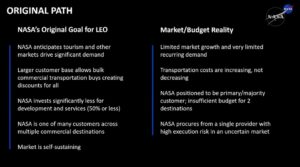
By contrast, Cavossa said today that “industry has raised over a billion dollars in private capital” in the last six months and “several billions of dollars over the last several years.” Some of his member companies have said they’ve already sold out the available rack space on their space stations. NASA’s rationales are “flawed” and the repeated changes are “sowing confusion” in the industry reminiscent of Lucy and the Football.
Rep. George Whitesides (D-CA), a former NASA chief of staff and former CEO of Virgin Galactic, sparred with Montalbano over exactly what the new proposal is and how it would be executed.
“My experience with new pieces of the ISS is that it takes 10 years to build. I don’t get how, where, we’re going to get this new thing. And doesn’t that [timeframe] go beyond the lifetime of the ISS? …
“I just don’t see how it’s fiscally possible for NASA to afford the development and launch of a custom-built government core module, while maintaining ISS, while claiming at the same time it can’t afford to be a customer on a commercial station that is being privately financed. I just don’t understand it.” — Rep. George Whitesides (D-CA)
Montalbano replied that the new core module would not have to have its own propulsion or life support systems because it will be docked to the ISS. NASA also would be able to move some of the ISS systems, like the carbon dioxide removal system, into the new module for use by the commercial companies whose modules are docked there.
Charlie Precourt, a former astronaut and member of NASA’s Aerospace Safety Advisory Panel (ASAP), said ASAP’s main concern is that the ISS is aging and in the “highest-risk phase of its lifecycle.” ASAP supports the goal of CLDs, but a “comprehensive and executable transition strategy” is needed. “There is a credible risk of a gap” that would have “implications beyond any single program, affecting microgravity research, human health studies, exploration readiness for missions beyond Earth orbit, and the Nation’s continuous presence and leadership in space.”
ASAP recently has been focusing on NASA’s acquisition strategy as the agency relies more and more on Public-Private Partnerships. ASAP and an independent review team each concluded earlier this year that flaws in NASA’s response to Boeing’s Starliner Crew Flight Test incident in 2024 stemmed from ambiguity about government versus private sector roles in safety and accountability when using Public-Private Partnerships.
“The United States is entering a period of significant transition in human spaceflight, characterized by the simultaneous management of an aging orbital platform, the development of commercial successors in low Earth orbit, and the pursuit of exploration beyond Earth orbit.
“These transitions introduce new opportunities, but also new complexities in how risk is understood, managed, and governed.
“The Aerospace Safety Advisory Panel continues to emphasize that strong governance, clear safety authority, disciplined acquisition strategies, and sustained technical capability are essential to ensuring safe and successful outcomes.
“Innovation in acquisition must not outpace NASA’s ability to manage risk.”
Charlie Precourt, Aerospace Safety Advisory Panel
User Comments
SpacePolicyOnline.com has the right (but not the obligation) to monitor the comments and to remove any materials it deems inappropriate. We do not post comments that include links to other websites since we have no control over that content nor can we verify the security of such links.