First Time is the Charm! Four Astronauts Headed to the Moon
All the hard work to get the Space Launch System rocket and Orion spacecraft ready to send four people around the Moon for the first time in 53 years paid off today. The few technical hiccups that arose during the countdown were quickly resolved. Liftoff was at 6:35:12 pm ET, just a few minutes past the opening of the two-hour launch window.
NASA astronauts Reid Wiseman, Victor Glover and Christina Koch and Canadian Space Agency astronaut Jeremy Hansen are in earth orbit tonight, preparing to head for the Moon tomorrow.
Liftoff.
The Artemis II mission launched from @NASAKennedy at 6:35pm ET (2235 UTC), propelling four astronauts on a journey around the Moon.
Artemis II will pave the way for future Moon landings, as well as the next giant leap — astronauts on Mars. pic.twitter.com/ENQA4RTqAc
— NASA (@NASA) April 1, 2026
They’ll be the first humans to travel that far from Earth since Apollo 17 in December 1972.
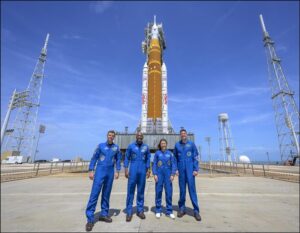
Last minute technical surprises and weather challenges are so common with space launches that the smooth countdown today was a bit of a surprise. Hydrogen leaks that delayed the uncrewed launch of the Space Launch System (SLS) rocket and Orion for months on its first mission in 2022 were absent today. What few problems emerged during countdown — a communications issue with the Flight Termination System and an apparent problem with one of two batteries on the Launch Abort System that turned out to be a sensor issue — were quickly resolved.
The 2-hour launch window opened at 6:24 pm ET and launch took place just a few minutes later at 6:35:12 pm ET.
The crew will spend a day in earth orbit checking out the spacecraft, which they named Integrity, before beginning their trip around the Moon. On this test flight they won’t go into orbit, much less land, but use a “free-return” trajectory that will bring them back to Earth even if their propulsion system doesn’t perform as planned. If all goes well, they’ll splash down in the Pacific Ocean on April 10 similar to the last crew that reached lunar distance, Apollo 17 in 1972.
NASA’s new moon program is Artemis, named after Apollo’s twin sister in Greek mythology. This mission, Artemis II, is the beginning of what is planned as long-term sustained presence on the Moon. Artemis began during President Trump’s first term, but delays in the SLS/Orion system, especially unexpected char loss on the Orion heat shield, development of the Starship Human Landing System by SpaceX, and of lunar spacesuits by Axiom Space, has pushed the date for the first lunar landing since Apollo from 2024 to 2028.
NASA Administrator Jared Isaacman recently announced major changes to the Artemis program, but still plans to land astronauts on the Moon by 2028, before Trump’s second term ends and before Chinese taikonauts arrive there around 2030.
Trump congratulated NASA and the astronauts this evening at the opening of a speech to the nation about the situation with Iran.
Let me begin by congratulating the team at NASA and our brave astronauts on the successful launch of Artemis II. It was quite something. It will be traveling further than any manned rocket has ever flown, and will very substantially pass the Moon, go around it, and come back home from a distance that has never been done before. It’s amazing. They are on their way and God bless them.” — President Trump
The crew will indeed set a new record for the furthest any humans have traveled from Earth — 252,799 statute miles (406,841 kilometers) — if all continues to go as planned. That’s about 4,000 miles (6,400 km) further than the crew of Apollo 13.
In 1970, the Apollo 13 crew was enroute to the Moon when their Service Module exploded, severely damaging the spacecraft and imperiling their lives. Mission controllers in Houston were able to use the descent engine on their Lunar Module to put them onto a free-return trajectory that brought them safely home. They reached a distance of 248,655 statute miles (400,171 km).
The Artemis II crew has made clear that setting records is not on their mind as they test out SLS/Orion to pave the way for future flights to the Moon and Mars. They often say they’ll be successful when future missions are successful because of what they demonstrate on this flight.
The United States is the only country to send astronauts to the Moon. Including Apollo 13, nine crews made the trip. Two (Apollo 8 and 10) orbited the Moon. Apollo 11, 12, 14, 15, 16 and 17 landed. All of the crew members were white American males. By comparison, Artemis II includes the first African American, Victor Glover, the first woman, Christina Koch, and the first international astronaut, Canada’s Jeremy Hansen.
For all their political differences, Republicans and Democrats are united in their determination to ensure Americans are back on the Moon before Chinese taikonauts arrive. In addition to Trump’s statement, congratulations from key Senate and House appropriators and authorizers were pervasive tonight. Their support will be crucial in getting NASA the money it needs to execute those plans. The FY2027 budget request is expected to be released on Friday.
Among the appropriators cheering on the astronauts are Senate Appropriations Committee chair Susan Collins (R-Maine) and Commerce-Justice-Science (CJS) subcommittee chair Jerry Moran (R-Kansas) and Ranking Member Chris Van Hollen (D-Maryland), as well as House Appropriations Committee chair Rep. Tom Cole (R-Oklahoma) and CJS subcommittee chair Hal Rogers (R-Kentucky), and CJS subcommittee Ranking Member Grace Meng (D-New York).
Godspeed to Artemis II! This historic lunar mission is the first of its kind in more than 50 years. I’m praying for a safe and successful journey for the intrepid crew as they take this incredible leap forward for human exploration. https://t.co/2itpOv3Ipg
— Sen. Susan Collins (@SenatorCollins) April 1, 2026
Blast off! Artemis II is on its way to orbit the Moon, marking a new era of American leadership in human space exploration and taking astronauts further into deep space than ever before. Praying for the safety and success of the Artemis mission. https://t.co/f3ETB1g7rG
— Senator Jerry Moran (@JerryMoran) April 1, 2026
Tonight, Artemis II will take humans further than they’ve ever gone into space, helping us learn more about our universe & one day return to the moon.
Marylander Reid Wiseman leads the mission guided by the Near Space Network at NASA Goddard.
Making Maryland & America proud!… pic.twitter.com/m3382itHIC
— Senator Chris Van Hollen (@ChrisVanHollen) April 1, 2026
America is headed back to the moon!
Today’s Artemis II launch marks a bold step for the next generation of space exploration and for American leadership in science, technology, and innovation. Wishing this courageous crew a safe and successful journey as they help advance… pic.twitter.com/GmHNfoWUxU
— Grace Meng (@RepGraceMeng) April 1, 2026
NASA’s Senate and House authorizing committees also are strongly supportive. That includes Senate Commerce Committee Chair Senator Ted Cruz (R-Texas), who added $10 billion for NASA’s exploration program to the One, Big Beautiful Bill Act (OBBBA) last summer, and Ranking Member Maria Cantwell (D-Washington), as well as House Science, Space and Technology Committee Chair Brian Babin (R-Texas) and House SS&T Democrats.
As Chairman of the @SenateCommerce Committee, I’ve worked to advance the success of the Artemis II program by advancing the NASA reauthorization bill last month, empowering @NASA to help return American astronauts to the Moon and carry out the President’s National Space Policy.… https://t.co/DP5B2epFw6
— Senator Ted Cruz (@SenTedCruz) April 1, 2026
The world will be watching in awe as the Artemis II crew pushes the limits of what humanity can do by traveling around the moon. This trip lays the groundwork for returning to the Moon’s surface and staying there. And Washington state’s space industry is making it happen – from… https://t.co/Tj3bEqFjpB
— Sen. Maria Cantwell (@SenatorCantwell) April 1, 2026
Standing at Kennedy Space Center watching America count down to history.
From the Moon to Mars, we’re not just launching rockets, we’re launching the next chapter of American greatness.
Let’s go. 🚀 pic.twitter.com/XTHr25v6lx
— Brian Babin (@RepBrianBabin) April 1, 2026
Congratulations to NASA and its partners on this magnificent feat! I look forward to following along as NASA and the Artemis team continue to support our brave astronauts during the mission and their safe return to Earth.https://t.co/PMOfFRkipD pic.twitter.com/7EzH9c1u3n
— Science Committee Democrats (@sciencedems) April 2, 2026
NASA is providing 24/7 coverage of the mission on its YouTube channel.
User Comments
SpacePolicyOnline.com has the right (but not the obligation) to monitor the comments and to remove any materials it deems inappropriate. We do not post comments that include links to other websites since we have no control over that content nor can we verify the security of such links.