Four Astronauts Headed to Moon After Successful TLI Burn
After a day in earth orbit checking out systems on the Orion capsule, the Artemis II crew is headed to the Moon. Earlier today the Mission Management Team gave them permission to proceed to the next step, the Trans-Lunar Injection or TLI burn. They fired the Service Module’s main engine at 7:49 pm EDT (23:49 UTC) and are on their way to go around the Moon, the first humans to travel that far from Earth since the Apollo era.
The crew of three Americans and one Canadian — NASA’s Reid Wiseman, Victor Glover and Christina Koch and Canadian Space Agency’s Jeremy Hansen — has been very busy since launch yesterday at 6:35 pm EDT.

One of the first important tasks was checking out the toilet, or Universal Waste Management System. Mission Specialist Christina Koch reported a blinking fault light that was traced to a jammed fan. The commode could still be used for poop, but not urine (in which case urine bags could be used). Ground controllers determined what the problem was and instructed Koch on how to fix it. All is well now. Pre-treated urine (to prevent generation of ammonia) is periodically vented overboard. The solid waste is stored in canisters and will return with the crew.
In their first hours in orbit, they also conducted proximity operations tests between the Orion capsule, which they’ve named Integrity, and the Interim Cryogenic Propulsion Stage (ICPS) that helped put them in space. The ICPS is the upper stage for the Space Launch System (SLS) rocket. After SLS’s propellant is exhausted about 8 minutes into flight, it detaches and the ICPS takes over for the rest of the boost into orbit. It then detaches to allow Orion to proceed on its way. In this case, however, the ICPS stayed nearby to serve as a target for Pilot Victor Glover to practice rendezvous operations. While not needed on this mission, future Orion spacecraft will need to dock with Human Landing Systems being built by SpaceX and Blue Origin that will take astronauts down to and back from the lunar surface.
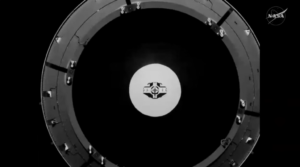
Glover, a Navy test pilot before joining NASA, performed a series of approach and retreat maneuvers before firing a departure burn. At a press briefing this evening, Orion program manager Howard Hu said Glover was able to accomplish it in 65 minutes, six minutes ahead of schedule.
The ICPS performed a disposal burn to reenter Earth’s atmosphere over the Pacific Ocean after deploying four cubesats from Argentina, Germany, Saudi Arabia, and South Korea.
The crew then took a 4-hour nap before awakening at 7:00 am EDT this morning for an engine burn to change Integrity’s orbit around Earth to get into the correct position for the TLI. They then got to sleep for a few more hours, waking up at 2:35 pm EDT. It’s important to exercise in space and Integrity has a “Resistive Overload Combined with Kinetic Yo-Yo” or ROCKY device similar to a rowing machine. Commander Reid Wiseman used it in space for the first time this afternoon and gave it high marks.
Then the 5 minute 50 second TLI burn began at 7:49 pm EDT using the Service Module’s Orbital Maneuvering System or OMS engine. The TLI burn was “flawless,” according to Lori Glaze, Acting Associate Administrator for Exploration Systems Development at this evening’s press conference. As NASA says, the TLI burn is also the deorbit burn since it puts the crew on a free-return trajectory around the Moon and back to Earth and splashdown in the Pacific Ocean near San Diego on April 10.

The astronauts are excited to be on their way. Speaking on behalf of his crewmates, Mission Specialist Jeremy Hansen shared these words after the burn:
With that successful TLI, the crew is feeling pretty good up here on our way to the Moon and we just wanted to communicate to everyone around the planet who’s worked to make Artemis possible that we firmly felt the power of your perseverance during every second of that burn.
Humanity has once again shown what we are capable of, and it’s your hopes for the future that carry us now on this journey around the Moon. — Jeremy Hansen

They will reach the Moon on Flight Day 6, making their closest approach to the Moon’s surface, between 4,000-6,000 miles (6,400-9,600 kilometers). Their path will take them further from Earth than any humans in history: 252,799 statute miles (406,841 kilometers). That’s about 4,000 miles (6,400 km) further than the crew of Apollo 13.
This is a test flight and Artemis II will not orbit the Moon, much less land on the surface, but they are the first humans to travel to lunar distance since Apollo 17 in 1972.
That was the last time humans walked on the Moon. The next time will be in 2028 on the Artemis IV mission under NASA’s recently announced plan. Artemis III was to be a landing mission, but now will be an earth orbital test flight in 2027.
NASA is providing 24/7 coverage of the mission on its YouTube channel. NASA also will hold daily media updates. The list is available (keep scrolling down), but times are subject to change.
User Comments
SpacePolicyOnline.com has the right (but not the obligation) to monitor the comments and to remove any materials it deems inappropriate. We do not post comments that include links to other websites since we have no control over that content nor can we verify the security of such links.