Trump FY2027 NASA Budget Supports Moon Missions, But Cuts Everything Else
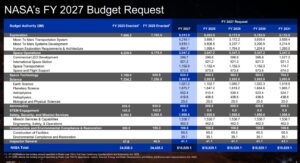
Like last year, the Trump Administration’s FY2027 budget request for NASA proposes deep cuts to everything other than human exploration. For FY2027, the agency would be cut 23 percent to $18.8 billion, the same level the White House proposed for FY2026. Congress rejected the FY2026 proposal and kept the agency funded at roughly the same appropriated level as FY2025. Congress also added almost $10 billion in last summer’s reconciliation bill, although that was for mostly for human spaceflight, not the rest of NASA’s portfolio. What will happen this year is anyone’s guess.
The White House Office of Management and Budget released the FY2027 budget request this morning.
For NASA, OMB says it supports “the safe and timely return of Americans to the Moon and funds first elements of a permanent American presence on the lunar surface,” while cutting “unnecessary and overpriced activities.”
OMB highlights these changes:
- Landing Astronauts on the Moon by 2028: +$731 million. A total of $8.5 billion for Artemis, including lunar landers, spacesuits, lunar surface systems, and astronaut transportation systems.
- Establishing a Lunar Base Camp: a new $175 million investment for robotic missions that along with astronaut missions will deploy initial elements of a permanent outpost near the Moon’s South Pole.
- Landsat Program: $109 million to support a phased transition to a commercial solution. Supports development of one final government satellite while working with industry on the transition.
- Science: -$3.4 billion. Terminates over 40 low-priority missions. [The two missions listed as examples in the OMB document were terminated last year: Mars Sample Return and the USAID-NASA SERVIR program.]
- Legacy Human Exploration Systems: continues development of commercial replacements for SLS and Orion, and “allows the agency to work with Congress to repurpose” the $2.6 billion in last year’s reconciliation bill for the Gateway lunar space station towards development of the lunar base camp and other priorities in the “Ensuring American Space Superiority” Executive Order.
- Space Technology: -$297 million. Prioritizes early stage R&D for future lunar missions and to support a competitive space industry.
- International Space Station: -$1.1 billion. Reduces funding for “operations, maintenance and transportation that is unnecessary given its looming retirement” and for the “expansive bureaucracy … spread across multiple NASA centers.”
- STEM Engagement: -$143 million, zeroing the program as the White House proposed last year.
This afternoon, NASA posted more information including the full request, a summary, and a fact sheet.
NASA Administrator Jared Isaacman expressed his support for the President’s request in his “Message from the Administrator” statement in the request itself (page SUM-2) and in a letter to employees obtained by NASAWatch. In the latter statement, he says he strongly supports “the President’s fiscal policies and mandate to drive efficiency” and the requested funding is “sufficient for NASA to meet the Nation’s high expectations and deliver on all mission priorities.”
The President’s request for FY2026 also was $18.8 billion. Congress rejected that cut and approved $24.4 billion instead, just slightly less than the $24.8 billion NASA had for FY2025.
Not reflected in the budget charts is the almost $10 billion Congress added for NASA over several years in last summer’s One, Big Beautiful Bill Act (OBBBA), alternatively known as the reconciliation bill or the Working Families Tax Cut act. About 90 percent of that is for human spaceflight, with the remainder for infrastructure improvements at several NASA centers. NASA’s budget document includes a table showing how the funding is spread out from FY2025-2029. About 5 percent was for FY2025, 40 percent for this year (FY2026), 20 percent each for FY2027 and FY2028, and the remainder in FY2029. The $2.6 billion for the Gateway lunar space station that Isaacman decided to cancel is in the “Moon and Mars Systems Development” line ($1.1 billion in FY2026, $750 million in FY2027 and $750 million in FY2028). As noted above, the budget request “allows” NASA to work with Congress to reallocate that to other purposes including the lunar base camp.
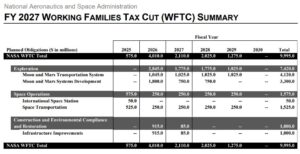
Isaacman often says the OBBBA funding is what enabled the changes to the Artemis program he announced on February 27 and detailed at the Ignition event last week, especially increasing the cadence of launches of the Space Launch System (SLS) rocket and Orion capsule. The Administration’s FY2026 request called for cancelling SLS/Orion after the Artemis III mission, but the OBBBA required two more. Instead of waiting to launch Artemis III as a lunar landing mission in 2028, he’ll use that SLS/Orion as an earth orbit test flight in 2027, and the two funded by the OBBBA as two landing missions in 2028 (Artemis IV and Artemis V).
The OBBBA money is largely for human exploration to the Moon and Mars, not the other parts of NASA’s portfolio — science, technology, and aeronautics. Isaacman expresses strong support for all of NASA’s activities, but it will be challenging to advance them with $18.8 billion, which is why Congress rejected the request last year. Science, technology and aeronautics all have strong congressional support.
As of 6:00 pm EDT today, a Friday mid-way through a two-week congressional recess and a holiday (Good Friday) for some, reaction to the budget request is relatively muted.
The Planetary Society, which fought hard last year to “Save NASA Science,” is again calling on the public to contact their members of Congress. Rep. Zoe Lofgren (D-CA), Ranking Member of the House Science, Space, and Technology Committee, criticized the request not specifically because of NASA, but the broader negative impact on science and innovation. Rep. George Whitesides (D-CA), HSS&T Vice Ranking Member, who is a former NASA Chief of Staff and former CEO of Virgin Galactic, similarly argued that the proposal would “demolish our scientific agencies and drive technical leadership to other countries,” while noting that it was released while four astronauts are on their way to the Moon.
Senate Appropriations Committee chair Sen. Susan Collins (R-Maine) and Vice Chair Sen. Patty Murray (D-WA), both criticized the request overall and Murray mentioned NASA specifically saying it contradicts the administration’s claims of “Shaping the Golden Age of Innovation.”
House Appropriations Committee chair Rep. Tom Cole (R-OK) supported the request, while Ranking Member Rep. Rosa DeLauro (D-CT) strongly opposed it. Neither mentioned NASA.
In short, the FY2027 budget request closely parallels FY2026. Whether Congress will reject it again is anyone’s guess. This is an election year and congressional attention will be focused on November 3. Which part(ies) control the House and Senate in the 120th Congress could play a role. Even though NASA has strong bipartisan support, it is part of the Commerce-Justice-Science appropriations bill that includes controversial departments and that could complicate congressional action.
In many cases agencies are temporarily funded through a Continuing Resolution (CR) at their existing levels when appropriations bills aren’t enacted by the start of the fiscal year on October 1, but sometimes Congress doesn’t pass a CR. The record-breaking government shutdown just a few months ago and what the Department of Homeland Security is experiencing right now are testament to that. Another strained year seems likely.
This article has been updated.
User Comments
SpacePolicyOnline.com has the right (but not the obligation) to monitor the comments and to remove any materials it deems inappropriate. We do not post comments that include links to other websites since we have no control over that content nor can we verify the security of such links.