Artemis II Swings Around the Moon, Begins Trip Home with White House Congratulations
The four Artemis II astronauts set a new record today for the furthest any humans have traveled from Earth, swinging around the Moon and then heading back towards Earth. Their day began with a message from Jim Lovell, one of the first astronauts to orbit the Moon who recorded it last year a few months before he passed away. The day ended with a congratulatory chat with President Trump. In-between was an intense day of scientific observations that left them at a loss for superlatives to describe it all.
NASA’s Reid Wiseman, Victor Glover, and Christina Koch and Canadian Space Agency’s Jeremy Hansen spent hours looking out the windows both with their eyes and cameras to study parts of the farside lunar surface not seen by humans before. The farside cannot be seen from Earth and scientists are eager to hear from the crew about what they observed with their own eyes. Although the Lunar Reconnaissance Orbiter has taken detailed images of the farside for years, Artemis II Lunar Science Lead Kelsey Young explains that human eyes can detect nuances, especially colors, that cameras can’t capture.
Following a musical wake-up call, their morning began with Lovell’s recorded message. Lovell, Frank Borman and Bill Anders were the first humans to orbit the Moon on Apollo 8 in December 1968.
“Welcome to my old neighborhood.” Our @NASAArtemis II astronauts woke up on the sixth day of their mission to a special message recorded in 2025 by astronaut Jim Lovell, the pilot of Apollo 8. pic.twitter.com/XA4Dc2yQm5
— NASA (@NASA) April 6, 2026
Lovell not only was on Apollo 8, but the ill-fated 1970 Apollo 13 mission whose Service Module exploded enroute the Moon, imperiling the crew. Mission Control was able to use the Lunar Module’s descent engine to put them on a free-return trajectory that brought them back home safe and sound. Artemis II is using a similar trajectory to test out Orion and today surpassed Apollo 13’s record, traveling further from Earth than ever before — 252,756 miles (406,771 kilometers).
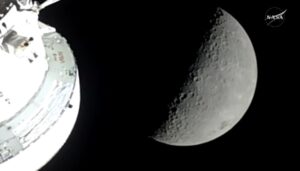
Lovell’s message was a heartwarming moment, and not the only one. With the help of Young and her team of scientists, they identified two unnamed craters. As the day began, Hansen called down to say they want to name one Integrity after their Orion capsule, and the other Carroll.
Carroll was Wiseman’s wife, who died of cancer in 2020 at the age of 46. The astronaut corps is a small, tight group and all four crewmates were deeply affected as Hansen made the request, his voice cracking as he said the crater is “a bright spot on the Moon and we would like to call it Carroll.” Hugs and tears flowed naturally. A very human moment in the vastness of space.
To commemorate the Artemis II mission, the astronauts announced their suggestion to rename certain features on the Moon to honor the Orion spacecraft, named Integrity, as well as commander Reid Wiseman’s late wife, Carroll. pic.twitter.com/ejfhnItDo8
— NASA (@NASA) April 6, 2026
NASA shared the locations of the two craters and a photo of the Wisemans. The International Astronomical Union officially names celestial bodies and their features and the agency said it will make a formal request after the mission is over.


The crew collected massive amounts of data and images during their many hours of observations as they moved from the nearside to the farside — coming as close as 4,067 miles (6,545 kilometers) to the surface — and back out towards Earth. They even got to see a solar eclipse as the Moon blocked the Sun, the first humans to see an eclipse from the lunar environment.

Some of the imagery and crew commentary was available in real time, but much more will be downloaded to Mission Control overnight for detailed analysis. That includes their observations during a 40-minute Loss of Signal (LOS) period when communications with Earth were blocked by the Moon. It was during that time that they made their closest approach to the surface and reached their furthest distance from Earth.
The crew was full of superlatives describing what they were seeing throughout the day and joked they’d have to invent some new ones.
The busy day wasn’t over when the scientific observations ended, though. Late in the evening Eastern Time, President Trump called up to the crew to offer congratulations and remind them Mars is the longer-term goal. “You really inspired the entire world” and “we’re going to be doing a lot of traveling and then you’re going to ultimately do the whole big trip to Mars.”
Each crew member spoke with Trump, including Hansen who expressed appreciation for America including international partners: “A nation that leads like that and creates and sets big goals for humanity, that brings other countries along with it, is truly incredible.” Trump replied that he’d spoken with legendary Canadian hockey player Wayne Gretzky and Prime Minister Mark Carney and other Canadian friends and they’re very proud. Trump invited the entire crew to the White House when they return. “This is really big stuff. The whole world is talking about it.”
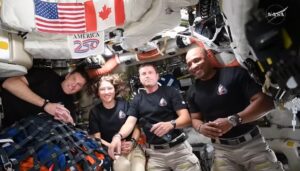
Artemis II is now headed back to Earth with splashdown in the Pacific Ocean near California on Friday at about 8:07 pm ET. NASA will continue their 24/7 live coverage and daily media briefings until then.
A number of Senators and Representatives also are following the mission even though the Senate and House are in recess. Among those posting congratulatory messages on X today are Sen. Patty Murray (D-WA, Vice Chair of the Senate Appropriations Committee); Sen. Jerry Moran, R-KS (chairman of the Senate Appropriations CJS subcommittee that funds NASA); Sen. Maria Cantwell, D-WA (ranking member of the Senate Commerce Committee that oversees NASA); Sen. Tim Sheehy, R-MT; Sen. Mark Kelly, D-AZ (a former NASA astronaut); Rep. Hal Rogers, R-KY (chairman of the House Appropriations CJS subcommittee); Rep. Brian Babin, R-TX (chairman of the House Science, Space & Technology Committee); Rep. Mike Haridopolos, R-FL (HSS&T space subcommittee chairman), and Rep. George Whitesides D-CA (HSS&T Vice Ranking Member).
This article has been updated.
User Comments
SpacePolicyOnline.com has the right (but not the obligation) to monitor the comments and to remove any materials it deems inappropriate. We do not post comments that include links to other websites since we have no control over that content nor can we verify the security of such links.