Artemis II Less Than Two Days from Home
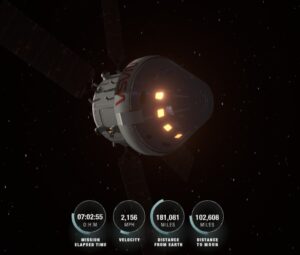
The Artemis II crew continued a variety of tests of the Orion capsule today as they began preparations for splashdown in the Pacific Ocean in less than two days. They are now about 181,000 miles (291,291 kilometers) from Earth and getting closer every minute.
Images captured while they swung around the Moon on Monday are still coming back. One that created a lot of excitement today is of the Milky Way galaxy.

The crew also sent back group photos, including this one.

Among the planned activities today, Flight Day 8, were additional manual piloting tests by all four crew members. Ascent Flight Director Rick Henfling said at this afternoon’s daily press briefing that commander Reid Wiseman wanted to determine how easy it is for Orion to be flown both by pilots and non-pilots to “open the door for a wider range of future astronaut selections and flight crew assignments.” Wiseman and Glover are former Navy test pilots and Hansen a former Canadian Air Force fighter pilot. Koch is an electrical engineer. However, the test was called off because ground control wanted to conduct a propulsion characterization test in one of the two Service Module liquid oxygen manifolds. The crew already did manual piloting tests on Flight Day 4.
Hansen and his crewmates had a live chat with Canadian Prime Minister Mark Carney and later with the media, and tested the orthostatic intolerance garments they’ll wear to help ensure proper blood flow as they return to Earth’s gravity on Friday. As of 9:30 pm ET, Orion was 181,081 miles (291,421 kilometers) from Earth.
Tomorrow the crew will spend most of the day getting ready for reentry, especially stowing everything they’ve been using during their trip.
Splashdown off the coast of California will be on Friday at about 8:07 pm ET. Henfling and Liliana Villarreal, Landing and Recovery Director, gave a preview of what will happen during reentry, splashdown and recovery. Villarreal is aboard the U.S.S. John P. Murtha that already has departed Naval Base San Diego enroute to the landing zone.
Unexpected char loss on the Orion heat shield during reentry of the Artemis I Orion capsule in 2022 led NASA to modify the “skip return” reentry profile used on that mission. Instead, Artemis II will use a “lofted return” trajectory that puts less stress on the heat shield. Hefling shared slides of key aspects of the reentry.


The maximum speed during reentry will be 34,965 feet per second (10,657 meters per second), which is less than the record set by the Apollo 10 crew in 1969 (36,397 fps or 11,094 m/s). Entry interface to splashdown will take just 13 minutes during which the crew will experience 3.9 g’s (gravitational force) during a nominal descent and the crew will make “a gentle 20 mile an hour splashdown.” Henfling added there are contingencies that could cause them to land short and could result in forces as high as 7-7.5 g’s.
At the moment the weather forecast is favorable, with winds about 10 knots (5 m/s), waves less than four feet (1.2 meters), and a wave period of 17 seconds.
Once in the water, divers from the Murtha will approach Orion and assess the air and water around the capsule to ensure it’s safe to approach, Villareal said. Then medical officers will go in to assess the crew, after which they’ll be extracted one by one — Koch, Glover, Hansen, and Wiseman in that order — and helped into an inflatable raft called the “front porch.” The capsule then will be towed away so helicopters can pick up the crew and deliver them to the ship where they’ll undergo medical checkouts. “We had a very successful recovery of the uncrewed Orion spacecraft during the Artemis I mission and we feel confident that through our testing and training alongside the Navy and other collaborators, we will make Artemis II just as successful.”
The crew will return to Naval Base San Diego. Depending on the exact splashdown site, it will take about 24 hours.
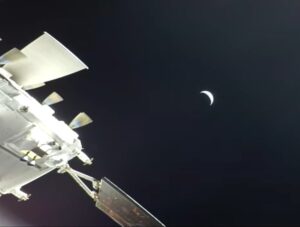
That’s not until Friday, though. For now, they still have time to enjoy the view as Earth gets closer and closer.
This article has been updated.
User Comments
SpacePolicyOnline.com has the right (but not the obligation) to monitor the comments and to remove any materials it deems inappropriate. We do not post comments that include links to other websites since we have no control over that content nor can we verify the security of such links.