Crew-12 Back on Earth as ISS Keeps Busy
NASA’s Crew-12 mission splashed down in the Pacific Ocean off the coast of California this morning, bringing the 237-day mission to an end. Their replacements on Crew-13 arrived a week ago and the busy cadence on the International Space Station continues with a Northrop Grumman Cygnus cargo ship departing tomorrow and a SpaceX Cargo Dragon arriving next week.
Crew-12 commander Jessica Meir (NASA), pilot Jack Hathaway (NASA), and mission specialists Sophie Adenot (ESA) and Andrey Fedyaev (Roscosmos) arrived back on planet Earth at 11:34 am ET.
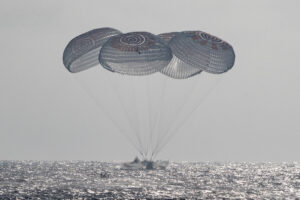
Within an hour, SpaceX’s Crew Dragon Freedom was aboard SpaceX’s recovery ship Shannon and the astronauts were being helped out of the capsule and onto stretchers as their bodies readjusted to gravity after seven months in weightlessness. They were flown to shore by helicopter and then by airplane back to Johnson Space Center in Houston, headquarters for the astronaut corps. Adenot and Fedyaev will soon return to their homes in Europe and Russia.
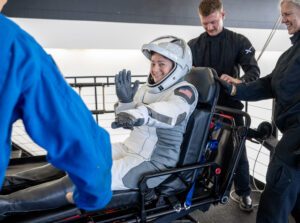
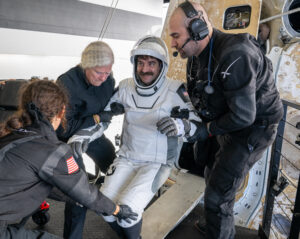
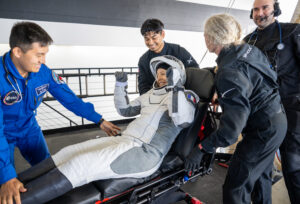

The crew spent 235 of their 237 days in space aboard the International Space Station. Meir conducted four spacewalks in addition to the three on her previous flight in 2019. She now is third on the list of most spacewalks by women astronauts, behind Peggy Whitson (10) and Suni Williams (9).
Meir’s first flight was aboard a Russian Soyuz. This also was Fedyaev’s second flight, but both of his were on Crew Dragons. In fact, he is the first person to fly on a Crew Dragon twice. NASA’s Jessica Watkins, who just launched on Crew-13, is the first NASA astronaut to be a Crew Dragon “frequent flyer,” but Fedyaev is first overall. He was a member of Crew-6 in 2023.
Hathaway and Adenot were rookies. Adenot is the first French woman to make a spacewalk and she did three of them.
During a post-splashdown news conference shortly after splashdown, Liz Warren, deputy chief scientist for NASA’s Low Earth Orbit program, shared highlights of the scientific research the crew conducted: work to understand venous thrombosis embolism in spaceflight, technology development to test a system to produce IV fluids for medical care in spaceflight, and learning how to expand stem cells for use on Earth.
Many of the experiments conducted on the ISS are delivered on cargo spacecraft including Northrop Grumman’s Cygnus XL and SpaceX’s Cargo Dragon. NG’s 24th Commercial Resupply Services mission, CRS-24, docked at the ISS in April carrying more than 1,000 kilograms (2,300 pounds) of scientific experiments and will undock tomorrow. Unlike SpaceX’s Dragon, Cygnus is not designed to survive reentry. It is filled with trash — less glamorous, but essential — that burns up along with the spacecraft. NASA will provide live coverage of Cygnus CRS-24’s departure from the ISS tomorrow starting at 12:30 pm ET, but not of reentry on Sunday. Another Cygnus will launch later this year.
Then on Tuesday, SpaceX will launch it’s next Cargo Dragon. Among the cargo onboard are the final two ISS Roll Out Solar Arrays or iROSAs for installation on the exterior of the ISS to augment the energy supply. Developed by Redwire, six have been installed so far over the existing solar arrays. NASA will provide live launch coverage starting at 6:15 am ET and docking on Thursday starting at 9:15 am ET.
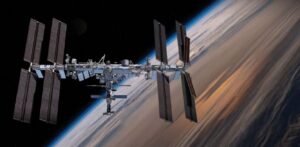
With the arrival of Crew-13 last week and Crew-12’s return, the ISS is back to its usual crew complement of seven. Aboard right now are Crew-13’s Jessica Watkins (NASA), Luke Delaney (NASA), Josh Kutryk (Canadian Space Agency), and Sergey Teteryatnikov (Roscosmos), and Soyuz MS-29’s Pyotr Dubrov (Roscosmos), Anna Kikina (Roscosmos), and Anil Menon (NASA).
User Comments
SpacePolicyOnline.com has the right (but not the obligation) to monitor the comments and to remove any materials it deems inappropriate. We do not post comments that include links to other websites since we have no control over that content nor can we verify the security of such links.