FCC Approves Elon Musk’s One Million Orbital Data Centers
FCC Chairman Brendan Carr announced today that the FCC has approved Elon Musk’s request to launch one million satellites to low Earth orbit to serve as data centers in space. Called Starmind, they are in addition to the 42,000 Starlink broadband internet satellites SpaceX plans to deploy plus the military version, Starshield. The vast number of satellites is raising concerns about collisions, atmospheric effects of reentry, and the impact on optical and radio astronomy.
SpaceX revealed plans to build one million Orbital Data Centers in January, but it’s not the only company with sights set on taking advantage of the continuous sunlight available in space to power ODCs. The Secure World Foundation maintains a list and how many satellites each expects to launch.
Of the nine companies on the list, five are American and will need FCC approval for the radio frequencies needed to communicate between the ground and space. In announcing today’s “historic” approval on X, Carr noted those “competitor constellations,” but only SpaceX’s application has been approved so far.
DATA CENTERS IN SPACE🇺🇸
Today, in a historic first, the FCC approved SpaceX’s request for 1 million satellites (orbital compute modules) to create data centers in space
The Starmind & competitor constellations will use solar power to extend America’s lead in Super Intelligence https://t.co/VJinjK5e5E
— Brendan Carr (@BrendanCarrFCC) November 25, 2026
Musk replied on X that it will be a “great asset to America and the world.”
The FCC assigns spectrum to all commercial users to ensure they don’t interfere with each other and requires them to deploy their systems within a set period of time so they don’t disadvantage others who want the same frequencies.
For Starmind, SpaceX must deploy:
- one satellite by November 25, 2033;
- the first 10 percent of the total by November 25, 2035;
- 50 percent by November 25, 2038; and
- the remainder by November 25, 2040.
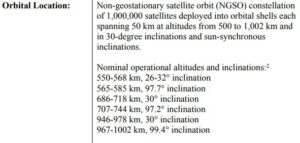
Six operational altitudes and inclinations are allowed:
Secure World was one of several organizations that filed public comments in response to the ODC plans put forward by SpaceX and others. “The current wave of ODC applications represents a qualitative shift in the scale of proposed satellite constellation operations,” that “raises novel technical, environmental, and governance considerations.” It called for “robust technical review” assessing not only spectrum interference, but the environmental impact of increased launch rates, the atmospheric effects of so many satellites reentering Earth’s atmosphere at end-of-life, and “cumulative impacts on dark and quiet skies and long-term implications for optical and radio astronomy.”
The American Astronomical Society (AAS) has similar concerns. In a statement today, AAS said it is “disheartened and dismayed” at the FCC decision because it will “significantly undermine (i) decades of federal investment in astronomical facilities and (ii) the ability of astronomers and the public to enjoy and study the night sky.”
“We believe that it is critical for the FCC to consider the protection of optical and infrared astronomy when assessing applications from satellite operators, in the absence of another licensing agency that can take these concerns into account. We continue to emphasize that American technical innovation in space cannot come at the expense of imperiling scientific research, which has been foundational for American innovation and global leadership for decades.” — American Astronomical Society
In its ruling, the FCC said any impacts on the environment or astronomy are outside its jurisdiction.
An ODC is similar to a data center on Earth in terms of function. Unlike data centers here, however, water isn’t required for cooling since space itself is so cold. Solar arrays on the spacecraft provide the power, and ODCs in Sun-Synchronous Orbits (SSOs) have continuous access to the Sun’s solar energy.
With a million (or more) satellites travelling in the same orbit, however, collision concerns are real.
The satellites can travel in what’s referred to as “dawn-dusk” or “dusk-dawn” orbits where they cross the equator either at 6:00 am and 6:00 pm, or at 6:00 pm and 6:00 am, to optimize exposure to sunlight. A global “Rules of the Road” agreement has not been reached on whether these millions of satellites will all use one route or the other, however. At a July 29, 2026 Secure World event, concern was expressed that government regulation won’t happen fast enough. Matias Cava from the Department of Commerce’s Office of Space Commerce encouraged satellite operators to develop and follow responsible practices now based on how they want competitors to behave.
User Comments
SpacePolicyOnline.com has the right (but not the obligation) to monitor the comments and to remove any materials it deems inappropriate. We do not post comments that include links to other websites since we have no control over that content nor can we verify the security of such links.