NASA Will Wait Until March for Artemis II
Following a Wet Dress Rehearsal (WDR) that ended early this morning, NASA decided to pass on this month’s opportunities to send astronauts around the Moon on the Artemis II mission. At a news conference this afternoon, NASA said they need to review data before deciding when they will be ready, but the earliest is March. The four Artemis II astronauts — three from NASA and one from the Canadian Space Agency — ended their pre-launch quarantine for now. Whenever they do launch, they will become the first humans to fly to the Moon since the Apollo era.
During the WDR that ended just before 2:00 am ET this morning, hydrogen leaks occurred at an interface between the core stage of the Space Launch System (SLS) rocket and the launch pad. The SLS uses cryogenic liquid hydrogen (LH2) and liquid oxygen (LOX) as propellant. NASA and its contractors were able to overcome the leaks during most of the test, but the leak rate spiked during a practice countdown and NASA needs more time to investigate.
In addition, once the tanks were full NASA moved on to the next stage of the test, sending the closeout crew to practice the final steps of getting the Orion crew capsule and its Launch Abort System ready. The crew was not present for the WDR, but the closeout crew followed all the steps as though they were. During that process, a valve associated with pressurizing the capsule had to be retorqued, further delaying the test.

NASA had planned practice countdowns to about 30 seconds before liftoff, but ultimately did only one to almost T-5 minutes. At that point a ground launch sequencer automatically stopped the countdown because the liquid hydrogen leak rate spiked. Other issues included audio dropouts across communications teams.
NASA Administrator Jared Isaacman posted on X that safety always comes first “for our astronauts, our workforce, our systems, and the public.”
With the conclusion of the wet dress rehearsal today, we are moving off the February launch window and targeting March for the earliest possible launch of Artemis II.
With more than three years between SLS launches, we fully anticipated encountering challenges. That is precisely why we conduct a wet dress rehearsal. These tests are designed to surface issues before flight and set up launch day with the highest probability of success.
During the test, teams worked through a liquid hydrogen leak at a core stage interface during tanking, which required pauses to warm hardware and adjust propellant flow. All core stage and interim cryogenic propulsion stage tanks were successfully filled, and teams conducted a terminal countdown to about T-5 minutes before the ground launch sequencer halted operations due to an increased leak rate. Additional factors included extended Orion closeout work, intermittent ground audio dropouts, and cold-weather impacts to some cameras, along with the successful demonstration of updated Orion closeout purge procedures to support safe crew operations.
As always, safety remains our top priority, for our astronauts, our workforce, our systems, and the public. As noted above, we will only launch when we believe we are as ready to undertake this historic mission.
This is just the beginning. It marks the start of an Artemis program that will evolve to support repeated and affordable missions to the Moon, in line with President Trump’s national space policy. Getting this mission right means returning to the Moon to stay and a future to Artemis 100 and beyond.
I want to thank the talented workforce at NASA, along with our industry and international partners, who are working tirelessly on this effort. The team will fully review the data, troubleshoot each issue encountered during WDR, make the necessary repairs, and return to testing. We expect to conduct an additional wet dress rehearsal and then target the March window.
We will continue to keep the public and the media informed as readiness progresses. — Jared Isaacman
The Earth and Moon must be properly aligned for the flight to take place. A few days each month are available. NASA posted a chart of opportunities in February, March and April.
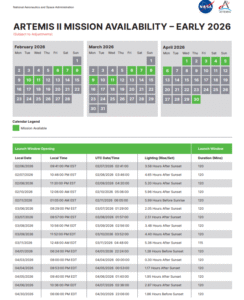
During a news conference this afternoon, NASA officials said they will review the data and decide when to conduct another WDR, a prerequisite to setting a launch date.

Liquid hydrogen leaks were a problem during WDRs for the first SLS/Orion launch in 2022, the uncrewed Artemis I mission. Launch Director Charlie Blackwell-Thompson said today they’ve made changes to several of the hydrogen components since then and could see improvements, but this was the first chance they’ve had to test everything in an actual launch environment. Despite successfully managing the leaks at the Tail Service Mast Umbilical (TSMU) during early phases of the WDR, the leak rate “came up pretty quick” just inside of 6 minutes from the end of the practice countdown, ending the test.
Blackwell-Thompson cited three milestones they were not able to accomplish during “terminal count,” the final 10 minutes: a three-minute hold with all cryogenic systems in a launch-ready state; recycling to a new launch time within the same launch window; and getting to the T-33 second mark where operators hand off to the Automated Launch Sequencer (ALS) and then cutting off the launch.
None of the NASA officials would commit to when a new WDR would take place, never mind the actual launch. Lori Glaze, Acting Associate Administrator for the Exploration Systems Development Mission Directorate that oversees the Artemis program, was optimistic that it wouldn’t be too long and the technical problems can be fixed while SLS/Orion remains at the launch pad rather than rolling it back to the Vehicle Assembly Building (VAB). She acknowledged, however, that if they do not launch in March, they likely will have to roll back in order to service batteries in the Interim Cryogenic Propulsion Stage (ICPS). Glaze also serves as NASA’s Moon-to-Mars Mission Manager.
This article was updated after the news conference.
User Comments
SpacePolicyOnline.com has the right (but not the obligation) to monitor the comments and to remove any materials it deems inappropriate. We do not post comments that include links to other websites since we have no control over that content nor can we verify the security of such links.