NASA Sets Launch Date for Roman Space Telescope
NASA is moving up the launch date for the Nancy Grace Roman Space Telescope. In April, the agency said it would lift off in early September, but NASA Administrator Jared Isaacman has been hinting ever since that it might be in August. Today, it’s official — Roman is scheduled to launch on August 30.
The news came from Joel Montalbano at a joint meeting of the Space Studies Board and Aeronautics and Space Engineering Board, both part of the National Academies of Sciences, Engineering, and Medicine. Montalbano is Acting Associate Administrator for the Space Operations Mission Directorate (SOMD), which oversees the Launch Services Program that manages NASA launches. Under the recently announced reorganization, SOMD and the Exploration Systems Development Mission Directorate will merge and Montalbano will become Deputy AA of the new Human Spaceflight Mission Directorate, but it hasn’t taken effect yet.
Named after NASA’s first Chief of Astronomy, Nancy Grace Roman, the telescope was constructed, assembled, and tested at Goddard Space Flight Center in Maryland just outside Washington, D.C. At an April 21 event there, Isaacman said the telescope would launch in early September. Today, Montalbano displayed a slide with that date, but quickly added they’d “just recently updated” it and the launch will be on August 30. Florida summer weather often interferes with launch dates, but it’s August 30 for now.
The 8,000 kilogram (18,000 pound) telescope will lift off on a SpaceX Falcon Heavy from Kennedy Space Center. With propellant, Roman’s mass is 10,500 kg (23,100 pounds). The primary mission lifetime is 5 years, but NASA expects the propellant to last at least twice that.
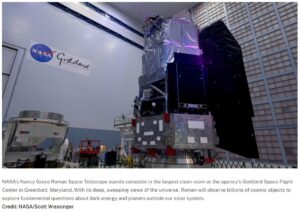
The telescope is getting ready to be shipped via barge to KSC. Isaacman and Nicky Fox, head of the Science Mission Directorate, delight in pointing out that Roman is ahead of schedule and under cost. Roman’s project manager, Jamie Dunn, was just appointed as Goddard’s new Director.
Roman is a wide-field space telescope — its original name was Wide-Field Infrared Space Telescope or WFIRST — that will complement the James Webb Space Telescope launched in 2021. Both survey the universe in infrared wavelengths, but JWST has a narrow field of view allowing it to zoom in on areas of interest. Roman’s “big picture” panoramic view can identify more of those areas for JWST to investigate in detail. Roman will join JWST at the Sun-Earth L2 Lagrange point 1.5 million kilometers (1 million miles) from Earth in the direction away from the Sun.
The telescope is equipped with a coronagraph that can block starlight to better see planets orbiting other suns — exoplanets — and also will seek to solve the mysteries of dark energy and dark matter.
Roman is the most recent in NASA’s decades-long series of great observatories that began with the Hubble Space Telescope, most built in cooperation with other countries. Nancy Grace Roman is credited as the “mother” of Hubble, which launched in 1990. Hubble observes the universe primarily in the visible wavelengths, but also in ultraviolet and infrared. NASA’s Chandra space telescope observes in the x-ray band. JWST in infrared. NASA has other space telescopes in operation, but the next great observatory will be the Habitable Worlds Observatory, or HWO, designed specifically to search for signs of life on exoplanets. HWO is still in the planning stages.
User Comments
SpacePolicyOnline.com has the right (but not the obligation) to monitor the comments and to remove any materials it deems inappropriate. We do not post comments that include links to other websites since we have no control over that content nor can we verify the security of such links.