Nancy Grace Roman Space Telescope Lifts Off to Open New Insights Into the Universe
NASA’s Nancy Grace Roman Space Telescope lifted off this morning on a mission to find more planets around other stars in the universe and solve the mysteries of dark energy and dark matter. After a three-month voyage to join the James Webb Space Telescope at the L2 Lagrange point, NASA expects to release the first images from Roman early next year.
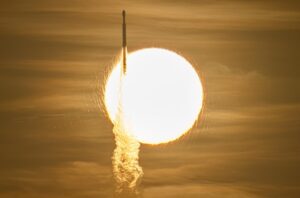
Roman lifted off atop a SpaceX Falcon Heavy rocket at 7:26 am ET from Kennedy Space Center, FL.
The telescope is named after NASA’s first Chief of Astronomy, Nancy Grace Roman, known as the “mother” of the beloved Hubble Space Telescope.
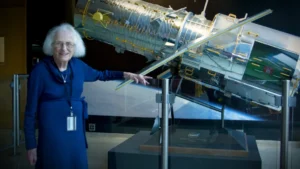
Hubble is still operating 36 years after launch. It’s in earth orbit while Roman is headed out to the second Sun-Earth Lagrange point, L2, a million miles (1.5 kilometers) from Earth in the direction away from the Sun. Several other space telescopes, including JWST and Europe’s Euclid and Gaia, are located there where they have an unobstructed view of the universe.
All of those space telescopes plus others on Earth, including the National Science Foundation’s Vera Rubin Observatory in Chile, study the universe with different instruments in a range of wavelengths collecting data that can complement each other. Nicky Fox, head of NASA’s Science Mission Directorate, said at the post-launch briefing this morning that every telescope has a unique role, but they also can work together. Julie McEnery, senior program scientist for Roman at NASA’s Goddard Space Flight Center, added that Roman, Rubin and Euclid are “siblings” that were “designed from the beginning to be synergistic.”
Roman is equipped with a Wide Field Instrument (WFI) that will survey the universe and a coronagraph to search for planets orbiting distant stars, called exoplanets.
Roman will send back 1.4 terabytes of data every day, far surpassing JWST’s 50-60 gigabytes. With a scan rate 1,000 times that of Hubble and 100 times the field of view, it’s expected to discover 20 billion stars and thousands of exoplanets.
Fox pointed out that when Hubble was launched in 1990 “we didn’t even know there were exoplanets.” Other telescopes have identified more than 6,000 so far, but Roman’s coronagraph will be able to discern them in greater detail by blocking out the light of their suns. NASA is already developing plans for the next “great observatory,” the Habitable Worlds Observatory, that will try to determine if there is life on any of those exoplanets.
Roman also will measure dark matter and dark energy. They are called dark both because they don’t interact with light and their characteristics are unknown even though dark matter comprises 27 percent of the universe and dark energy 68 percent.
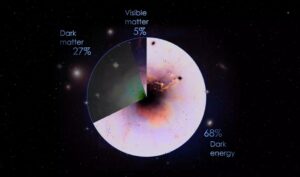
Their existence is indirectly detected by gravity. Fox said “Roman will usher us into a new era of discovery and make the invisible visible, setting the foundation for humanity’s search for life beyond our solar system.”
President Trump called in during the post-launch briefing to offer his congratulations. He was at Johnson Space Center on Friday to present the Congressional Space Medal of Honor to the four Artemis II astronauts and sign an Executive Order directing NASA Administrator Jared Isaacman to lead a commission to design a U.S. Space Academy. The Trump Administration proposed terminating Roman last year, but Congress disagreed and provided the requisite money. Asked today how he got Trump to become an enthusiast, Isaacman replied that it’s a “great moment” to have a President so interested in NASA and “we’re entering a new Golden Age of discovery” and “I’m going to have a lot to thank the President for on that.”
The Trump Administration proposed deep cuts to NASA’s science budget again for FY2027, from $7.3 billion to $3.9 billion. Congress has not completed action on that request, but the House Appropriations Committee approved $6 billion.
Roman’s baseline operational period is 5 years, but NASA expects it will operate for at least 10 years and it’s feasible it could operate longer. The spacecraft was designed to be refuelable, although accomplishing such a feat at such a distance from Earth will require new technologies.
The cost of the telescope including operations through the 5-year period is $4.3 billion. NASA has been heralding Roman as being ahead of schedule and under cost. Although it was ahead of schedule, launching nine months earlier than planned, they now say it was “on budget,” not under.
The launch was completely successful and the telescope is now in a 90-day commissioning period on its way to L2. The solar panels deployed soon after separation from the rocket and communications were established with the Deep Space Network antenna in Canberra, Australia. Two mid-course correction burns are planned in the next few days, but only one may be needed to fine tune the trajectory.
Roman was built at NASA’s Goddard Space Flight Center and the coronagraph at the Jet Propulsion Laboratory. The Space Telescope Science Institute in Baltimore will manage scheduling and operations as it does for Hubble and JWST. The California Institute of Technology’s Infrared Processing and Analysis Center (Caltech/IPAC) manages operations of the coronagraph. International partners include ESA, JAXA, CNES, and Germany’s Max Planck Institute for Astronomy.
User Comments
SpacePolicyOnline.com has the right (but not the obligation) to monitor the comments and to remove any materials it deems inappropriate. We do not post comments that include links to other websites since we have no control over that content nor can we verify the security of such links.