House Appropriators Reject Deep Cuts to NASA in FY2027
The House Appropriations Committee approved the FY2027 Commerce-Justice-Science (CJS) bill today, rejecting deep cuts proposed by the Trump Administration. Instead of the $18.8 billion requested, the committee approved $24.4 billion, the same as what the agency received for FY2026. Still, it favors human spaceflight by cutting other NASA activities like science, which would get $1.3 billion less than current spending.
The full committee approved the bill on a party-line vote, just like its CJS subcommittee on April 30. All Democrats opposed the bill primarily over matters in the Department of Commerce and Department of Justice sections, but in the subcommittee markup Democrats also disagreed with cuts to NASA’s science program even though it’s an improvement over the Administration’s request.
In total, the FY2027 request for NASA was $18.829 billion and the committee approved $24.438 billion, the same as FY2026 (not adjusted for inflation). The pattern is the same as last year when the Trump Administration proposed a similar reduction and Congress rejected it.
NASA’s Artemis human exploration program is clearly a priority for both ends of Pennsylvania Avenue, but Congress also supports NASA’s other activities in science, technology, space operations (including the International Space Station), aeronautics, and STEM education.
Despite signficant disagreements in other parts of the bill, the two parties seem largely aligned on funding for NASA except for science and STEM Education. As detailed in the report to accompany the bill, the Republican-led committee approved $6 billion for NASA’s science programs. That’s over $2 billion more than the $3.9 billion request, but $1.3 billion short of the $7.3 billion in FY2026. Democrats want to maintain current science spending. They also object to a $59 million cut to STEM education that eliminates two STEM programs (MUREP and Next Gen Stem).
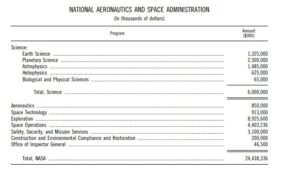
Several slight modifications were made to the subcommittee’s markup in a manager’s amendment today. For example, one requires that the Habitable Worlds Observatory (HWO) be funded at no less than FY2026 ($150 million was specified in the final appropriations bill) and another directs NASA to report to Congress on the acquisition schedule for the recently announced “dual path” for Commercial LEO Destinations (CLDs) as well as ensure at least one CLD provider is available by the end of operations of the International Space Station.
It’s important to note that NASA has additional funding available through last year’s One, Big Beautiful Bill Act (OBBBA). The OBBBA gave NASA $10 billion for human exploration spread over several years. CJS subcommittee chairman Rep. Hal Rogers (R-KY) said during a hearing on NASA’s budget that $2 billion of that is in FY2027.
A few highlights from the committee’s report (not a comprehensive list):
Science
- $1.325 billion for earth science including $110 million for Landsat Next, and no less than $55.3 million or more than $97.5 million for Commercial Satellite Data Acquisition
- $2.5 billion for planetary science including no less than $283.7 million for NEO Surveyor, no less than $218 million for the Lunar Discovery and Exploration Program, no less than $423.9 million for Dragonfly, $20 million for OSIRIS-APEX, $300 million for Mars Exploration emphasizing committee support for the Skyfall Mars Helicopter mission, and support for New Horizons, Juno, and Uranus Orbiter and Probe
- $1.485 billion for astrophysics including $92.8 million for Hubble, no less than $208 million for James Webb, no less than $166.8 million for Roman to ensure an on-time launch, $80.5 million for LISA, and continued support for Chandra, Fermi, and UVEX
- $625 million for heliophysics noting that NASA is working to reformulate the Geospace Dynamics Constellation
- $65 million for biological and physical sciences
Aeronautics
- $53.5 million for hypersonic technology and other support and direction regarding hypersonics, support for X-59 infrastructure, up to $18 million for the Advanced Core Demonstrator, not less than $60 million for Subsonic Flight Demonstrator
Space Technology
- $110 million for Nuclear Thermal Propulsion, $50 million for Nuclear Electric Propulsion, and $5 million for Fusion Propulsion
- $100.9 million for Vertical Solar Array Technology (VSAT) for lunar solar surface power [fission surface power is in the Exploration account]
- no less than $20 million and no more than $60 million for CAPSTONE 02 to mature rendezvous and proximity operations capabilities in multibody cislunar orbits
Exploration
- $1.4 billion for Orion
- $2.6 billion for SLS ($1.575 billion here and $1.025 billion in the OBBBA) and prohibits NASA from reallocating funds from SLS until a commercial alternative is proven to meet or exceed the SLS/Orion capabilities including through human-rated certification
- $448.1 million for CLPS
- $2.277 billion for the HLS landers as well as heavy cargo landers derived from them, and directs NASA to leverage those contracts for future deep space missions
- $419.9 million for Fission Surface Power
- strongly supports NASA’s plan for a permanent, sustainable American outpost on the Moon as soon as 2030, and “supports NASA’s priority of safely land [sic] American astronauts on Mars and efforts to accelerate this objective by reducing costs through maximizing commercial innovation.”
- $59.5 million for Advanced ECLSS
- $104.3 million for the Human Research Program
Space Operations
- no less than $400 million for Commercial LEO Development
- $1.49 billion for the ISS and directs NASA to maintain fullest possible utilization of the ISS
- $1.344 billion for Commercial Crew and Cargo, noting an additional $250 million is in the OBBBA and directing NASA to maintain at least the same cadence of flights to the ISS as FY2026
- $238.6 million for the U.S. Deorbit Vehicle
Safety, Security, and Mission Services
- $26 million for EPSCoR
- $58 million for Space Grant
User Comments
SpacePolicyOnline.com has the right (but not the obligation) to monitor the comments and to remove any materials it deems inappropriate. We do not post comments that include links to other websites since we have no control over that content nor can we verify the security of such links.