Blue Origin Nails It — NG-2 Makes a Landing, ESCAPADE Enroute to Mars
Blue Origin not only had a successful launch today and sent two NASA cubesats on their way to Mars, but landed their New Glenn-2 first stage on a barge at sea on just their second try. It was a winning trifecta for Jeff Bezos’s company that is beginning to compete in the orbital launch market after years of suborbital launches from the West Texas desert.
Following a scrub on November 9, liftoff today was at 3:55 pm ET from Launch Complex-36 at Cape Canaveral Space Force Station, Florida. The launch had been scheduled for 2:57 pm ET, but entered an automatic hold 20 seconds before liftoff. Blue Origin teams were able to remedy the problem before the launch window closed at 4:25 pm ET.

Like SpaceX’s Falcon, the New Glenn first stage, GS-1, is designed to be reusable. Blue Origin attempted a landing on the first New Glenn launch in January, NG-1, but the three rocket engines needed to slow the rocket down as it returns did not reignite. Today they did and GS-1 made a bullseye landing on the Jacklyn landing platform (named after Bezos’s mother) 375 miles out at sea. They named this first stage “Never Tell Me the Odds” and it turned out the odds were on their side this time.
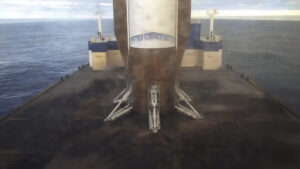
— Jeff Bezos (@JeffBezos) November 13, 2025
It was a great success for the fledgling orbital launch vehicle company although it has years of experience with suborbital launches of the New Shepard rocket from its base in West Texas. Bezos himself flew on the first New Shepard flight to carry passengers on July 20, 2021. Those are short 10 minute flights above the imaginary line that separates air and space, though, not the much more difficult task of reaching orbit. The New Shepard rocket and capsule also are reusable. New Shepard is named after Alan Shepard, the first American to reach space on a May 5, 1961 suborbital flight. New Glenn is named for John Glenn, the first American to reach orbit on February 20, 1962.
Blue Origin is competing with SpaceX and the United Launch Alliance for DOD’s National Security Space Launch (NSSL) contracts to launch the most critical and expensive national security payloads into space. The rockets need to have two successful flights to be certified. U.S. Space Force’s Space Systems Command congratulated Blue Origin this afternoon. Lt. Col Brian Scheller, SSC’s system program manager and chief engineer for System Delta 80, called today a “monumental step towards New Glenn delivering our most critical warfighting capabilities to orbit.”
This launch wasn’t for the Space Force, though, but NASA. Aboard NG-2 were two cubesats destined for Mars. Dubbed Blue and Gold, they comprise ESCAPADE, one of NASA’s Small Innovative Missions for Planetary Exploration or SIMPLEx missions. SIMPLEx missions trade risk for cost, making them comparatively inexpensive, but with a lower chance of success. The two spacecraft were built by Rocket Lab. The mission was managed by NASA Goddard Space Flight Center with project management by the University of California Berkeley.
They were supposed to launch in 2022 with another NASA mission, Psyche, but that spacecraft wasn’t ready in time and when it did launch no longer was headed the right direction to drop off ESCAPADE. NASA’s been looking for a way to get ESCAPADE to Mars and Blue Origin offered to provide the launch. The timing was not optimal for the 26-month Earth-Mars windows, so it will loiter at the Sun-Earth L2 Lagrange point about one million miles from Earth in the direction of Mars before setting off to the Red Planet. The unique trajectory was designed by Advanced Space. Animations are posted on Goddard Space Flight Center’s website including of this “kidney bean” segment where the two cubesats travel from Earth to circle around L2 then come back to Earth for a gravity assist before heading off to Mars.
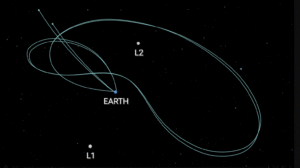
Concern about extra radiation exposure to the cubesats delayed the launch from yesterday due to an intense solar storm — space weather — that created breathtaking auroras around the northern hemisphere. Perhaps fittingly, ESCAPADE’s mission is to investigate space weather around Mars in advance of future robotic and human trips there. Nicky Fox, NASA Assocate Administrator for the Science Mission Directorate, said after the launch: “Understanding Martian space weather is a top priority for future missions because it helps us protect systems, robots, and most importantly, humans, in extreme environments.”
This article has been updated.
User Comments
SpacePolicyOnline.com has the right (but not the obligation) to monitor the comments and to remove any materials it deems inappropriate. We do not post comments that include links to other websites since we have no control over that content nor can we verify the security of such links.