Category: Commercial

China Launches Its Biggest Rocket Yet – Long March 5

China Launches Its Biggest Rocket Yet – Long March 5

China conducted the first launch of its new Long March 5 rocket today.  At 25 metric tons (MT) to low Earth orbit (LEO), it has twice the capability of the largest existing Chinese rocket and is only slightly smaller than the largest U.S. rocket, Delta IV.  It opens many possibilities for China, which has identified large space stations and probes to the Moon and Mars among its nearer-term uses.

China announced on October 28 that the launch would take place in early November, but its English-language news services, Xinhua and CCTV, typically used by the Chinese government to herald headline-grabbing space events, provided virtually no new information in the interim.  Even a CCTV segment just hours before the launch (November 3, 12:46 Beijing Time; 12:46 am EDT) did not mention the launch date or time, again saying only it would be in November. 

Web- and Twitter-based sources who closely follow the Chinese space program kept the public apprised of the launch status, including Andrew Jones (@AJ_FI), who writes for gbtimes.com (@gbtimescom); Chris Bergin at NASASpaceflight.com (@nasaspaceflight); and two who do not identify themselves — @cosmicpenguin and China Spaceflight @cnspaceflight (in Chinese).  About 1 minute before launch, CCTV finally began live coverage, which continued until the payload separated from the second stage.

Liftoff from the Wenchang Satellite Launch Center on Hainan Island was initially expected at 6:00 am ET (10:00 GMT; 18:00 local time at the launch site) based on Notices to Airmen (NOTAMs) issued by the Chinese government to warn pilots to avoid the airspace.  Launch was briefly delayed twice due to technical issues, but ultimately came at 8:43 am ET (12:43 GMT; 20:43 local time).  [Editor’s note:  several accounts have appeared about the causes of the delays based on Chinese sources.  SpacePolicyOnline.com cannot confirm them, but here are links to three for those who are interested.  The first is an account apparently from one of the launch crew translated into English by @cosmicpenguin and posted to NASASpaceFlight.com. The second (text) and third (audio) are in Chinese – we used Google Translate for the text copy — and posted to Twitter by @cnspaceflight.  The gist is that the first delay was due to indications of a liquid oxygen leak and the second was related to a chill-down problem with the first stage engines.  Editor’s note 2:  China’s CCTV has now posted a YouTube video about the “nail-biting countdown.”]
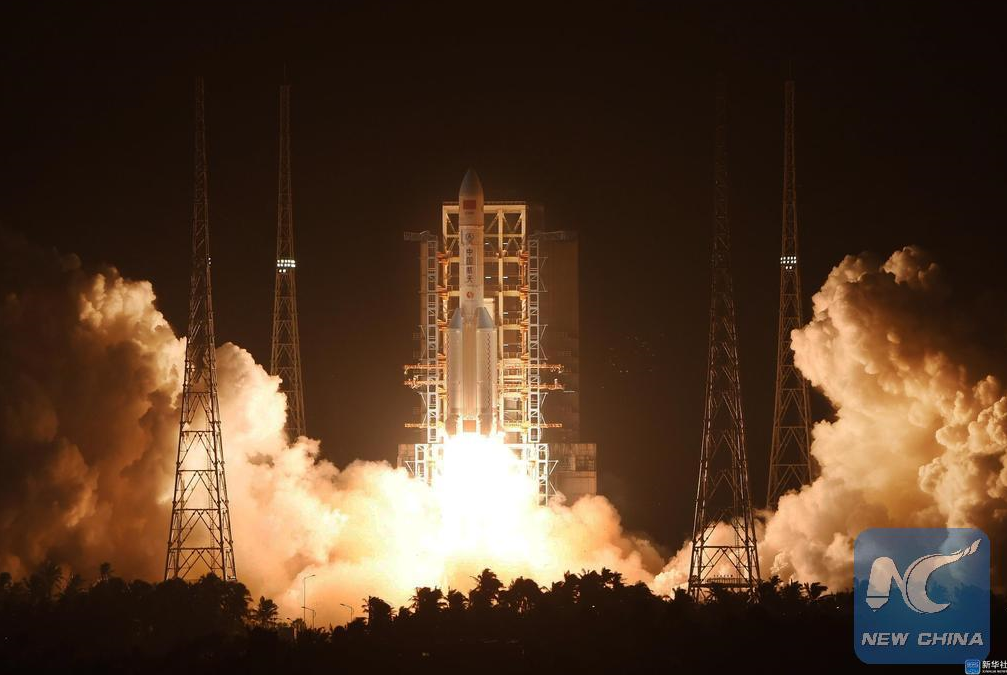

China’s Long March 5 lifts off on inaugural flight from Wenchang Satellite Launch Center, Hainan Island, China, November 3, 2016, 20:43 local time.  Photo Credit: China Xinhua News (@XHNews)

The payload is the Shijian-17 experimental satellite that is on its way to geostationary orbit.  Long March 5 delivered it to an elliptical geostationary transfer orbit. The spacecraft’s on-board propulsion will take it the rest of the way (as is typical with such launches).

Until now, the most capable Chinese rockets have been the older Long March 3B (12 MT to LEO) and the brand new Long March 7 (13.5 MT to LEO), which made its first flight in June.

Delta IV Heavy is the most capable U.S. rocket in use today.  It can deliver 28.4 MT to LEO.  Long March 5 and Delta IV Heavy, though large by today’s standards, are modest compared to the U.S. Saturn V developed for the Apollo program (118 MT to LEO) or the Space Launch System currently being developed by NASA in three versions (70 MT, 105 MT and 130 MT).  In addition, two U.S. private companies are developing or planning new heavy lift rockets: SpaceX’s Falcon Heavy, 54 MT to LEO, which is close to its first flight; and Blue Origin’s New Glenn, 70 MT to LEO, still in the planning phase.

Among the payloads China has announced for Long March 5 are space
station modules that will be docked together in orbit to form a 60 MT
space station by 2022 and robotic
exploration missions. Those include a sample return mission to the Moon (Chang’e 5)
next year and an orbiter/lander/rover to Mars in 2020.


Stafford Committee Worries About SpaceX Plans to Fuel Rocket While Crew Aboard

Stafford Committee Worries About SpaceX Plans to Fuel Rocket While Crew Aboard

Lt. Gen. Tom Stafford (Ret.) and other members of NASA’s International Space Station (ISS) Advisory Committee are worried about a proposal by SpaceX to fuel its Falcon 9 rocket while crews are aboard when it conducts commercial crew launches.  The committee was made aware of the SpaceX proposal last year and wrote a letter to the head of NASA’s human exploration program, Bill Gerstenmaier, expressing concern, but has not received a reply.  The September 1 incident in which a SpaceX vehicle caught fire and exploded during fueling has accentuated the committee’s concerns.

Stafford is a very highly respected former astronaut who flew on Gemini and Apollo missions, including commanding the U.S. portion of the U.S.-Soviet 1975 Apollo-Soyuz Test Project (ASTP).  He chairs the ISS Advisory Committee, which is chartered to assess all ISS aspects related to safety and operational readiness, utilization and exploration.  The committee also meets as a joint commission with its counterparts on the Roscosmos state space corporation’s Advisory Expert Council.

At the end of its public meeting at NASA on Monday, committee member Joe Cuzzupoli raised the Space X issue.  He asked Stafford if the committee had received a response from Gerstenmaier, especially considering the fire and explosion that destroyed a SpaceX Falcon 9 rocket and the Amos-6 satellite during a routine pre-launch on-pad test on September 1.  Cuzzupoli has many decades of industry experience in designing and building rockets dating back to the Apollo-Saturn and space shuttle programs.

Stafford noted that the committee first learned of the SpaceX proposal at a briefing last December by Kathy Lueders, NASA’s program manager for the commercial crew program.  Lueders told the committee that SpaceX wants crews strapped into their seats before the Falcon 9 rocket is loaded with superdensified chilled oxygen, which would happen just 30 minutes before launch.  Stafford said committee members were “unanimous” in opposition because no one should ever be near the pad when fueling takes place, which is true internationally.   On December 9, he wrote a letter to Gerstenmaier, NASA’s Associate Administrator for Human Exploration and Operations, expressing those concerns.

The committee was briefed again by Lueders in February 2016 and “she said she would get back to us,” Stafford continued.  She had not done so by August, however, so he called Gerstenmaier who promised the committee another briefing within two months. 

That call was just days before the September 1 incident, he said.   NASA has not provided the committee with any further information, but Stafford said he expects a briefing at the committee’s next
meeting in December in Houston, asserting that “our letter hit the nail on the
head that this is a hazardous operation.”

SpaceX is still trying to determine the root cause of the fire, but believes it is associated with helium loading conditions in one of three composite overwrapped pressure vessels (COPVs) in the second stage liquid oxygen tank.  SpaceX noted that no one was injured: “Per standard operating procedure, all personnel were clear of the pad.”

Falcon 9 is used for launches of commercial satellites like the Amos-6 communications satellite that was destroyed on September 1, as well as commercial cargo launches of its robotic Dragon spacecraft for NASA to support ISS.   It is developing a version of Dragon to take astronauts to and from ISS called Crew Dragon.   It has an integrated abort system that would propel the crew capsule away from the rocket in an emergency. It can operate at any point during launch and ascent, including on the pad.  SpaceX conducted a pad abort test of the system last year.

SpaceX founder and CEO Elon Musk said via Twitter (@elonmusk) the day of the incident that if a Dragon had been on top of the rocket, it “would have been fine.” 


SpacePolicyOnline.com asked NASA for a copy of the letter Stafford sent to Gersternmaier immediately after Monday’s meeting, but has not received a reply. Separately, however, NASA sent the following statement via email:

“Spacecraft and launch vehicles designed for the Commercial Crew Program must meet NASA’s safety and technical requirements before the agency will certify them to fly crew. The agency has a rigorous review process, which the program is working through with each commercial crew partner.

“Consistent with that review process, NASA is continuing its evaluation of the SpaceX concept for fueling the Falcon 9 for commercial crew launches. The results of the company’s mishap investigation will be incorporated into NASA’s evaluation.”

Editor’s Note:  NASA released the letter on November 4.

Bridenstine: This is Our Sputnik Moment & The Moon Will Ensure U.S. Preeminence in Space

Bridenstine: This is Our Sputnik Moment & The Moon Will Ensure U.S. Preeminence in Space

Exclaiming “this is our Sputnik moment,” Rep. Jim Bridenstine (R-OK) told an audience of lunar scientists and entrepreneurs tonight that the Moon is the pathway to American preeminence in space.  He also addressed comments made several weeks ago by his colleague, Rep. Brian Babin (R-TX), that seemed to contradict his approach to government oversight of commercial space activities, saying that the two views are closer than they appear.

Bridenstine, a former Navy pilot elected to Congress in 2012 who has term-limited himself to three terms (he is in his second term now), has become a leading advocate in Congress for passing laws that create a stable legal and regulatory environment for new types of commercial space activities.  A member of both the House Science, Space and Technology Committee and the House Armed Services Committee, he has a broad outlook on U.S.civil, commercial and national security space issues.  He introduced the American Space Renaissance Act (ASRA) earlier this year as a compendium of legislative provisions that can be incorporated into various pieces of legislation, including authorization and appropriations bills.  Commercial space is one of the themes in ASRA.

He spoke at a meeting of NASA’s Lunar Exploration Analysis Group (LEAG) being held at the Universities Space Research Association’s headquarters in Columbia, MD.  The three-day meeting, which concludes tomorrow, has sessions ranging from deeply scientific to highly commercial.

Bridenstine took the theme of lunar science and resource utilization and ran with it.  His closing sentences summed it up:  “This is our Sputnik moment.  America must forever be the preeminent spacefaring nation and the Moon is our path to being so.”

The discovery of water ice at the lunar poles by DOD’s Clementine mission, which originated with DOD’s Brilliant Pebbles concept as part of the Reagan-era Strategic Defense Initiative, should have “transformed” the U.S. space program, he asserted, because of the significance of finding water there.  He foresees a cis-lunar industry based on servicing and maintaining Earth-orbiting satellites that includes refueling those satellites using liquid oxygen and hydrogen produced from the Moon’s water ice.  If existing satellites can be refueled and otherwise maintained, fewer new spacecraft can be launched, reducing costs and the space debris population.  He views the government’s role as risk reduction to “empower” commercial companies to establish such industries.

Creating a U.S. legal framework to encourage investment in such businesses is key, he stressed.  Bridenstine is a leading advocate of expanding the FAA Office of Commercial Space Transportation’s (AST’s) regulatory authority to include “enhanced payload reviews” for new types of commercial space activities to ensure they comply with the 1967 Outer Space Treaty.  He has worked closely with industry, especially through FAA/AST’s Commercial Space Transportation Advisory Committee (COMSTAC), to advance that idea. 

COMSTAC adopted an OFR (Observations, Findings, and Recommendations) at its meeting last week recommending that the government take “expeditious action to enable a safe, predictable, and conducive environment for the growth of commercial space operations and activities…”

Babin expressed an opposite point of view in September, insisting that no legislation is needed.  Instead, he argued, the private sector should be able to do whatever it wishes in space and the burden should be on the government to demonstrate why government intervention is needed, not on the private sector to follow regulations.

Though the two philosophies seem at odds, Bridenstine said tonight that, in fact, they are not as far apart as they may seem.  Both he and Babin want minimal regulation and a free market in space for a broad range of commercial activities. 

Bridenstine, however, strongly believes that legislation is needed.  The Department of State already has said it does not have the tools to say “yes” to new commercial activities to ensure U.S. compliance with the Outer Space Treaty, he said.  That means there is a risk that a U.S. company could proceed with an activity only to have the State Department stop it at the last minute because of a protest by another country.  Such a risk could dampen investor confidence.   Also, Congress should be involved in setting the legal regime, rather than the Executive Branch alone, so that it can endure through successive administrations. 

A “rock solid … airtight” regime is needed so “that when you get your authorization, you know, not with absolute certainty, but you’re pretty darn certain, that you’re going to be able to launch.”  That means Congress passing a law that includes an enhanced payload review process that provides “maximum regulatory certainty with the minimum regulatory burden” implemented by FAA/AST.  “Enhanced space situational awareness [SSA] and reporting” also is needed.  The Air Force does not have the necessary resources to provide SSA for non-DOD entities and is not a regulatory agency, so FAA/AST should take on that responsibility as well, he said, repeating comments he has made in the past.

Bridenstine’s remarks tonight went further, branching out into threats posed by China, a country that understands “the geopolitical value of space operations.” The possibility that the “highly valuable platinum group of metals are much more available on the moon from astroblemes than they are on earth” could explain China’s interest in the Moon, he said.  “Such a discovery with cis-lunar transportation capabilities … could profoundly alter the economic and geopolitical balance of power on Earth.”  

To “enable freedom of action, the United States must have cis-lunar situational awareness, a cis-lunar presence, and eventually must be able to enforce the law through cis-lunar power projection.  Cis-lunar development will either take the form of American values with the rule of law and private property rights, or it will take the form of totalitarian state control.  The United States can decide who leads.”

What's Happening in Space Policy October 31-November 5, 2016

What's Happening in Space Policy October 31-November 5, 2016

Here is our list of space policy events for the week of October 31-November 5, 2016 and any insight we can offer about them. Congress is in recess until November 14.

During the Week

As usual, there is a full plate of interesting space policy events coming up this week.  

To highlight just two, NASA’s Lunar Exploration Analysis Group (LEAG) will meet in Columbia, MD at the headquarters of the Universities Space Research Association (USRA).  It will spend part of the first day (Tuesday) discussing ESA Director General Jan Woerner’s concept for a Moon Village (or Lunar Village).  Wednesday features an evening reception where Rep. Jim Bridenstine (R-OK) will provide an update on his American Space Renaissance Act and policies needed to ensure free enterprise can occur on the Moon and in cislunar space.  Bridenstine is a leading voice in Congress for determining what is needed to enable the United States government to fulfill its obligations under the Outer Space Treaty in a manner that facilitates new types of private sector activities in Earth orbit and beyond.   We’ve inquired as to whether any of the meeting will be webcast and will add that information to our calendar entry if/when we get an answer. [UPDATE:  It will be available by WebEx.  See our calendar entry for details.]

On Friday and Saturday, the New Worlds Institute will hold the New Worlds 2016 Conference and Space Settlement Symposium at the Renaissance Austin Hotel at the Arboretum in North Austin, TX.  It features a star-studded line-up of speakers separately making “the case for” the Moon, for Mars, and for free-space, plus sessions on space elevators, space solar power, protecting the planets, who owns space, and a broad range of other topics.  Co-chaired by Mary Lynne Dittmar (Coalition for Deep Space Exploration), Pete Worden (Breakthrough Prize) and Phil Metzger (founder of Kennedy Space Center Swamp Works), speakers include Bob Richards (Moon Express), Bob Zubrin (Mars Society), Bill Gerstenmaier (NASA), Margaret Race (SETI Institute), John Lewis (University of Arizona), and Rick Tumlinson (New Worlds Institute).  The website does not indicate whether any of it will be webcast.  We’ve inquired and will post the information on our calendar if/when we find out. [UPDATE: we’ve been informed that it will NOT be webcast, although a few videos may be posted later.]

Those and other events we know about as of Sunday morning are shown below. Check back throughout the week for others we learn about later and add to our Events of Interest list.

Monday, October 31

Monday-Tuesday, October 31 – November 1

Tuesday, November 1

  • NASA Innovation Mission Day, NASA HQ and all NASA centers, various times and locations [keynote address by Deputy Administrator Dava Newman at 12:00 pm ET will be broadcast on NASA TV)

Tuesday-Thursday, November 1-3

Wednesday, November 2

Wednesday-Thursday, November 2-3

Wednesday-Friday, November 2-4

Thursday-Saturday, November 3-5

  • SpaceVision 2016 (annual SEDS conference), Purdue University, West Lafayette, IN

Friday-Saturday, November 4-5

China Readies Long March 5 for First Launch

China Readies Long March 5 for First Launch

China’s new Long March 5 rocket was transported to its launch pad yesterday in preparation for its inaugural launch according to China’s official Xinhua news agency.  Xinhua did not specify the launch date, saying only it would be in “early November.”

Long March 5 will be the largest of China’s rockets, slightly smaller in capability than the U.S. Delta IV Heavy.  It will be able to place 25 metric tons (MT) into low Earth orbit (LEO) compared to Delta IV’s 28.4 MT.

This is the fourth new Chinese rocket to make its debut in the past 13 months and the second to utilize China’s new Wenchang Satellite Launch Center on Hainan Island.

China tested two very small new rockets last fall, the liquid-fueled Long March 6 and solid-fueled Long March 11. The first launch from Wenchang was of the new medium-class Long March 7 in June. 

Long March 5, 6 and 7 are all part of China’s plan to replace its older launch vehicles (Long March 2, 3 and 4) with those that use more environmentally-friendly propellants — liquid oxygen (LOX)/kerosene instead of hydrazine.

Among the payloads China has announced for Long March 5 are space station modules that will be docked together in orbit to form a 60 MT space station around 2022.  China currently has two astronauts aboard its small (8.6 MT) Tiangong-2 space station, but they will remain there for only 30 days.  China has sent mixed signals as to whether a second crew will occupy Tiangong-2, but it is not intended for long-term occupancy.  

While the 60 MT space station planned for 2022 is still small compared to the 400 MT International Space Station (ISS), under current plans, the ISS partners (the United States, Russia, Japan, Canada, and 11 European countries) will discontinue ISS operations in 2024.  That could mean China’s will become the only earth orbiting space station, although some or all of the ISS partners could decide to continue ISS operations thereafter.  NASA also is requesting input from the U.S. private sector to determine if a commercial space station is feasible as an ISS follow-on.

China also plans to use Long March 5 for robotic space exploration missions. They include a sample return mission to the Moon (Chang’e 5) next year and an orbiter/lander/rover to Mars in 2020.  China launched a lunar sample return test spacecraft in 2014 that demonstrated returning a capsule to Earth from lunar distance, and a lander/rover (Chang’e-3/Yutu) to the Moon’s surface in 2013.  The 2020 Mars mission will be China’s first to that planet on its own, although a Chinese orbiter was aboard Russia’s failed Phobos-Grunt mission in 2012.

Long March 5 will open many new opportunities for China’s space program in earth orbit and beyond.  It is roughly double the capability of its largest existing rockets, the Long March 3B (12 MT to LEO) and Long March 7 (13.5 MT to LEO).

SpaceX Narrows Investigation, But Still no Root Cause

SpaceX Narrows Investigation, But Still no Root Cause

SpaceX said today that it continues to narrow the investigation into what caused the on-pad fire that destroyed a Falcon 9 rocket and its Amos-6 satellite on September 1.  The root cause still has not been determined, although the company hopes it can resume launches before the end of this year.

The Falcon 9 rocket was engulfed in flames and exploded during a standard pre-launch test two days before the scheduled launch of the Israeli-built Amos-6 communications satellite, which also was destroyed. The launch pad, Launch Complex 40 (LC-40), at the Air Force’s Cape Canaveral Air Force Station (CCAFS), was damaged. SpaceX leases the pad from the Air Force.

SpaceX founder Elon Musk calls it the “most difficult and complex failure we have seen.”  Earlier, the company said it was focusing on a breach in the cryogenic helium system of the liquid oxygen (LOX) tank in the rocket’s second stage.  A video of the incident shows the fire beginning near that location.  Today’s statement explains that engineers have narrowed the cause to one of three composite overwrapped pressure vessels (COPVs) inside that LOX tank.  They have been able to recreate a COPV failure “entirely through helium loading conditions” that are “mainly affected by the temperature and pressure of the helium being loaded.”

They are now focusing on finding the exact root cause and “developing improved helium loading conditions,” implying that they consider this a procedural rather than hardware-related issue.

The statement asserts that they are still working towards a resumption of Falcon 9 launches “before the end of the year” from launch pads at NASA’s Kennedy Space Center (KSC) in Florida or Vandenberg Air Force Base in California.  It does not mention the status of LC-40. 

SpaceX has several launch site options.  In addition to LC-40, it leases Launch Complex 39A (LC-39A) from NASA at Kennedy Space Center (KSC), adjacent to CCAFS, and Space Launch Complex 4 (SLC-4) at Vandenberg Air Force Base (VAFB), CA from the Air Force (it has two pads, 4E and 4W).   VAFB is used for launches into polar orbits that circle the Earth’s poles, as opposed to lower inclination orbits that benefit from launching in an easterly direction from Florida. 

The announcement said both of those launch sites “remain on track to be operational in this timeframe.”  SpaceX has already launched Falcon 9s from SLC-4E at VAFB.  Its first launch from KSC’s LC-39A was expected this year, but of a different version of Falcon, the first flight of Falcon Heavy.  It is not clear now when that rocket will make its debut.

SpaceX also is building its own launch site near Brownsville, Texas, although it has said little about that the status of that site in recent months.

Clinton Wants Balanced NASA Program With Climate Change Research and Exploration Partnerships

Clinton Wants Balanced NASA Program With Climate Change Research and Exploration Partnerships

Jim Kohlenberger, who served in both the Obama and Bill Clinton administrations, published an op-ed in Space News today laying out Hillary Clinton’s civil space agenda.  Clinton wants a balanced NASA program with a focus on climate change research as well as a “robust” exploration program, all in partnership with the international and commercial communities.

Kohlenberger was chief of staff for the Obama White House’s Office of Science and Technology Policy (OSTP) from 2009-2011.  During Bill Clinton’s presidency, he was Senior Domestic Policy Advisor to Vice President Al Gore.   Currently he is President of JK Strategies, a public policy consulting practice, and Executive Director of the Center for Copyright Information. 

This is the third op-ed in the trade publication providing information on the candidates’
views on space.  The first two, published last week (on civil space issues) and yesterday (on national security space) were from two representatives of the Trump
campaign, Bob Walker and Peter Navarro.  Trump himself also spoke about NASA briefly today.

Kohlenberger’s op-ed, like those from the Trump campaign, is very broad and offers few specifics, but provides an overview of Clinton’s views on civil space issues.  She will “advance American ideals” through a balanced program of science, technology and exploration and promote strong coordination across the federal government as well as “cooperation with industry and collaboration with the international community.”  That includes efforts to “deepen support for strong public-private partnerships.”

While he does not say that Clinton would reestablish a White House National Space Council, as Walker and Navarro said Trump would do, he states that she “will elevate executive branch coordination of federal space agency initiatives.”  He does not specify the mechanism for accomplishing that goal.

The need for NASA and NOAA to engage in climate change research is specifically called out.  Kohlenberger criticizes Trump’s opinion that climate change is “a hoax,” stating that it is not just “shortsighted,” but endangers space exploration since launch sites in Florida and Virginia are vulnerable to rising sea levels.  Clinton “knows that climate change is an urgent threat” and NASA and NOAA programs to study it are “invaluable.”

As for exploration, Clinton is committed to a program that includes the International Space Station (ISS), commercial space leadership, bold missions into deep space, and the commercial crew program. 

“Secretary Clinton knows that, just like taking on challenges here on Earth, the strongest way to explore and utilize space is by doing so together” with international and commercial partners. 

At a top level, except for climate change research, the Trump and Clinton positions seem fairly similar.  Both endorse public private partnerships, the need for better coordination within the federal government, and a strong human exploration program beyond low Earth orbit (LEO).  However, they both also lack specifics about whether they support the ongoing beyond LEO programs: the Space Launch System, Orion, and the Asteroid Redirect Mission.

Trump: "I Will Free NASA" From Being Just a LEO Space Logistics Agency

Trump: "I Will Free NASA" From Being Just a LEO Space Logistics Agency

Republican Presidential nominee Donald Trump vowed today to “free NASA” from serving “primarily” as a logistics agency for low Earth orbit operations.   He also supported more public private partnerships and asserted that if he wins “America and Florida will lead the way into the stars.”

Trump spoke at the Orlando Sanford International Airport today.  Originally, he planned to visit Kennedy Space Center on Florida’s Space Coast, but those plans changed over the weekend.  Florida Today reported that the Trump campaign concluded there was no suitable indoor venue near KSC and outdoor locations posed security risks, but Trump did, indeed, speak outdoors at the Sanford rally.  He mentioned that it was to have taken place inside an airplane hangar, but it was too small for the crowd.

The space program came up at the end of an almost hour-long speech (available on YouTube).  The following is SpacePolicyOnline.com’s transcript:

“My plan also includes major investments in space exploration, also right here [in Florida].  You know what we call this place.

“Over the last 8 years, the Obama-Clinton administration has undermined our space program tremendously. That will change. So many good things come out of it, including great jobs. That will change very quickly under a Trump administration and it’ll change before it’s too late.

“Did you ever see what’s going on with space, with Russia and different places?  And us?  We’re, like, we’re like watching.   Isn’t that nice? So much is learned from that, too.

“A cornerstone of my policy is we will substantially expand public private partnerships to maximize the amount of investment and funding that is available for space exploration and development.  This means launching and operating major space assets, right here, that employ thousands and spur innovation and fuel economic growth.

“I will free NASA from the restriction of serving primarily as a logistics agency for low earth orbit activity.  Big deal.

“Instead we will refocus its mission on space exploration. Under a Trump administration, Florida and America will lead the way into the stars.  With a victory in November, everything will change.  Just think about what we can accomplish in 100 days.”

His characterization of NASA as an agency whose primary mission is providing logistics to low Earth orbit (LEO) is surprising even assuming that his remarks were centered on the human spaceflight program and not NASA’s many robotic spacecraft in Earth orbit and elsewhere in the solar system.   The only logistics flights to LEO associated with NASA are the commercial cargo missions to the International Space Station (ISS).   Upcoming commercial crew flights would also fit under that categorization, but it ignores the the ISS itself and the round-the-clock, round-the-year crew presence that enables scientific experiments important to future human exploration.

His embrace of public-private partnerships, rather than being at odds with the Obama Administration, is an extension of President Obama’s policy, which itself built on the George W. Bush Administration’s commercial cargo initiative.

Still, these are the most extensive remarks from the candidate himself.  Two campaign advisers, Robert Walker and Peter Navarro, published on op-ed in Space News last week laying out the broad strokes of a Trump civil space policy.  They followed-up this week with a second op-ed addressing national security space, asserting that Trump would follow a “peace through strength” strategy.  That includes a recognition that “many of our military needs can be met with commercially available launch, communications and observation capabilities,” an approach that will reduce costs and access new advances more quickly, they stated.  “No space goals will be more important to Donald Trump than defense of our nation and that a freedom-loving people will lead the way to the heavens above.”

Walker is Executive Chairman of the Wexler|Walker lobbying firm and a former member of Congress from Pennsylvania who served as chairman of what is now the House Science, Space, and Technology Committee when Newt Gingrich was Speaker of the House.  He was part of Gingrich’s inner circle.  Both are avid space supporters and advisers to Trump.   Navarro is a Harvard-educated economist and business professor at the University of California-Irvine.

What's Happening in Space Policy October 24-29, 2016

What's Happening in Space Policy October 24-29, 2016

Here is our list of space policy events for the week of October 24-29, 2016 and any insight we can offer about them.  The House and Senate are in recess until November 14.

During the Week

Commercial space policy is at the top of the list this week. The FAA’s Commercial Space Transportation Advisory Committee (COMSTAC) and its working groups meet on Tuesday afternoon and Wednesday.  Those will be preceded by two associated meetings of interest — one tomorrow (Monday) afternoon to discuss voluntary industry standards and another Tuesday morning on a Civil Space Traffic Management system. 

Tomorrow’s meeting is of ASTM International, a standards setting body, that will discuss whether it should create a new technical committee to develop voluntary consensus standards for commercial spaceflight.  Last year’s Commercial Space Launch Competitiveness Act (CSLCA) called for the development of such standards and COMSTAC has had a working group on the topic for some time.  Tuesday morning, the FAA’s Office of Commercial Space Transportation (FAA/AST), in conjunction with the Commercial Spaceflight Federation and the Satellite Industry Association, will hold an “industry day” (actually half a day) to discuss a Civil Space Traffic Management System.  The meeting is open to the public and has an interesting agenda that includes Doug Loverro, Deputy Assistant Secretary of Defense for Space Policy.   Space Traffic Management (STM) is a step beyond Space Situational Awareness (SSA).  While definitions vary, generally speaking SSA is knowing where everything is in orbit and where it’s going, thereby enabling “conjunction analyses” to warn satellite operators if a collision is likely.  STM – with an emphasis on “management” —  would empower some entity to require those operators to take action to avoid a collision.  Rep. Jim Bridenstine has proposed that FAA/AST be assigned that role.  CSLCA called for a study by an independent organization on alternative frameworks for STM.  To date, FAA/AST has focused on the SSA portion.  FAA/AST is part of the Department of Transportation, which sent a report to Congress last month concluding it is feasible for them to take over DOD’s role of providing SSA data to commercial and foreign entities (CFEs).  All of this likely will be discussed on Tuesday.

Separately, the Center for Strategic and International Studies (CSIS) is beginning a new Aerospace Security Project and its first meeting (tomorrow afternoon) is also looking at commercial space.  Loverro will be at that one, too, along with Scott Pace of George Washington University’s Space Policy Institute and representatives of DigitalGlobe, Planet, and Boeing.  That discussion will focus on how the military can better leverage commercial space capabilities.

Elsewhere in the country, the American Astronautical Society (AAS) will hold its annual Von Braun Symposium in Huntsville, AL.  This year’s theme is “Exploring the Universe and Maintaining U.S. Leadership in Space.”   Among the sessions is one on Wednesday morning  where Scott Pace (GWU) and Ann Zulkosky (Lockheed Martin) will discuss “After the Election — What’s Next for Space?”  The symposium will be webcast.  Note that all times on the agenda are Central Daylight Time.

There are quite a few space science meetings, too.  The NASA Advisory Council’s Heliophysics Subcommittee meets via telecon on Tuesday from 10:00 am – 4:00 pm ET.  Heliophysics is the study of the Sun and its influence on Earth — space weather — and NASA and the National Air and Space Museum will have a panel discussion on the impact of space weather on human and robotic exploration missions at the same time (1:00-2:30 pm ET).  The full NAC Science Committee meets Wednesday and Thursday (also via telecon).  The NSF-NASA-DOE Astronomy and Astrophysics Advisory Committee (AAAC) meets at NSF in Arlington, VA on Thursday and Friday. 

The American Society for Gravitational and Space Research meets in Cleveland from Tuesday-Saturday.  It will hold a pre-conference workshop Tuesday morning entitled “Nanoracks and Blue Origin.”   Some of the conference sessions will be webcast, including a luncheon talk on Wednesday by former Senate staffer Jeff Bingham on evolving U.S. civil space policy and the role of the International Space Station.  NASA’s Julie Robinson and Brian Motil have a session right after that on “15 Years of Microgravity Science on the ISS” that also will be webcast.  Lots of interesting sessions throughout the week.

Those and other events we know about as of Sunday morning are shown below.  Check back throughout the week for others that we learn about later and add to our Events of Interest list.

Monday, October 24

Monday-Thursday, October 24-27

Tuesday, October 25

Tuesday-Thursday, October 25-27

Wednesday, October 26

  • FAA COMSTAC (full committee), NTSB Conference Center, 429 L’Enfant Plaza, SW, Washington, DC, 9:00 am – 4:00 pm ET (webcast)

Wednesday-Thursday, October 26-27

Wednesday-Saturday, October 26-29

Thursday-Friday, October 27-28

Trump Would Reinstate White House Space Council – UPDATE

Trump Would Reinstate White House Space Council – UPDATE

UPDATED October 22, 2016 to reflect the fact that Trump no longer plans to visit Kennedy Space Center next week, as reported by Florida Today.

In an op-ed published in Space News on October 19, two advisers to Donald Trump’s presidential campaign laid out the broad strokes of what a Trump space policy would look like.  Trump himself reportedly had planned to visit NASA’s Kennedy Space Center (KSC) in Florida next week as the campaign enters its final phase.  Florida is one of the battleground states that each candidate especially wants to win.  Florida Today reported on October 22, however, that those plans have changed.

The op-ed was penned by former Congressman Bob Walker and University of California-Irvine professor Peter Navarro.   Walker was a Pennsylvania Congressman for 20 years and is now Executive Chairman of one of the top lobbying firms in Washington, Wexler|Walker.  Earlier he was advising Ohio Gov. John Kasich’s presidential campaign on space issues, writing an essay in response to questions posed by Aerospace America.

While in Congress, Walker served as chairman of what is now the House Science, Space and Technology Committee when Republicans took over the House in 1995 and was one of then-House Speaker Newt Gingrich’s inner circle.  Both men are ardent space program supporters.  Gingrich also is associated with the Trump campaign.

An op-ed in a trade publication is not the same as a statement from the candidate himself.  Florida Today had reported that Trump was planning to visit KSC on October 24 and participate in an industry roundtable.  However, it updated its report on October 22 saying that he would not visit the Space Coast after all because there was no suitable indoor venue and outdoor venues “present security concerns.” The event would have been reminiscent of Gingrich’s own presidential campaign in 2012 when he held an industry roundtable and made a major speech in Cocoa, FL (near KSC) laying out plans for a Moon base.

A key element espoused by Walker and Navarro in the Space News op-ed is reinstating the White House National Space Council, chaired by the Vice President.

The 1958 National Aeronautics and Space Act created NASA to conduct U.S. civil space activities and assigned military space efforts to DOD.  It established a White House National Aeronautics and Space Council to coordinate those activities.  Originally the President was to chair the council, but that was quickly changed to the Vice President and it operated through the first Nixon term.  Nixon abolished the Council in 1973, however, and a variety of other mechanisms were used thereafter to coordinate government space activities and provide advice to the President. 

Following the 1986 space shuttle Challenger tragedy, Congress became so dissatisfied with how the White House was making space policy decisions, however, especially the length of time and lack of transparency, that it recreated a National Space Council (without the aeronautics component) in the 1989 NASA Authorization Act.  President George H.W. Bush signed an Executive Order shortly after taking office formally establishing it as part of his Executive Office of the President.  Chaired by Vice President Dan Quayle, it had an often fractious relationship with NASA.  Mark Albrecht, who served as Executive Director for most of the Bush Administration, wrote a book with an insider’s view of what transpired during those years.

Subsequent Presidents have chosen not to staff or fund the Council, although it still exists in law. Currently, national security space policy resides within the White House National Security Council and civil space policy is overseen by the White House Office of Science and Technology Policy, with the White House Office of Management and Budget playing a major role as well.

Opinions in the space policy community about the value of such a Council run the gamut.  Opponents argue it is just one more White House entity that can say “no” to any idea, but without the clout to say “yes” and make something happen.  Supporters insist that a top-level mechanism is needed not only to effectively coordinate government civil and national security space programs, but to bring in the commercial sector and develop a holistic approach to space.

Walker and Navarro clearly share the latter opinion.  They say the Council would “end the lack of proper coordination” and “assure that each space sector is playing its proper role in advancing U.S. interests.”

The op-ed offers few specifics, other than to praise private sector launch vehicle development efforts and question the need for the government to duplicate such capabilities.  Overall it is a rallying cry for the need to have a strong space program based on classic arguments that it will spur invention, innovation, and economic growth and appeal to aspirational and inspirational needs:  “Americans seem to know intuitively that the destiny of a free people lies in the stars.  Donald Trump fully agrees.”

Neither Trump nor his Democratic opponent Hillary Clinton have space policies posted on their campaign websites.  Both the Republican and Democratic party platforms mention space activities, but only briefly.  Trump has made a number of statements in response to questions about the space program during the campaign, but they often are vague and sometimes conflict.  Clinton also has responded to questions about space, but she is invariably enthusiastic and often tells the story of how she wanted to be an astronaut herself, but at the time, females were not allowed in the astronaut corps.