IM-2’s Imperfect Landing Due to Altimeter Interference, South Pole Lighting Conditions
Intuitive Machines’ second lunar lander, IM-2, landed on its side near the Moon’s South Pole because of altimeter interference and lighting conditions according to the company’s president and CEO. During an earnings call this morning, Steve Altemus expressed confidence that the next mission, IM-3, will land upright and ready to operate.
Intuitive Machines or IM is one of several companies building lunar landers to deliver payloads to the Moon for NASA through the Commercial Lunar Payload Services (CLPS) initiative. Instead of building landers itself, NASA purchases services from companies like IM. The companies are expected to find non-NASA customers to close their business cases.
IM’s first CLPS lander, IM-1, tipped over after landing in February 2024 because the laser altimeter didn’t work properly and it was going too fast when it reached the surface, breaking one of the legs. Nevertheless, some of the payloads operated for several days and IM and NASA consider it a success.
Hopes were high for IM-2, which launched on February 26, 2025. Eight days later it landed, but on its side like IM-1. This time it operated for only about 12 hours before the batteries died because of how the solar panels faced the Sun. IM and NASA still consider it successful because some instruments turned on, albeit briefly. NASA actually argues that every CLPS mission is a success regardless of the outcome because lessons are learned that advance the overall goal of helping American companies establish a lunar economy.
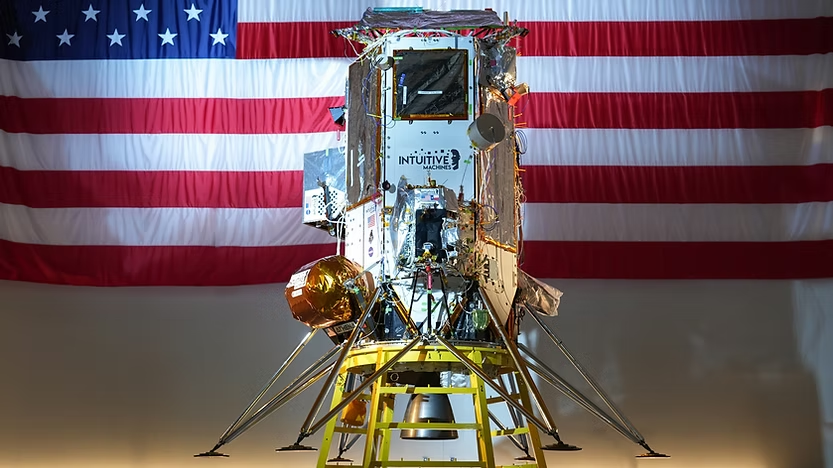
IM-2 landed closer to the Moon’s South Pole than any other spacecraft. The South Pole has very rugged terrain and unique lighting conditions, but is of great interest to scientists and NASA because water is thought to exist in permanently shadowed regions there. NASA plans to put astronauts there beginning with Artemis III in mid-2027 expecting that eventually water can be extracted from the regolith and used to support human outposts.
One advantage of sending robotic landers there first is discovering the challenges that await. During IM’s first quarter 2025 financial earnings call this morning, Altemus listed three primary contributors to IM-2’s imperfect landing.
Signal noise and distortion interference with the laser altimeter was one, but the other two were because of the terrain itself. Long shadows and low-angle sunlight “challenged the precision capability of our landing system” and imagery from NASA’s Lunar Reconnaissance Orbiter (LRO) at 100 kilometers couldn’t accurately account for how craters appear at lower altitudes in those lighting conditions. IM-2’s optical navigation system is designed to recognize craters using LRO imagery.
Altemus said they’ve identified the issues and are making the necessary changes for IM-3. They include redundant and dissimilar altimeters that will be tested more rigorously, a lighting-independent sensor for surface velocity measurements, an expanded onboard terrain crater database, and adding imagery of the area taken by IM-2 to their machine learning algorithms to improve crater tracking and navigation performance. He said buying more sensors will result in a “slight cost increase,” but does not expect an impact on schedule.
IM-3 isn’t headed to the South Pole, but to Reiner Gamma, a “lunar swirl” on the western edge of the Moon near the equator. NASA already has contracted with IM for a fourth mission, IM-4, which will return to the South Pole.
Firefly, Astrobotic, Blue Origin, and Draper are other companies with CLPS contracts. Firefly’s Blue Ghost Mission 1 was the first fully successful CLPS mission in March. Astrobotic’s first mission in 2024 suffered a propulsion failure and didn’t reach the Moon. They plan to try again at the end of this year. Before that, Blue Origin plans to launch Blue Moon Mark 1 in August. Draper’s first mission is scheduled for 2026.

User Comments
SpacePolicyOnline.com has the right (but not the obligation) to monitor the comments and to remove any materials it deems inappropriate. We do not post comments that include links to other websites since we have no control over that content nor can we verify the security of such links.