Mars Samples Must Be Returned To Earth to Prove If Life Existed There
A rock sample discovered by NASA’s Mars Perseverance Rover last year may hold proof that life once existed on Mars, but scientists need to get the sample back to Earth to confirm it. The finding that the sample shows the best evidence so far of past microbial life on the Red Planet was revealed last year and published today in Nature after a rigorous peer review process. It still is just a possibility, though. Analysis by more sophisticated tools in laboratories here on Earth is the only way to be absolutely certain.
Katie Stack Morgan, Perseverance Project Scientist at NASA’s Jet Propulsion Laboratory (JPL), and Perseverance scientist Joel Hurowitz of Stony Brook University, excitedly described the 2024 discovery of a reddish rock with “leopard spots” in Mars’ Jezero Crater during a press conference today. Jezero Crater is the location of an ancient riverbed.
The Perseverance rover is collecting and storing samples from various places on Mars for later retrieval and return to Earth. Perseverance and its companion, the Ingenuity helicopter, launched on July 30, 2020 and landed on Mars on February 18, 2021. Ingenuity was a technology demonstrator that was only expected to fly 5 times, but made 72 flights over three years.
Perseverance continues its mission and last year was exploring a region of rocky outcrops in an area called Bright Angel when its cameras detected an arrowhead-shaped 3.2 x 2 foot (1 x 0.6 meter) rock with colorful spots.

Scientists named the rock Cheyava Falls. As Perseverance’s WATSON imager on the turret at the end of Perseverance’s arm took a closer look, it saw intriguing millimeter-sized “leopard spots” and took a sample, called Sapphire Canyon.

The findings were reported last year. Since then they’ve been undergoing detailed peer review by other scientists before today’s publication.
While peer reviewers couldn’t come up with anything to disprove the hypothesis, Hurowitz and Morgan emphasized the findings still are not definitive. There are abiotic explanations and while they are less likely, they can’t be ruled out. “Astrobiological claims, particularly those related to the potential discovery of past extraterrestrial life, require extraordinary evidence,” Morgan said.
Making a final determination requires bringing the sample back to Earth. Perseverance has done all it can.
“The payload of the Perseverance rover was selected with a Mars Sample Return effort in mind. The idea was for our payload to get us just up to the potential biosignature designation and have the rest of the story told by instruments here on Earth. — Katie Stack Morgan
Perseverance is the first leg of what was planned as a three-leg Mars Sample Return (MSR) mission. Next is sending a lander to Mars to retrieve the samples and launch them into Martian orbit. Once in orbit, the third leg of the trip requires transferring the samples into another spacecraft for the return to Earth.
NASA and ESA have been working jointly on MSR for many years, but cost growth and schedule delays have put the project in jeopardy. Former NASA Administrator Bill Nelson punted at the end of the Biden Administration, leaving the decision to his successor. As of April 2025, a major decision was whether to use NASA’s existing Skycrane as the landing system or a new commercial option.
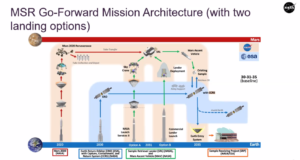
The Trump Administration’s decision, however, was to cancel the program in the FY2026 budget request. During today’s press conference, Acting NASA Administrator Sean Duffy was clearly enthusiastic about Mars science efforts as long as they support future human exploration of Mars, but had no news about plans to get the samples back to Earth.
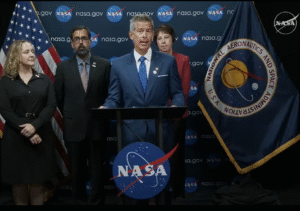
Like Nelson, Duffy says they need to find a way to do it faster and cheaper.
“We care about resources, we care about the time frame, we believe there’s a better way to do this, a faster way to get these samples back. That is the analysis that we’ve gone through … and we think we can. …
“President Trump didn’t say, hey, let’s divert, let’s forget about Mars. We’re continuing our exploration. And, by the way, we’ve been very clear under this president that we don’t just want to bring samples back from Mars. We want to send our boots to the Moon and to Mars, and that is the work we’re doing. — Sean Duffy
How to do Mars Sample Return more cost effectively and on a shorter time frame remains unclear. Eight companies replied to NASA’s request for ideas last year, but none were sufficient for NASA to make a decision before the change in administrations.
The House Appropriations Committee is marking up its version of the FY2026 Commerce-Justice-Science (CJS) bill today. It would provide a lifeline for MSR — $300 million — for FY2026. The Senate CJS subcommittee is silent on the program. Earlier problems and budget uncertainty forced JPL to lay off 13 percent of its workforce in 2024. JPL is a Federally Funded Research and Development Center (FFRDC) operated for NASA by the California Institute of Technology. Caltech makes personnel decisions for JPL based on anticipated funding from NASA.
User Comments
SpacePolicyOnline.com has the right (but not the obligation) to monitor the comments and to remove any materials it deems inappropriate. We do not post comments that include links to other websites since we have no control over that content nor can we verify the security of such links.