Meink: U.S. Has Orbiting Space Control Weapons
Air Force Secretary Troy Meink revealed today that the United States has orbiting space control weapons.
Speaking at the AFA’s Air, Space & Cyber Conference in National Harbor, MD this morning, Meink said that to ensure the United States is ready to meet evolving threats, it now has on-orbit space control weapons.
“Today, we continue to ensure we remain ready to meet the challenges of evolving threats, wherever they exist. This is why the United States now has on-orbit space control weapons capable of defending the joint force against hostile adversary action.” — Troy Meink, Secretary of the Air Force
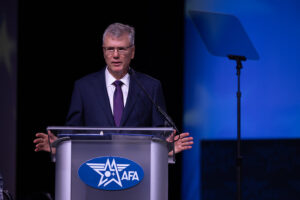
He didn’t provide any additional details of what the weapons are capable of doing even after being asked during a fireside chat immediately after his remarks. Meink told AFA President Lt. Gen. Burt Field (Ret.) that the “phrase was very well thought out, so whatever I said before is what I say again.”
The United States pledged not to conduct debris-generating antisatellite (ASAT) tests after the most recent ASAT test, which was launched by Russia in November 2021 and generated debris that imperiled the Russian, American and European astronauts aboard the International Space Station. But the only other restrictions are those prohibited by the 1967 Outer Space Treaty — no nuclear weapons or other weapons of mass destruction in orbit, on celestial bodies, or stationed elsewhere in space. The U.S. Golden Dome program is developing Space-Based Interceptors, for example. Meink said today they moved from “initial contract to flight-ready hardware in less than one year.”
Victoria Samson, Chief Director, Space Security and Stability for the Secure World Foundation, mused on X that Meink might be referring to space-based jammers, which would not generate debris. She told SpacePolicyOnline.com that Russia and China have such jammers as detailed in SWF’s Global Counterspace Capabilities report and she assumes the U.S. does too.
If that’s what Meink meant “it doesn’t surprise me,” but it is the “first time that any governmental official has publicly acknowledged an actually designed weapon — not a satellite with a counterspace capability — that has been placed in space.”
What prompted Meink’s decision to publicize this capability is unclear, but Samson postulated it could be an effort to emphasize the U.S. Space Force is “a warfighting branch in and of itself,” and/or to send a message to China and other adversaries that we can counter them in space “as an effort to deter hostile activities on orbit.”
Samson worries it may backfire, however.
“The issue is the same thing it’s always been: the United States stands to lose the most if space becomes a place of actual conflict, as we depend on it the most and have invested the most in it. China and Russia will either use this statement as yet another example of the United States being the bad actor on orbit (which has been their argument in international fora for years now, particularly since the US began openly calling space a warfighting domain) or as justification for their own offensive programs. I don’t see either of these paths ending well for the United States.” — Victoria Samson, Secure World Foundation
User Comments
SpacePolicyOnline.com has the right (but not the obligation) to monitor the comments and to remove any materials it deems inappropriate. We do not post comments that include links to other websites since we have no control over that content nor can we verify the security of such links.