NASA is Full Steam Ahead on Artemis III, IV and V
NASA officials projected confidence today in their plans to launch the Artemis III earth-orbital test flight in mid-2027 and land American astronauts on the Moon in 2028. Whether SpaceX’s Starship or Blue Origin’s Blue Moon MK2 gets there first is up in the air, but NASA expects both will have delivered crews to the surface by the end of that year. The South Pole is still the destination, but acknowledged they need more data from robotic landers before making a final decision.
NASA Administrator Jared Isaacman was joined by Associate Administrator and Chief Engineer Amit Kshatriya and Artemis Program Manager Jeremy Parsons in explaining how efforts to return Americans to the lunar surface have evolved over the years. With the changes initiated this year in accelerating the pace of Artemis launches and revamping the NASA workforce by in-boarding contractors, they firmly believe they can meet the deadlines.

In December 2025 as Isaacman was sworn in as NASA Administrator, the Artemis II mission was getting ready to send four astronauts around the Moon and the next mission, Artemis III, was targeted as the flight that would land astronauts on the surface.
A month before Artemis II lifted off, Isaacman made a course correction for the next flights. Artemis III would be an earth-orbiting test in mid-2027 of rendezvous and docking procedures with the two Human Landing Systems being built by SpaceX and Blue Origin. Artemis IV and Artemis V would return astronauts to the surface, both in 2028.
The deadlines are viewed as ambitious because progress appears slow on the Human Landing Systems (HLSs) needed to ferry the crews between lunar orbit and the surface, and on the spacesuits they need to wear when they exit the lander. Axiom Space is building the suits.
Concerns also have emerged about the choice of the South Pole as the landing site. Not only has it been more than 50 years since NASA landed anyone on the Moon, but it was with a different type of vehicle and in comparatively safe areas closer to the equator. The South Pole is an entirely different environment with steep slopes, low Sun angles, and temperature extremes and fewer mission abort options. NASA wants to go there because water ice deposited by comets over the eons is thought to be accessible in permanently shadowed regions. The water ice possibly could be extracted to support human outposts or create propellant for rockets travelling further into space.
Today’s briefing was a progress update. The bottom line is NASA is going full steam ahead on mid-2027 for Artemis III and 2028 for Artemis IV and V.
In a note to the NASA workforce in September, Isaacman said the mid-2027 date was “90 days broken to schedule,” but explained today that internal message was intended to galvanize the workforce to find solutions. All three speakers repeatedly praised the NASA and contractor workforce for doing just that and Artemis III is still expected in mid-2027.
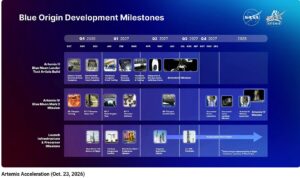
Test versions of Blue Origin’s Blue Moon MK2 and SpaceX’s Starship will dock with NASA’s Orion spacecraft in earth orbit. Blue Origin’s Blue Moon MK2 can loiter in orbit for up to 30 days, so will launch first. Next is Orion on a NASA Space Launch System (SLS) rocket with a “spacer” instead of the Interim Cryogenic Propulsion Stage used for Artemis since it doesn’t need to depart earth orbit. Orion and Blue Moon MK2 will dock on Day 3 and spend two days together while the crew enters the lander and a variety of tests are conducted. Starship will launch on Day 6. The only change from other Starships is that it will have a passive docking system on the nose. Orion will spend only 2 hours docked to Starship and the crew will not enter it.
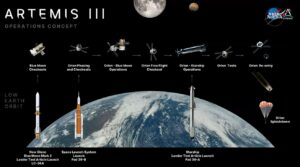
Uncrewed test flights of both HLSs are required to demonstrate they can safely land on the Moon.
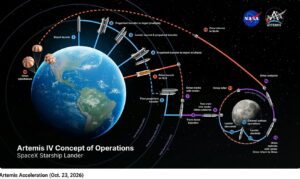
Starship requires in-space propellant transfer to leave earth orbit. A fuel depot is needed where cryogenic propellant can be aggregated and replenished to compensate for boil-off. Earth-orbiting fuel depots don’t exist yet and in-space cryogenic fuel transfer hasn’t been demonstrated. SpaceX anticipates doing that for the first time early next year, and the uncrewed lunar landing test in late 2027. For the 2028 lunar landing, the fully-fueled Starship will dock with Orion in earth orbit and push it to the Moon rather than meeting Orion in lunar orbit as originally planned. Once there, two crew members will transfer into the lander and make the trip down and back, returning to Earth in Orion.
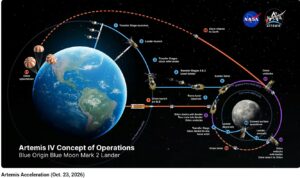
Originally Blue Origin also planned to use in-space propellant transfer to reach the Moon, but they’ve modified their plan. Now, they will use three of their smaller Blue Moon MK1 spacecraft as tugs to get the Blue Moon MK2 lander to lunar orbit where it will meet up with Orion. As with Starship, two crew members will transfer into the lander to go down and back and return home on Orion.
Like the landers, Axiom’s spacesuits are behind schedule. NASA recently changed the requirements to allow a simpler, lighter “sortie” suit. The crews will only be able to spend two hours on the surface, on two excursions, but NASA considers that acceptable for the first missions.
Yesterday, NASA’s Aerospace Safety Advisory Panel raised a number of concerns about plans for Artemis IV including the readiness of the landers, the requirement for only one uncrewed landing test for each provider, and the fact this will be the first time cryogenic propellants are used on the Moon (Apollo used hypergolics).
Concerns also have been expressed about choosing the South Pole for the first lunar landing in more than 50 years instead of an easier-to-reach location closer to the equator with smoother terrain. The National Academies of Sciences, Engineering, and Medicine (NASEM) released a NASA-requested report earlier this week identifying four non-polar sites that would yield valuable scientific results.
Asked today if NASA is considering other landing spots, Kshatryia acknowledged there’s a lot of unknowns about the South Pole and “we will always debate” the best landing spot. More data is needed and they will come from Commercial Lunar Payload Services (CLPS) robotic missions that have landed already and are planned between now and when crews arrive. Isaacman added the South Pole “is probably the most advantageous area” and the CLPS landings will provide “a really good understanding of the environment” so that’s what they’re tracking right now, but agreed that returning to one of the Apollo landing sites as recommended in the NASEM report would be “very cool at some point in the future.”
User Comments
SpacePolicyOnline.com has the right (but not the obligation) to monitor the comments and to remove any materials it deems inappropriate. We do not post comments that include links to other websites since we have no control over that content nor can we verify the security of such links.