NASA Shares Early Planning for Artemis III
NASA is beginning to share plans for the next Artemis mission, Artemis III, scheduled to launch next year. Artemis III was going to be the first human landing on the Moon since the Apollo era, but NASA Administrator Jared Isaacman reformulated the Artemis program on February 27, inserting an earth-orbiting flight into the sequence. It will test integrated operations between Orion and the landers needed to get the crew down to and back from the lunar surface. The launch date for this reimagined Artemis III mission hasn’t been announced, but some basic elements are now public.
Following last month’s successful Artemis II crewed flight around the Moon, the two pacing items for when American astronauts can land on the Moon for the first time since 1972 are when one or both of the SpaceX and Blue Origin Human Landing Systems (HLSs) are tested and certified, and when Axiom Space’s lunar spacesuits are ready.

The new Artemis III mission is primarily directed at rendezvous and docking tests between the Orion spacecraft and SpaceX’s Starship HLS and/or Blue Origin’s Blue Moon Mark 2 (MK2). NASA contracted with Space X for the Starship HLS in 2021 with a targeted launch date of 2024, although many considered that unrealistic. From the beginning of the Artemis program in President Trump’s first term, NASA made clear it wanted two HLS systems to ensure redundancy and competition. Congress didn’t initially provide sufficient funds for two, so the second award, to Blue Origin, had to wait until 2023 with an anticipated first launch at the end of the decade. With the clock ticking and chances growing that China might land taikonauts on the Moon before Americans returned, last year NASA sought to accelerate both HLSs.
SpaceX has launched 11 Starship test flights so far with varying success and the 12th is scheduled for next week on May 19. That’s the first launch of a substantially upgraded Version 3, or V3, with completely redesigned Raptor engines. SpaceX posted photos of the new version as the Super Heavy booster and Starship second stage came together at Starbase, TX.
First full stack of Starship V3 pic.twitter.com/l2s7U7ndCs
— SpaceX (@SpaceX) May 9, 2026
All the Starship launches so far are suborbital. Orbital launches are expected this year, but the HLS version also needs in-space cryogenic propellant transfer at an orbital fuel depot to compensate for boil off. In-space cryogenic fuel transfer has not yet been demonstrated and orbital fuel depots do not yet exist.
Blue Origin hopes to launch a cargo version of Blue Moon, MK1, for the first time later this year and another next year on its New Glenn rocket, but the MK2 version that can support crews is still in development. New Glenn has launched only three times and an upper stage anomaly on the most recent flight last month is under investigation. Blue Moon MK2 also requires in-space cryogenic propellant transfer.
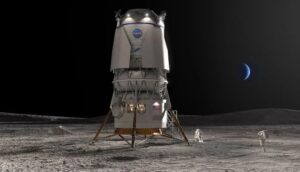
Nonetheless, Isaacman has sounded increasingly optimistic since the February announcement that “pathfinder” versions of both HLS systems will be ready at the same time in 2027 to enable Artemis III to rendezvous and dock with them. On a Bloomberg podcast last week, he painted a picture of how the mission will unfold with launches of NASA’s Space Launch System (SLS) rocket with the Orion spacecraft, SpaceX’s Starship HLS and Blue Origin’s Blue Moon MK2 all within a short period of time.
You’re going to see three distinct and the most powerful rockets in the world launch in quick succession. So you’re going to see SLS, which is what launched Artemis II, that will launch. You will see New Glenn launch, which will put the Blue Origin lander into low Earth orbit. And then you’re going to see Starship launch, which will put their HLS lunar lander in low Earth orbit.
So three massive launches in quick succession. And then you’re going to see the Orion spacecraft rendezvous and dock with the Blue Origin lander, test out the interoperability, detach, rendezvous, dock with the Starship lander, the SpaceX lander, in low Earth orbit, test out the full stack controllability, and then it’s going to detach, come back and land.
And what should that tell us? It should teach us more about the Orion spacecraft, that should build muscle memory about launching SLS, which is extremely complicated, 8.8 million pounds of thrust, you cannot get that wrong. And it’s going to teach a lot about our two landers, Blue and SpaceX. That data, no doubt, will result in hardware changes, software updates, procedural changes, to permit, in 2028, Artemis IV to take the astronauts to the surface of the Moon. — Jared Isaacman
Yesterday, NASA added more details about the plan.
Orion will launch into a circular low Earth orbit allowing more launch opportunities for Starship and Blue Moon to meet up with it than if the orbit were higher. The Interim Cryogenic Propulsion Stage (ICPS) upper stage used on Artemis II to send Orion to the Moon won’t be needed so a “spacer” will be put between SLS and Orion instead. That’s being built at NASA’s Marshall Space Flight Center right now.
The four-person crew for the mission hasn’t been revealed or how many days the mission will last, but NASA said it will be longer than Artemis II’s nine-day flight. The astronauts “could potentially enter” one or both landers.
A redesigned Orion heat shield also will be tested. The heat shield used on the uncrewed Artemis I mission in 2022 experienced unexpected char loss. After a two-year investigation NASA decided it would be safe for Artemis II if they flew a gentler trajectory during reentry, but would be changed for future flights. Artemis II did return safely and Artemis III will test the new version for reentry from Earth orbit, even if not the more challenging profile of a lunar return.
As for Axiom’s AxEMU lunar spacesuit, which like Starship HLS is well behind schedule, NASA is assessing options for evaluating how it interfaces with the landers during Artemis III. Last month NASA’s Office of Inspector General concluded it may not be ready until 2031. Axiom responded on X they remain confident they’ll be ready for a demonstration in 2027 and a lunar landing in 2028.
The date for the Artemis III mission is TBD. At the February event, Isaacman estimated mid-2027. During an April 27 hearing before the House Appropriations Commerce-Justice-Science subcommittee that funds NASA, however, he told subcommittee chair Rep. Hal Rogers (R-KY) that NASA had received responses from the two companies that they could meet NASA’s needs in “late 2027.” In an exchange on X today, he pushed back saying it was a misinterpretation by a reporter and the timing hasn’t changed, but he did say late 2027 at the hearing.
Be that as it may, the date for Artemis III is dependent on at least one and perhaps both of the “pathfinder” versions of the HLS landers being ready just a year from now or perhaps a few months more. One advantage is that the in-space cryogenic propellant transfer capabilities won’t be needed for this low Earth orbit mission.
User Comments
SpacePolicyOnline.com has the right (but not the obligation) to monitor the comments and to remove any materials it deems inappropriate. We do not post comments that include links to other websites since we have no control over that content nor can we verify the security of such links.