Trump Issues Executive Order to Ensure U.S. Space Superiority
President Trump issued a new Executive Order today aimed at ensuring U.S. space superiority. The order covers all three sectors — civil, national security, and commercial — and comes on the same day that Jared Isaacman was sworn in as the 15th NASA Administrator.
Trump issued five Executive Orders, seven Space Policy Directives, and quite a few other space-related documents during his first term. This is his second EO about the space program this time, following one in August on commercial space.
Perhaps ironically, his very first space-related EO in June 2017 revived the White House National Space Council after decades of dormancy, leading to all of those EOs, SPDs and other directives. President Biden retained the Space Council, but today’s EO revokes it.

Despite rumors in May that Trump planned to keep the Council, it’s the Assistant to the President for Science and Technology (APST) who will be in charge of implementing the EO. Michael Kratsios is the current APST and Director of the White House Office of Science and Technology Policy.
Ensuring American Space Superiority begins by explaining space is important as “a measure of national vision and willpower” and the United States must “pursue a space policy that will extend the reach of human discovery, secure the Nation’s vital economic and security interests, unleash commercial development, and lay the foundation for a new space age.”
Trump says he will focus on four priorities:
- Leading the world in space exploration and expanding human reach and American presence in space;
- Securing and defending American vital national and economic security interests in, from, and to space;
- Growing a vibrant commercial space economy through the power of American free enterprise; and
- Developing and deploying advanced capabilities and approaches to enable the next century of space achievements.
Among the specifics, the EO asserts Americans will return to the Moon by 2028 through the Artemis program and establish “initial elements” of a permanent outpost there by 2030, as well as enhance “sustainability and cost-effectiveness of launch and exploration architectures, including enabling commercial launch services and prioritizing lunar exploration.”

The Artemis program began in the first Trump Administration with the goal of getting Americans back on the Moon by 2024. Viewed by most as unrealistic, the date for the landing on Artemis III unsurprisingly slipped to 2027 during Biden’s term. Setbacks with development of SpaceX’s Starship, which will serve as the Human Landing System (HLS) to get astronauts down to and back from the surface, began casting doubt on that date, too. Republicans and Democrats on both ends of Pennsylvania Avenue are united in their determination to get Americans back on the Moon before China puts taikonauts there, which it plans to do by 2030.
Whether the EO’s date of 2028 is achievable remains to be seen, but Secretary of Transportation Sean Duffy, who has been dual-hatted as Acting NASA Administrator until today, recently vowed that Americans would be on the Moon before Trump’s term ends on January 20, 2029. Duffy reopened the HLS contract to determine if there’s any other company that can develop a lander sooner, but it’s a tall order.
On Inauguration Day and during his March State of the Union Address, Trump championed sending humans to Mars, sparking concerns that the Moon would be given a back seat. The FY2026 budget request added $1 billion for Mars while cutting NASA’s overall budget by 24.3 percent. In this EO, however, the Moon is clearly the priority even if the specifics beyond Artemis III are unclear.
Casey Dreier, Director of Space Policy for The Planetary Society, told SpacePolicyOnline.com that at least directives for a lunar surface presence and in-space nuclear power are included. He expects the FY2027 budget request “will have very little of the nascent Mars programs” outlined in FY2026.
For national security space, today’s EO restates the commitment to the Golden Dome missile defense program, which includes space-based components; calls for ensuring the ability to detect and counter threats, including the possibility that adversaries might place nuclear weapons in space, from very low Earth orbit out through cislunar space (the area between Earth and the Moon); embracing acquisition reform and commercial space to create a “responsive and adaptive” space architecture; and “strengthening ally and partner contributions” to U.S. and collective space security.
On the commercial space front, the EO vows to foster economic growth through attracting “at least $50 billion of additional investment” by 2028, and increasing launch and reentry cadence through “new and upgraded facilities, improved efficiency, and policy reforms.” It will also improve spectrum management and spur “private sector initiative and a commercial pathway to replace the International Space Station,” which NASA plans to deorbit in 2030. NASA wants to purchase services from commercial space stations instead of building another government-owned facility.
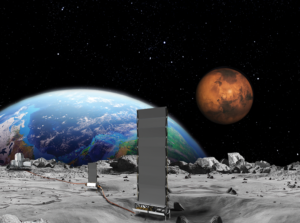
Developing new technologies to “enable the next century of space achievements” has a strong focus on space nuclear power. The Outer Space Treaty prohibits placing nuclear weapons in space, but not nuclear reactors. The U.S. has launched only one, SNAP-10A in 1965, but the Soviet Union’s Radar Ocean Reconnaissance Satellite or RORSAT program used them in the 1960s-1980s. One failed (Kosmos 954) and reentered over Canada in 1978, spreading nuclear material over a 370 mile path. After two more close calls over the next decade, the USSR abandoned the program.
Still, space-based nuclear reactors can provide substantial amounts of power for long periods of time making them attractive for both civil and national security purposes. In August, Duffy announced that NASA will put a nuclear fission reactor on the Moon by 2030 and today’s EO restates that goal. It also calls for nuclear reactors in earth orbit, likely to support the Golden Dome missile defense shield. The EO directs the APST to issue guidance on establishing a National Initiative for American Space Nuclear Power within 60 days among a long list of other assignments with near-term deadlines.
Science gets a brief mention in that research and development investments are intended to “enable scientific discovery for America’s long-term scientific and technology leadership” among other goals. Improved space- and Earth-weather forecasting gets a shout-out, but with the caveat that it be done using firm fixed-price contracts and as-a-service models.
Many other topics are addressed, including assuring space sustainability and orbital debris mitigation and remediation. Tracking satellites and warning of potential collisions — Space Situational Awareness (SSA) and Space Traffic Management (STM) — to avoid debris-creating impacts historically has been the responsibility of the Department of Defense. The first Trump Administration’s Space Policy Directive-3 (SPD-3), however, directed the Department of Commerce (DOC) to become the government’s interface with civil and commercial satellite operators so DOD could focus on its military mission.
The Office of Space Commerce within NOAA, part of DOC, has been working on the Traffic Coordination System for Space (TraCSS) in partnership with companies that have their own systems. Under SPD-3, premium services would be available from commercial providers, but “basic U.S. Government-derived SSA data and basic STM services should be available free of direct user fees.”

Section 4 of this EO, however, replaces “free of direct user fees” with “for commercial and other relevant use.” Scott Pace, who was Executive Secretary of the National Space Council in Trump’s first term (Trump45), tells SpacePolicyOnline.com that the changes “look fine,” but expects there “will be questions on what the government data policy will be, how existing OMB guidance and regulations will apply, and more precision on the definition of what a ‘basic service’ will be.”
Pace added that overall he finds the EO “comprehensive” and “well done,” leaving most space policy decisions from Trump45 in place and taking on “important implementation questions, which I think is the right approach.”
The implementation section is, indeed, extensive, with a strong focus on acquisition reform and controlling costs and schedules. For acquisition, commercial solutions and the use of Other Transaction Authorities or Space Act Agreements rather than traditional contracts will be preferred.
The EO even requires NASA to pay the costs of publishing the EO.
That falls to NASA’s new Administrator, Jared Isaacman. Confirmed by the Senate yesterday, he was sworn in today at the Eisenhower Executive Office Building next to the White House.

He later joined Trump and Kratsios in the Oval Office for the EO signing.
Space has been a lifelong passion of mine. I’m grateful to President Trump for giving me the opportunity to serve alongside the best and brightest at NASA.
It was an honor to have stood with @mkratsios47 as @POTUS signed the most impactful executive space policy in generations.… pic.twitter.com/u0WH5ciOun
— NASA Administrator Jared Isaacman (@NASAAdmin) December 19, 2025
This article has been updated.
User Comments
SpacePolicyOnline.com has the right (but not the obligation) to monitor the comments and to remove any materials it deems inappropriate. We do not post comments that include links to other websites since we have no control over that content nor can we verify the security of such links.