What’s Happening in Space Policy October 18-24, 2026
Here is SpacePolicyOnline.com’s list of space policy events for the week of October 18-24, 2026 and any insight we can offer about them. The House and Senate are in recess, except for pro forma sessions, until after the midterm elections.
During the Week
This week has two especially interesting events — the launch of JAXA’s Martian Moons eXploration (MMX) mission tomorrow (Monday) afternoon EDT, and a NASA update on the Artemis program on Friday — plus many others. We’re also keeping track of the discussions on social media about the very close approach of Russia’s Kosmos 2612 to the U.S.-registered ICEYE X36 Synthetic Aperture Radar (SAR) satellite.
Starting with MMX, the launch is scheduled for 3:41 pm EDT tomorrow, which is 4:41 am Tuesday in Japan, on an H3 rocket from Tanegashima. Two NASA instruments are aboard the spacecraft, which will study the two moons of Mars, Phobos and Deimos, and return samples from Phobos. This is JAXA’s third sample return mission (Hayabusa brought back the first samples of an asteroid, Itokawa, in 2010 and another set from Ryugu in 2020 on Hayabusa2). JAXA had a pre-launch briefing for MMX earlier today.
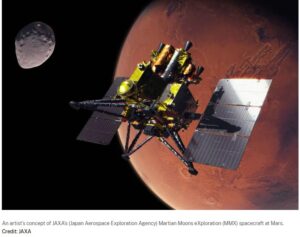
MMX will arrive at Mars in August 2027, collect the samples from Phobos no earlier than December 2028, and return them to Earth in 2031, landing in Australia. Among the 13 scientific instruments are two provided by NASA: the MEGANE spectroscopy instrument from the JHU Applied Physics Lab to study Phobos from above, and the Pneumatic collection mechanism (P-Sampler) from Honeybee Robotics, part of Blue Origin, to collect surface samples after MMX lands. MMX will be on the surface for 2.5 hours while JAXA’s Core sampler (C-sampler) drills down 2 centimeters (0.8 inches) for deeper samples, the CNES/DLR rover Idefix is deployed, and other studies are made. NASA and ESA are providing deep space communications support. JAXA will livestream the launch starting at 2:45 pm EDT tomorrow and you can also follow along on X at @JAXA_EN, @ISAS_JAXA_EN, and @mmx_jaxa_en.
At the end of the week, on Friday, NASA Administrator Jared Isaacman along with Associate Administrator Amit Kshatriya and Artemis Program Manager Jeremy Parsons will give an update on the next Artemis mission, Artemis III, and other aspects of the program to return American astronauts to the lunar surface. Isaacman has been targeting mid-2027 for Artemis III, an earth-orbiting mission to test rendezvous and docking between the Orion spacecraft and test versions of the SpaceX and Blue Origin lunar landers.
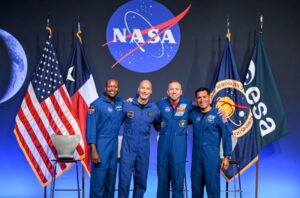
Isaacman indicated last month that Artemis III was about 90 days behind schedule. Ordinarily a delay like that isn’t a surprise or much of a problem in the space business, especially since Artemis III in its current form didn’t even exist until February, but NASA is intent on landing astronauts on the Moon in 2028, so any delay is a problem. We’ll see what the situation is on Friday, bearing in mind that safety of the crew on this flight and those that follow is paramount. The briefing is in-person at NASA HQ and will be livestreamed (check NASA Live for links).
Lots of other events in-between, too many to cover here so we’ll highlight just two.
On Wednesday, the National Academies of Sciences, Engineering, and Medicine will release their report on Human Exploration Across the Moon, the result of a request by NASA to look at “Key Non-Polar Destinations Across the Moon to Address Decadal-level Science Objectives with Human Explorers.” There are those, including Artemis II crew member Victor Glover, who argue that landing at the South Pole is overly risky as a first attempt more than 50 years after the last time we were on the Moon and a site nearer the equatorial regions, where the Apollo missions landed, might be a better initial choice. This is a sister study to one about human exploration of Mars and began a year before Artemis II lifted off, so there’s no tie to Glover’s remarks, but it does identify non-polar locations of high scientific value that can benefit by having astronauts take a look, not just robots. The committee is co-chaired by James Day, professor of geosciences at UC San Diego, and Purdue’s Dan Dumbacher (former NASA Deputy AA for Human Exploration and Operations and former Executive Director of AIAA). The briefing is virtual. Pre-registration is required.
The report release takes place in tandem with the fall meeting of the Academies’ Space Studies Board at the Beckman Center in Irvine, CA on Tuesday and Wednesday. Several top NASA leaders will be there including James Kenyon (AA for Research & Technology), Kelvin Manning (Deputy AA for Human Spaceflight), and Jake Bleacher (Chief Exploration Scientist for Human Exploration) on Tuesday, and Nicky Fox (AA for Science) on Wednesday. Other experts on the agenda include Dan Baker (Director of LASP at the University of Colorado), Bhavya Lal (RAND School of Public Policy and former NASA AA for Technology, Strategy, and Policy), Casey Dreier (The Planetary Society), Orlando Figueroa (Orlando Leadership Enterprise, who held many top science positions at NASA over several decades), and Jim Green (former NASA Chief Scientist). Looks very interesting. Open sessions will be livestreamed (note the agenda is in PACIFIC time — add three for Eastern).
Finally, as we mentioned at the top, we’re following with great interest a story from Axios citing LeoLabs, and posts on X by expert amateur satellite trackers Jonathan McDowell in the UK (@planet4589) and Marco Longbroek in The Netherlands (@Marco_Longbroek), about Russia’s Kosmos 2612 “stalking” ICEYE X36 and coming within 1-2 kilometers of it. McDowell said he’s “still waiting for further tracking data to confirm this, but this seems an unprecedented step by Russia if correct.”

ICEYE is a Finnish company that builds SAR satellites, which can see through clouds and smoke and provide imagery day and night. ICEYE X36 is operated by its American subsidiary, ICEYE US, and registered as a U.S. satellite. Some reports indicate it’s being used to support Ukraine. Concerns similarly were raised by the U.S. Space Force about several Russian military satellites, including Kosmos 2612, that maneuvered “close to a Western commercial radar satellite used by Ukraine for imagery intelligence,” apparently ICEYE X36, in May. Clayton Swope at CSIS has a useful summary of both events and others before them. We’ll see what develops in coming days.
Those and other events we know about as of Sunday morning are shown below. Check back throughout the week for others we learn about later and add to our Calendar or changes to these.
Monday, October 19
- Schriever Spacepower Series with USSF Brig. Gen. Todd Benson (Mitchell Inst), virtual, 1:00-2:00 pm ET
- Launch of JAXA’s MMX Mars Mission, Tanegashima, Japan, 3:41 pm EDT (October 20, 4:41 am JST), livestream begins 2:45 pm EDT
Monday-Tuesday, October 19-20
- ESPI 20th Annual Conference, Vienna, Austria
Tuesday, October 20
- Northrop Grumman 3rd Quarter 2026 Financial Results, virtual, 9:30 am ET
- NASA Briefing on Upcoming Spacewalks, JSC/online, 2:00 pm ET
- SpaceX 3rd Quarter 2026 Financial Results, virtual, 4:30 pm ET
Tuesday-Wednesday, October 20-21
- UP/LINK: The Space Tech Business Summit, New York City
- Space Studies Board Fall Meeting (National Academies), Irvine, CA
- 2026 International Security Space Forum (NSSA), Arlington, VA
Tuesday-Thursday, October 20-22
Wednesday, October 21
- Human Exploration Across the Moon: Report Release (National Academies), virtual, 1:00-2:30 pm ET
Wednesday-Friday, October 21-23
- SPAICE 2026: AI In and for Space (ESA-ESTEC), Noordwijk, The Netherlands
Thursday, October 22
- ESA Briefing Following the 350th ESA Council Meeting, Paris, FR/online, 8:00 am ET (14:00 CEST)
- Lockheed Martin Third Quarter 2026 Financial Results, virtual, 8:30 am ET
- 2026 Faga Forum on Space Intelligence (Space Foundation), Chantilly, VA (classified)
- NASA Aerospace Safety Advisory Panel (ASAP), telephone, 1:30-3:00 pm ET
- Public Meeting on FAA Draft EA To Increase Blue Origin Launches at Cape Canaveral Space Force Station, FL, virtual, 6:00-8:00 pm ET
Thursday-Saturday, October 22-24
- 29th International Mars Society Convention, Los Angeles, CA
Friday, October 23
- NASA Update on the Artemis Program, NASA HQ, Washington, DC/online, 2:00 pm ET
User Comments
SpacePolicyOnline.com has the right (but not the obligation) to monitor the comments and to remove any materials it deems inappropriate. We do not post comments that include links to other websites since we have no control over that content nor can we verify the security of such links.