Artemis II Delayed Due to Upper Stage Problem
Just one day after excitedly sharing the successful results of the second Artemis II Wet Dress Rehearsal, NASA has a different message this morning. A problem with helium flow to the Space Launch System’s upper stage overnight means they have to roll the SLS back to the Vehicle Assembly Building for repairs. NASA’s initial announcement this morning left room for the possibility that the repairs might take place at the pad, but NASA Administrator Jared Isaacman soon clarified that SLS must return to the VAB and launching in March no longer is an option.
The news was first posted on the Artemis II blog at 10:32 am ET with a headline that they were preparing to roll back to the VAB even though they might be able to fix the problem while the rocket remained at the launch pad. In either case, they said, it would “almost assuredly impact the March launch window.”
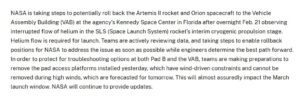
NASA Administrator Jared Isaacman posted the news on X as well.
After overnight data showed an interruption in helium flow in the SLS interim cryogenic propulsion stage, teams are troubleshooting and preparing for a likely rollback of Artemis II to the VAB at @NASAKennedy. This will almost assuredly impact the March launch window. @NASA will…
— NASA Administrator Jared Isaacman (@NASAAdmin) February 21, 2026
At 11:39 am ET, however, Isaacman posted a lengthier explanation and definitively stated they must roll back and March is off the table, no question about it: “Regardless of the potential fault, accessing and remediating any of these issues can only be performed in the VAB. As mentioned previously, we will begin preparations for rollback, and this will take the March launch window out of consideration.”
As an update to my earlier post.
– The ICPS helium bottles are used to purge the engines, as well as for LH2 and LOX tank pressurization. The systems did work correctly during WDR1 and WDR2.
– Last evening, the team was unable to get helium flow through the vehicle. This occurred during a routine operation to repressurize the system.
– We observed a similar failure signature on Artemis I.
– The Artemis II vehicle is in a safe configuration, using ground ECS purge for the engines versus the onboard helium supply.
– Potential faults could include the final filter between the ground and flight vehicle, located on the umbilical, though this seems least likely based on the failure signature. It could also be a failed QD umbilical interface, where similar issues have been observed. It could also be a failed check valve onboard the vehicle, which would be consistent with Artemis I, though corrective actions were taken to minimize reoccurrence on Artemis II.
Regardless of the potential fault, accessing and remediating any of these issues can only be performed in the VAB.
As mentioned previously, we will begin preparations for rollback, and this will take the March launch window out of consideration.
I understand people are disappointed by this development. That disappointment is felt most by the team at NASA, who have been working tirelessly to prepare for this great endeavor. During the 1960s, when NASA achieved what most thought was impossible, and what has never been repeated since, there were many setbacks. One historic example is that Neil Armstrong spent less than 11 hours in space on Gemini 8 before his mission ended prematurely due to a technical issue. A little over three years later, he became the first man to walk on the Moon.
There are many differences between the 1960s and today, and expectations should rightfully be high after the time and expense invested in this program. I will say again, the President created Artemis as a program that will far surpass what America achieved during Apollo. We will return in the years ahead, we will build a Moon base, and undertake what should be continuous missions to and from the lunar environment. Where we begin with this architecture and flight rate is not where it will end.
Please expect a more extensive briefing later this week as we outline the path forward, not just for Artemis II, but for subsequent missions, to ensure NASA meets the President’s vision to return to the Moon and, this time, to stay. — Jared Isaacman on X (@NASAAdmin), 11:39 am, Feb 21, 2026
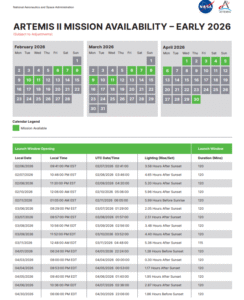
NASA determines when launches to the Moon can take place based on a variety of factors including the alignment of the Earth and Moon. NASA posted the available dates for February, March, and April, but there are opportunities every month.
The upper stage is the Interim Cryogenic Propulsion Stage or ICPS provided by the United Launch Alliance.
Just two days ago NASA and its contractor teams successfully loaded the SLS and ICPS tanks with liquid hydrogen (LH2) and liquid oxygen (LOX) — a “tanking” test — during a Wet Dress Rehearsal (WDR), called “wet” because the tanks are filled with propellant. No excessive hydrogen leaks were encountered this time as they were during the first WDR on February 2-3.
NASA officials were ebullient yesterday as they summarized the test and announced March 6 as the targeted launch date to send astronauts around the Moon for the first time since Apollo. Lori Glaze, acting Associate Administrator for Exploration Systems Development, cautioned that the launch date was tentative pending completion of various data reviews, but this helium flow issue is new.
Hydrogen and oxygen are the rocket’s propellant (fuel and oxidizer, respectively). Helium is an inert gas that doesn’t interact with either of those and is used to maintain pressure in propellant tanks and prevent them from buckling while they’re being filled. Helium is also used to purge the lines.
Isaacman said the ICPS helium system worked fine during both the first and second WDRs. They don’t know why it didn’t early this morning, but they’ve identified three possible causes as listed in Isaacman’s statement: a blocked filter between the vehicle and ground support equipment, a failed Quick Disconnect (QD) umbilical interface, or a failed check valve on the vehicle similar to what happened for the first SLS/Orion launch, Artemis I, in 2022. Fixing any of them has to be done inside the VAB, not on the launch pad according to Isaacman.
SLS consists of the orange core stage (Boeing), plus two white Solid Rocket Boosters on the sides (Northrop Grumman) and the white ICPS upper stage (ULA). The white Orion spacecraft and Launch Abort System (Lockheed Martin) are on top of the ICPS.


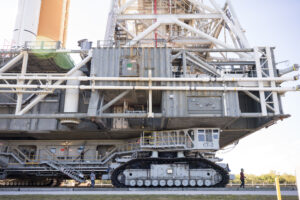
Rolling SLS/Orion between the VAB and the launch pad is no easy feat. The 3.5 million pound (1.6 million kg) “stack” attached to the Mobile Launcher moves atop a Crawler-Transporter, which travels at a top speed of 0.82 miles per hour. The 4.2 mile trip including settling SLS/Orion at its destination takes 8-12 hours.
This afternoon, Isaacman was at LC 39B with the workers “who had been up all night troubleshooting” the problem according to a post on X by NASA press secretary Bethany Stevens (Isaacman is in the front on the left in the photo).
🚀 @NASAAdmin out at LC-39B this afternoon with the team that had been up all night troubleshooting the Artemis II helium issues.
The Administrator met with the workforce, acknowledged their contributions, and promised all the support necessary to get the vehicle back to the… pic.twitter.com/sTFdhdMHdi
— Bethany Stevens (@NASASpox) February 21, 2026
This article has been updated.
User Comments
SpacePolicyOnline.com has the right (but not the obligation) to monitor the comments and to remove any materials it deems inappropriate. We do not post comments that include links to other websites since we have no control over that content nor can we verify the security of such links.