NASA IG Raises More Questions About Readiness for Human Lunar Landings
A new report from NASA’s Office of Inspector General raises more questions about whether landing humans on the Moon in 2028 is realistic. Last month the OIG pointed out that the Human Landing Systems are behind schedule. Today’s report is about the spacesuits astronauts need to wear on the Moon, as well as new suits NASA is developing for use on the International Space Station. The OIG concludes neither may be ready until 2031.
Last month’s report gave NASA credit for how it’s managing the Human Landing System (HLS) contracts with SpaceX and Blue Origin to ferry astronauts between lunar orbit and the surface. But it raised questions about whether SpaceX’s Starship HLS will be ready by 2028, NASA’s goal for putting American astronauts back on the Moon before China lands taikonauts there and before President Trump leaves office. The OIG identified safety as well as schedule concerns considering that Starship requires in-space cryogenic refueling, which has never been demonstrated. Blue Origin’s Blue Moon MK2 also requires in-space refueling, but didn’t get its contract from NASA until two years after SpaceX and isn’t supposed to be ready until the end of the decade. NASA is trying to accelerate development of both systems to ensure a landing by the end of 2028.
Today’s report is about the spacesuits the astronauts will wear after they’re on the surface. They’re not ready either.
Axiom Space is developing spacesuits for use in the one-sixth gravity on the Moon, as well as new spacesuits for astronauts to use in the microgravity environment outside the International Space Station, through a firm-fixed-price, service-based contract. NASA wanted the Artemis lunar spacesuits demonstrated by 2025 and the ISS spacesuits by 2026, but that schedule was “overly optimistic and ultimately proved unachievable.”
“Based on our analysis, if Axiom experiences design and testing delays in line with the historical average for recent space flight programs, the Artemis and ISS demonstrations may not occur until 2031.” — NASA OIG
In 2022, NASA made Exploration Extravehicular Activity Services or xEVAS awards to two companies, Axiom and Collins Aerospace, to develop next-generation spacesuits. Axiom won the contract for lunar spacesuits and Collins for the ISS spacesuits. Collins (then Hamilton Standard) and ILC Dover built the spacesuits the ISS astronauts use today. They were created more than 50 years ago for the space shuttle program.
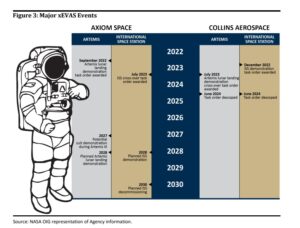
By 2024, however, NASA and Collins “mutually agreed to remove the company’s task orders citing an inability to meet the agreed-upon schedule.” That left Axiom as the only provider for both the ISS and Artemis spacesuits.
“Following this and other programmatic issues, NASA has been increasingly challenged to address immediate spacesuit needs for ISS operations through the Station’s planned decommission in 2030 while ensuring readiness for the Artemis lunar surface mission in 2028.” — NASA OIG
The OIG report is primarily about NASA’s management of the program and the decision to use fixed-price contracts and purchase spacesuit services instead of owning them, but it looks more broadly at the implications for achieving NASA’s human spaceflight goals on the timeline the agency promises.
On February 12, Axiom announced it had obtained $350 million in financing for the Axiom Extravehicular Activity Unit, or AxEMU, spacesuits. At the same time NASA said Axiom passed a contractor-led technical review and NASA would begin evaluating its readiness for the Artemis III mission. At the time, the 2028 Artemis III mission was to be the first human lunar landing since the Apollo era.
Two weeks later, however, NASA Administrator Jared Isaacman revealed a major restructuring of the program. Artemis III now will be an earth-orbital test flight in 2027, followed by not one, but two lunar landings in 2028. Depending on what systems are ready, the 2027 flight will test rendezvous operations with the SpaceX and/or Blue Moon landers, as well as the AxEMU.
Today’s OIG report notes the new plan, but remains cautious. Axiom is “proactively mitigating” supply chain risks and leveraging data from prior NASA efforts, but additional delays are likely “given the developmental nature of the spacesuits and the significant amount of testing and certification remaining.” The OIG identified three other companies — Genesis Engineering Solutions, ILC Dover, and SpaceX — NASA could turn to, but said the agency doesn’t think bringing someone new on at this point would accelerate the timeline.

Another problem the OIG points out, both in this report and last month’s, is that Axiom is using a different interface than Blue Origin for the Blue Moon MK2 lander. Blue Origin relied on NASA’s reference spacesuit interface design document when designing the area in the lander’s airlock where the astronauts put the suits on and take them off — the don/doff area. But Axiom decided to use a different connection and now Blue Origin will have to “make significant changes to the crew module airlock layout or develop its own don/doff hardware to support Axiom’s design.”
The OIG recommended that NASA seek industry input to maintain competition as needed in the future, and develop a plan for interoperability standards between the Artemis landers and spacesuits. As detailed in an appendix to the report, NASA concurred.
In a post on X today, Isaacman said he appreciated the OIG’s work, there are always lessons to be learned, and “I am confident that when NASA is ready to land on the Moon in 2028, our astronauts will be wearing Axiom suits.”
Most of the report is about the Artemis lunar landing spacesuits, but the OIG also points out that the current ISS spacesuits haven’t been redesigned in more than 20 years and pose safety risks. In a report last September, the OIG criticized the award fees NASA gave to Collins for 2020-2024.
User Comments
SpacePolicyOnline.com has the right (but not the obligation) to monitor the comments and to remove any materials it deems inappropriate. We do not post comments that include links to other websites since we have no control over that content nor can we verify the security of such links.