Top House NASA Appropriator Calls Budget Request “Disappointing”
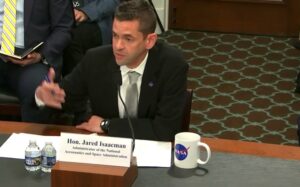
Rep. Hal Rogers (R-KY) told NASA Administrator Jared Isaacman today that he finds the agency’s FY2027 budget request “disappointing.” On a bipartisan basis, he and other members of the House Appropriations Commerce-Justice-Science subcommittee expressed enthusiasm for NASA and Isaacman’s leadership even as Isaacman insisted NASA can do more with less. The Trump Administration’s FY2027 request is a 23 percent reduction from FY2026.

An octogenarian who represents Morehead State University, which has played a role in several NASA missions, Rogers chairs the subcommittee and is a space enthusiast who enjoys telling the story about his reaction to the Soviet Union’s launch of Sputnik in 1957, the world’s first artificial satellite. He quit his job working for a radio station in North Carolina to return to Kentucky and study physics, but they wanted him to study math, not launch rockets, so he moved on to journalism (and later politics).
Today he said that “after the success and momentum NASA has built up over the last year, it’s disappointing to see” the FY2027 request.
The Trump Administration is asking for $18.8 billion, the same as it requested for FY2026. Congress rejected the FY2026 request and provided $24.4 billion, just slightly less than FY2025’s $24.8 billion. Congress also provided multi-year money for NASA in the One, Big Beautiful Bill Act (OBBBA), or the reconciliation bill. Rogers said about $2 billion of that is for FY2027.
Rogers and other members reminisced about Sputnik and Apollo 11 in the context of today’s “space race” against China to ensure American astronauts are back on the Moon before Chinese taikonauts arrive — Isaacman’s prevailing message — with which there was no disagreement. Accolades for the Artemis II mission earlier this month were abundant and support for the Artemis program overall indisputable.
One interesting note is that Isaacman said the two companies building the Human Landing Systems (HLSs) required to get astronauts down to and back from the lunar surface, SpaceX and Blue Origin, have indicated they’ll be ready for a rendezvous and docking demonstration in earth orbit by “late 2027.”
Isaacman reconfigured the Artemis program on February 27 making the next mission, Artemis III, an earth orbit flight instead of a lunar landing to test rendezvous and docking with one or both HLS systems. He’s been saying he wants launches on a 10-month cadence suggesting Artemis III would be in early-to-mid 2027, so this is a delay. NASA awarded a contract to SpaceX in 2021 for the Starship HLS to be available by 2024 and to Blue Origin in 2023 for a first flight by the end of the decade. NASA’s trying to accelerate both to ensure at least one can accomplish a lunar landing by the end of 2028 — before China gets there and before President Trump leaves office.
On a more pragmatic level, Rogers and others wanted to know when NASA would submit its FY2026 operating plan. An operating plan, or “spend plan,” tells Congress how an agency intends to spend the money Congress appropriated. Rogers made clear “we can’t proceed until we get the plan.” Isaacman replied he understands it “should be delivered next week.” The House will be in recess next week. The subcommittee is scheduled to mark up the CJS bill this Thursday, although full committee markup isn’t until May 13.
The Administration didn’t submit NASA’s FY2025 spending plan until last month, four months after the fiscal year ended. They’re supposed to be sent to Capitol Hill within 45 days of an appropriations bill being signed into law. For FY2026, that time has expired. While somewhat of a nerdy subject, the spend plans are useful.
The budget request calls for a reduction of almost 50 percent for NASA’s science programs, as it did last year. Congress rejected that cut and subcommittee Ranking Member Grace Meng (D-NY) pressed Isaacman on reports that 10 science programs were being paused until the FY2026 spending plan is approved.
She asked Isaacman about his comments to the House Science, Space, and Technology Committee last week that it is “long standing practice” for NASA to prioritize resources “based on the lowest of the House, the Senate, or the PBR mark,” referring to the President’s Budget Request. He clarified that applies when NASA is under a Continuing Resolution (CR) and no funds for science programs have been withheld since the FY2026 appropriations bill became law: “every science initiative under the FY2026 appropriations is active right now.”
Questions also have arisen about NASA’s plans to support ESA’s ExoMars Rosalind Franklin Mars rover mission. NASA affirmed on April 16 that it will support the mission, but no funding is evident in the FY2027 budget request. NASA and ESA originally were partners on the ExoMars mission, but NASA withdrew in 2012 except for providing one science instrument. ESA turned to Russia to provide the lander, radioisotope heating units (RHUs), and launch. The rover and lander were completed and about to be shipped to Russia’s Baikonur launch site on February 24, 2022 when Russia invaded Ukraine. ESA ended its cooperation with Russia and turned back to NASA, which agreed to provide the launch in 2028, RHUs, and retrorockets for landing.
Asked why the FY2027 budget doesn’t show any money for Rosalind Franklin, Isaacman said the launch funding is coming out of the FY2026 budget. He didn’t provide details on where the funding is for the RHUs or retrorockets. The promised spending plan may shed light on that when it’s submitted next week.
As was true at the House SS&T hearing, a number of members voiced opposition to the proposal to eliminate NASA’s Office of STEM Engagement to inspire children to study Science, Technology, Engineering and Mathematics. As he did last week, Isaacman insisted NASA’s grant and internship programs provide all the necessary incentives.
Isaacman defended the request as sufficient for NASA to meet all of its goals.
NASA has not always been the best steward of taxpayer dollars. Every cancelled program, every cost overrun and every schedule delay comes at the expense of great science and discovery. I have no doubt there will come a day when NASA can and should do more with more, and I hope I’m still in this position to advocate for it, but with a national debt of $39 trillion and growing, we owe it to the American people to show we can achieve extraordinary outcomes with budget requests that already exceed every civilian space agency in the world combined. — Jared Isaacman
The subcommittee members did not appear convinced.
Isaacman will appear before the Senate Appropriations CJS subcommittee tomorrow morning.
User Comments
SpacePolicyOnline.com has the right (but not the obligation) to monitor the comments and to remove any materials it deems inappropriate. We do not post comments that include links to other websites since we have no control over that content nor can we verify the security of such links.