House Science Committee Opposes Cuts in NASA’s FY2027 Budget Request
On a bipartisan basis, members of the House Science, Space, and Technology Committee left no doubt today that they oppose the dramatic cuts to NASA included in the Trump Administration’s FY2027 budget request. The President’s Budget Request or PBR calls for a 23 percent cut to the agency overall, with reductions to every part of the agency except human exploration.
Republicans and Democrats were effusive in their praise of the Artemis II mission that took four astronauts around the Moon for the first time since the Apollo era earlier this month. Almost everyone spoke of its exhilarating effect on them, their families and the nation. Across-the-board they projected confidence Congress will reject the cuts advanced by the Administration for FY2027 just as they disapproved the very similar FY2026 proposal.
Committee chair Rep. Brian Babin (R-TX), a self-described budget hawk, agrees that controlling the deficit is a priority, but stressed it must be done smartly and cutting NASA is not smart.
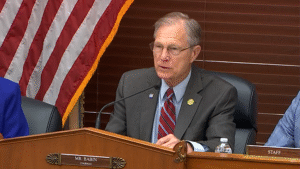
To be clear, I am a budget hawk. Our nation is nearly $39 trillion in debt, and we must address this alarming situation soon. But we must be smart in how we do so. Shortchanging NASA is simply not smart.
We face competition from China across all aspects of space activity. China aims to send astronauts to the lunar surface before the end of the decade. If we do not carefully address the future of NASA’s activities in low Earth orbit, the Chinese space station could become the only human-tended platform—and the only option for countries seeking to collaborate on microgravity research. China also conducted several impressive science missions and plans for more. We must ask whether this proposed budget maintains United States civil and commercial space dominance, or if we risk ceding that leadership to China. — Rep. Brian Babin (R-TX)
Babin noted that it’s difficult for the committee to evaluate the request when NASA hasn’t sent Congress the FY2026 “spend plan” that spells out exactly how NASA intends to spend the money Congress appropriated for the current year. In addition, the March 24 “Ignition” event included new near-term programs like the SR-1 Freedom space nuclear reactor with three Skyfall Mars helicopters for launch in 2028, and increasing the number of Commercial Lunar Payload Services (CLPS) missions to the Moon to 10 per year for the next three years. Babin said it’s impossible to assess the FY2027 request given the “disparity.”
Spend plans or operating plans are supposed to be submitted within 45 days of enactment of an appropriations bill, but agencies like NASA have to get approval from the White House Office of Management and Budget (OMB) before sending them to Capitol Hill. NASA Administrator Jared Isaacman told Babin NASA completed its work on the FY2026 spend plan in early April and it’s in “review in the Administration.” He’s “hopeful” it will be “presented shortly.” Rep. Sarah McBride (D-DE), however, noted that the plan for FY2025 wasn’t provided until last month, six months after that fiscal year ended. Isaacman replied that once he was confirmed in December 2025, he made it a priority to get the FY2025 plan to Congress and he hopes to be able to better adhere to schedules going forward.
Ranking Member Rep. Zoe Lofgren (D-CA) pointed out that the White House released the FY2027 request with its 23 percent cut while the Artemis II astronauts were on the way to the Moon and it didn’t provide much of a “welcome home message” for the crew or NASA and its partners.

On day three of their mission while Integrity’s crew were 99,900 statute miles from Earth, preparing for their lunar science observations, the President and Russ Vought released the FY2027 budget request. Like the FY2026 request, OMB once again tries to argue that NASA and the United States will continue to lead in space and Earth science, human exploration, aeronautics, and space technology while all but exploration would see draconian cuts. Cuts totaling $5.6 billion or 23% from the FY2026 enacted level is not wise. These reductions do not exactly send a welcome home message to the Artemis II crew or to the NASA workforce for that matter. — Rep. Zoe Lofgren (D-CA)
Many members criticized the Administration’s proposal to, once again, eliminate NASA’s Office of STEM Engagement that funds programs to inspire children’s interest in Science, Technology, Engineering, and Mathematics. President Trump has been trying to eliminate NASA’s STEM program since his first term without success because it’s very popular in Congress on both sides of the aisle.
Isaacman replied that everything NASA does is designed to inspire youth and there are other agency programs that award grants to universities or internships to create a pipeline of future workers. “I would just caution against being overly focused on a specific department when the entire agency’s budget directly contributes to inspiration.” The members appeared unconvinced and Rep. Luz Rivas (D-CA) reminded Isaacman that Congress specifically authorized the STEM Engagement office in the 2022 NASA Authorization Act. He replied that it’s also funded in the FY2026 appropriations bill and NASA has not eliminated the office so is in compliance with the law. “The office is open.”
Isaacman was repeatedly asked about the proposed cuts to earth and space science programs and aeronautics. The FY2027 budget request calls for a 47 percent cut to NASA’s science budget and 34 percent to aeronautics.
He pushed back on suggestions that NASA is abandoning “flagship” science missions — the most game-changing, complex and costly — like the Nancy Grace Roman Space Telescope and the Dragonfly mission to Saturn’s moon Titan. “I wholeheartedly believe we need more flagship missions” and resources for them can be freed up by taking advantage of the evolution of the commercial space launch industry and standardized spacecraft for NASA’s smaller, less complex missions.
Isaacman also defended his decision to cancel the international Gateway lunar-orbiting space station. While a good idea when it started in Trump’s first term, the goal now must be getting Americans onto the lunar surface before Chinese taikonauts arrive, rather than looking down at them from orbit.
Several members asked about the NASA proposal revealed at the Ignition event to put a new government-owned module on the earth-orbiting International Space Station and keep ISS operating beyond 2030, the current deorbit date. NASA has been working with Commercial LEO Destinations, or CLD, companies for many years to build commercial successors to the ISS, but isn’t convinced a commercial market exists to make them profitable. Isaacman worries China will end up as the only country with an earth-orbiting space station so is offering to put a new government module on the ISS where the CLD companies can dock their modules temporarily to save costs. The CLD companies oppose the new idea, however, insisting there is a market if only NASA sticks to the current plan.
Last week, committee Democrats released a report criticizing the agency for cutting programs last year before Congress acted on the budget request even though agencies are supposed to follow congressional appropriations, not a president’s request. Lofgren acknowledged that Isaacman wasn’t Administrator at the time, but sought assurances the agency would not implement the FY2027 PBR and wait for congressional action since it’s very likely Congress will reject the cuts. He replied it is “long standing practice” for NASA to prioritize resources “based on the lowest of the House, the Senate, or the PBR mark.”
Rep. George Whitesides (D-CA), a former NASA Chief of Staff and former CEO of Virgin Galactic, directly asked for a commitment to “not repeat last year’s de facto implementation of proposed cuts before Congress has carried out its constitutionally-mandated budget process.” Isaacman replied: “Congressman, you have my commitment. We will always follow the law. … But I also promise to very much over-communicate with this committee and Congress when I do believe we are putting resources not in the appropriate place for good scientific or discovery return.”
User Comments
SpacePolicyOnline.com has the right (but not the obligation) to monitor the comments and to remove any materials it deems inappropriate. We do not post comments that include links to other websites since we have no control over that content nor can we verify the security of such links.