NASA Cheers First Successful Moon Mission Since 1972
NASA is cheering the return of the Artemis II crew tonight after a 9-day mission around the Moon. Administrator Jared Isaacman aboard the recovery ship USS John P. Murtha declared “Mission Accomplished” as congratulations poured in from everywhere.
“America is back in the business of sending astronauts to the Moon and bringing them home safely,” Isaacman posted minutes after splashdown off the coast of San Diego at 8:07 pm ET.
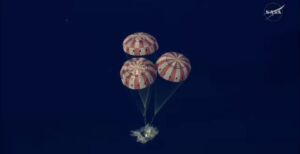
The international crew traveled a total of 694,481 miles (1,117,658 kilometers) between liftoff from the Kennedy Space Center on April 1 and splashdown this evening. Mission elapsed time was 9 days, 1 hour, 32 minutes and 15 seconds. They did not go into orbit around the Moon, but swung around behind it on a free-return trajectory that took them further from Earth than anyone before — 252,760 miles (406,778 kilometers), beating the record set by Apollo 13 in 1970 of 248,655 miles (400,171 kilometers). In another first, the crew included the first woman, the first person of color, and the first Canadian/non-American to fly to the Moon.
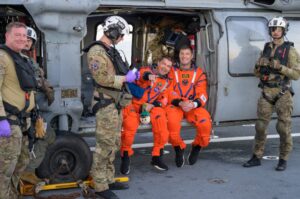
NASA astronauts Commander Reid Wiseman, Pilot Victor Glover, and Mission Specialist Christina Koch, and Canadian Space Agency astronaut Mission Specialist Jeremy Hansen were in great shape after landing. Almost exactly two hours after splashdown they had been helped out of the Orion capsule, which they named Integrity, onto an inflatable raft called the “front porch” and into helicopters for the short trip over to the Murtha. They will remain on the ship as it returns to Naval Base San Diego and then fly back to Houston tomorrow (April 11).


As he waited for the crew to arrive, the 43-year-old Isaacman exalted in the moment, telling NASA’s Megan Cruz “I’m still at a loss for words. I mean, the childhood Jared right now can’t believe what I just saw. I’ve almost been waiting my whole lifetime to see this. And as NASA Administrator, I just couldn’t be more proud of the entire workforce, the years, the effort, the late nights, all the hard work from across the country that contributed to this incredible moment right now.” He also thanked the U.S. Navy recovery team.
President Trump called Isaacman to congratulate him and posted a message on social media praising the crew and ending with “We’ll be doing it again and then, next step, Mars!” Many members of Congress also posted messages or issued press releases with congratulations including some of those who spoke with the crew yesterday. Canadian Prime Minister Mark Carney congratulated “Hansen and the team.”
The Empire State Building decked itself out in Red, White and Blue for the occasion.
Indeed, euphoria is the word for the day not only for NASA, but its international partners and contractors. In addition to including a Canadian crew member, Orion’s Service Module was built by the European company Airbus through an agreement with the European Space Agency (ESA). The prime contractors are Boeing for the Space Launch System (with Northrop Grumman providing the Solid Rocket Boosters, Aerojet Rocketdyne the engines, and United Launch Alliance the Interim Cryogenic Propulsion Stage), Lockheed Martin for Orion, and Amentum for Exploration Ground Systems.
During a post-splashdown briefing this evening, NASA Associate Administrator Amit Kshatriya talked about the hard work of thousands of people in making the mission a success, but “tonight belongs to the team that built the machine” that the crew rode. Many obstacles had to be overcome and they were, but there’s more to do.
The path to the lunar surface is open, but the work ahead is greater than the work behind us. It always will be.
Fifty three years ago, humanity left the moon. This time we return to stay. Let us finish what they started. Let us focus on what was left undone. Let us not go to plant flags and leave, but to stay — with firmness in our purpose, with gratitude for the hands who built the machines, and with love for the ones we carry with us. Welcome home, Integrity. — Amit Kshatriya
One of the obstacles that had to be overcome was with Orion’s heat shield. Orion has flown to the Moon only once before on the uncrewed Artemis I test flight in 2022. Orion has an ablative heat shield and material is intended to burn off — char — during reentry, but the char loss was much more than anticipated. It took two years for NASA to determine the root cause and decided that future heat shields would need to be redesigned, but the one for this mission was already built. They didn’t want to delay Artemis II any further so decided to keep it and use a different reentry profile to lessen the heat load. Spacecraft experience a several-minute communications blackout during reentry as plasma builds up around the vehicle, in this case for 6 minutes. Peak heating took place during the blackout so tensions were especially high until communications were restored. After that it was only a few more minutes before the three sets of parachutes had successfully deployed and Orion was safely bobbing in the Pacific Ocean. Soon the astronauts were aboard the Murtha.

NASA is determined to accelerate the cadence of Artemis missions and the next, Artemis III, is expected to take place next year. Under the new plan laid out by Isaacman on March 24, that will be an earth orbiting test flight, not a trip to the Moon, but two problems they need to resolve are with the toilet’s urine venting system and with a helium valve in the Service Module.
The urine venting problem cropped up early in the mission and at first they thought it was due to cold temperatures. But using heaters and pointing the spacecraft so the vent faced the Sun didn’t help. They now think it may be related to chemistry used to ensure the wastewater doesn’t create biofilms, but they won’t know until the spacecraft can be examined now that it’s back on Earth.
The helium leak is in a valve in the Service Module’s pressurization system. During yesterday’s daily briefing, Kshatriya acknowledged they knew about the leak before launch, but considered it acceptable because they had more than enough pressure to conduct all the Reaction Control System burns needed for the mission. But they want to understand the problem and since the Service Module is discarded before reentry, they had to do the tests while Orion was still in space. “The leak rate we saw in-flight is now an order of magnitude higher than what we saw on the ground” and while still acceptable, means “an extensive redesign” is needed before the next lunar mission. That’s Artemis IV, currently planned for 2028.
This article has been updated.
User Comments
SpacePolicyOnline.com has the right (but not the obligation) to monitor the comments and to remove any materials it deems inappropriate. We do not post comments that include links to other websites since we have no control over that content nor can we verify the security of such links.