House Clears FY2027 CR, Now to the President
A full month before FY2027 begins, the House today joined the Senate in passing a Continuing Resolution (CR) to avoid a government shutdown on October 1. Both parties are eager to avoid another disruption like last year and chose to avoid an eleventh-hour scramble. The bill now goes to the President for signature. [UPDATE: President Trump signed the bill into law on September 2.]
FY2027 begins on October 1, but none of the 12 FY2027 appropriations bills have cleared Congress yet. In fact only three have passed the House and none have even been reported from the Senate Appropriations Committee.
House and Senate leaders on both sides of the aisle decided back in July to get an early start on crafting a CR to avoid another crippling 43-day shutdown like last year’s, the longest in history. The House narrowly passed a CR on largely partisan lines, 220-205, on July 21 to fund the government through December 4. The Senate made substantial changes, passing its version on a bipartisan vote of 90-6 on August 8 to keep the government open through December 11.
The House returned from its 5-week summer break yesterday and while there was some dissatisfaction with the Senate modifications, overwhelmingly approved it. House Speaker Mike Johnson brought the bill to the floor under an expedited process called suspension of the rules that avoids the Rules Committee, but requires a two-thirds vote to pass. The vote was 370-48. (The Senate used an unrelated House bill, H.R. 6500, as the legislative vehicle for the CR, a common practice for these types of bills.)
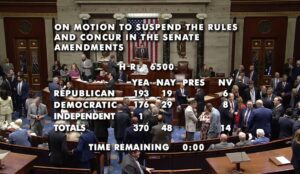
The bill still needs to be signed by the President. One change the Senate made, and which the House agreed to, prevents the White House Office of Management and Budget from implementing a proposed rule that substantially alters how federal grants are awarded for the duration of the CR. It would affect federal grants across the board, including for science and space. Critics argue grants would be awarded based on politics rather than merit if the rule is adopted.
From a space policy perspective, the CR keeps NASA funded at its FY2026 level of $24.4 billion, substantially more than the $18.8 billion requested by the Trump Administration for FY2027. The Commerce-Justice-Science (CJS) appropriations bill that includes NASA cleared the House Appropriations Committee in May, rejecting many of the proposed cuts, though the science budget still would drop from $7.3 billion to $6 billion while human spaceflight grows substantially. The Senate Appropriations Committee hasn’t reported any of its bills, but CJS subcommittee members expressed support for NASA during an April hearing.
The CR keeps DOD essentially at its FY2026 level although a number of exceptions (“anomalies“) requested by the White House were approved. The FY2027 request for national defense is $1.5 trillion composed of $1.15 billion in the base budget (of which $1.072 trillion is for DOD) that goes through the appropriations process, plus $350 billion in a separate reconciliation bill. U.S. Space Force funding is slated to grow substantially in FY2027, from $32 billion in FY2026 to $71 billion, of which $12 billion is via reconciliation. That increase will have to wait for final action.
The base DOD bill cleared the House Appropriations Committee in June, approving DOD’s $1.072 trillion. The reconciliation bill for the additional $350 billion hasn’t been introduced yet and many are skeptical it could pass. Reconciliation is a partisan process that allows the Senate to pass a spending bill by a simple majority instead of 60 votes and has been used sparingly in the past. Two have passed already in this Congress (last year’s One, Big Beautiful Bill Act and this year’s Secure America Act).
Little action is expected in Congress between now and the midterm elections on November 3. At the moment the House is scheduled to be in session through Thursday this week, then off for the Labor Day/Rosh Hashanah recess, then back for three weeks leaving on October 1. Rumors are circulating, however, that they may skip all or most of those days anticipating little can be achieved until it’s clear which party will be in control next year. The Senate returns on September 14 and is scheduled to stay through October 2, but that also could change.
If signed by the President, the CR will run out on December 11, 2026, 101 days from now and 38 days after the midterms. [UPDATE: President Trump signed the bill into law on September 2, P.L. 119-103.]
User Comments
SpacePolicyOnline.com has the right (but not the obligation) to monitor the comments and to remove any materials it deems inappropriate. We do not post comments that include links to other websites since we have no control over that content nor can we verify the security of such links.