Key Senators Agree NASA FY2027 Budget Request Inadequate
Senate appropriators from both sides of the aisle are joining their House counterparts in opposing President Trump’s proposed 23 percent cut to NASA for FY2027. NASA Administrator Jared Isaacman once again defended the request at a hearing today before the Senate Appropriations Commerce-Justice-Science subcommittee. The hearing covered familiar ground, but Isaacman shared one surprising bit of potentially good news about the Nancy Grace Roman Space Telescope.
Subcommittee chairman Sen. Jerry Moran (R-Kansas) and Ranking Member Sen. Chris Van Hollen (D-Maryland) started the hearing by voicing skepticism that the $18.8 billion requested for FY2027 is sufficient to continue NASA’s current programs, never mind add all the new initiatives spelled out at Isaacman’s Ignition event last month. The request is the same as it was for FY2026, which Congress firmly rejected, giving NASA $24.4 billion instead. That’s about the same as FY2025, unadjusted for inflation.
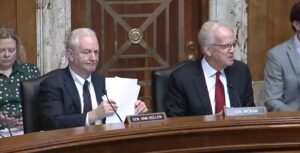
Today’s hearing is Isaacman’s third in just six days. He testified to the House Science, Space and Technology Committee on April 22, to the House Appropriations CJS subcommittee yesterday, and this subcommittee today. He’s unfailingly stayed on message that the requested funding is perfectly adequate as long as NASA is smart about spending it, even with an almost 50 percent cut to science, and about 30 percent cuts to space operations, aeronautics and technology. Only human exploration gets an increase — just over 9 percent — in the budget request, although it also gets about $2 billion in FY2027 from the One, Big Beautiful Bill Act (OBBBA), or the reconciliation bill, that Congress passed last summer.
Moran began the hearing as did his House counterpart Rep. Hal Rogers (R-Kentucky) yesterday by saying the request is far too low.
“I have significant concerns about the FY27 budget request. I want to make certain taxpayer dollars are spent wisely, but I don’t think now is the time necessarily to scale back. … A budget that prioritizes exploration at the expense of science, technology and other core missions risk undermining the very foundation that makes exploration efforts possible.” — Sen. Jerry Moran (R-Kansas)
Van Hollen represents Goddard Space Flight Center, which has been hit hard by funding and staffing cuts. He called the FY2027 request “shortsighted” and a “staggering retreat of U.S. leadership and ambition in space” that would be a “disaster for the NASA mission” at a time when China is “doubling down.” The proposed cut to the Science Mission Directorate would take it “below 2007 funding levels.”
“I think everyone in this room knows that without space science, there is no space exploration. Without space science, there is no new planetary discovery. Without space science, there is no NASA.” — Sen. Chris Van Hollen (D-Maryland)
Goddard is home to the Nancy Grace Roman Space Telescope and one piece of news that came out of the hearing is that the telescope may launch in August rather than September. Isaacman was at Goddard just last week to announce that Roman, which is under cost and ahead of schedule, would launch on a SpaceX Falcon Heavy rocket in early September. Apparently something has changed for the better since then.
“We’re not nailing down the date specifically, but you may in the near future be adjusting your remarks to talk about Nancy Grace Roman launching in perhaps August instead of September.” — Jared Isaacman
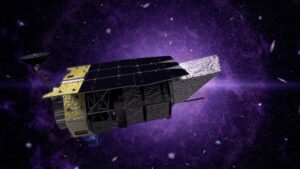
The coronagraph on Roman is a precursor to one that will be used on the Habitable Worlds Observatory (HWO), NASA’s next “great observatory,” that’s designed to detect planets elsewhere in the universe where life exists. Goddard is expected to play a major role in that as well. Until now HWO wasn’t expected to be built until the 2040s, but Isaacman told Van Hollen he wants to accelerate schedules for HWO and other NASA programs by accepting “70 percent solutions” instead of waiting for perfection. “We don’t want to build an empire around the program. We want to get the mission underway and learn as quickly as we can.”
Asked where the money is coming from to build the SR-1 Freedom nuclear-powered spacecraft with three “Skyfall” Ingenuity-class helicopters that he plans to launch to Mars in 2028 — none is requested for FY2027 — Isaacman assured Van Hollen it won’t be taken from money appropriated for the Science Mission Directorate. Instead they are repurposing “components that have sat in the lab for decades and billions of investments.” When Van Hollen asked for specifics, Isaacman said he’d be happy to brief the Senator and his staff. “We have a good model for that.”
Artemis got a lot of attention, too, with abundant accolades. Regarding missions beyond Artemis V, Sen. Katie Britt (R-Alabama) asked about the future of the Space Launch System (SLS). Marshall Space Flight Center in Huntsville is the home of SLS and former Alabama Sen. Richard Shelby was one of its strongest Senate supporters. Britt was his Chief of Staff at one time and succeeded him after he retired at the end of the 117th Congress. The OBBBA funds SLS through Artemis V, but questions are swirling about what comes next.
Often criticized because it’s expensive and not reusable like space transportation systems in development such as SpaceX’s Starship and Blue Origin’s New Glenn, Isaacman is saying only that NASA wants at least two “pathways” for getting humans to the Moon “with great frequency.” NASA asked industry for options and replies aren’t in yet, but he told Britt “I expect SLS to be one of those two pathways.”
Three common themes from all the hearings is excitement about the Artemis II mission and NASA’s revised human lunar exploration plans; determination that NASA’s other programs, especially science, also remain robust; and insistence that NASA’s Office of STEM Engagement (OSTEM) not be terminated so it can continue to inspire youth to study science, technology, engineering, and mathematics.
President Trump tried to eliminate OSTEM throughout his first term and continues now. Congress steadfastly rejects those efforts. The comparatively modest $143 million budget gets outsized attention because it funds projects with strong hometown constituencies — the National Space Grant College and Fellowship Project (Space Grant), Established Program to Stimulate Competitive Research (EPSCoR), Minority University Research and Education Project (MUREP), and Next Generation STEM project (Next Gen STEM).
Isaacman argues OSTEM is unnecessary because inspiration is part of everything NASA does and other parts of the agency offer internships or grants. OSTEM is an “inefficiency.” Many Senators disagreed and Sen. Chris Coons (D-Delaware) explained why it really matters to small states like his.
“States like mine that have the University of Delaware, Delaware State, Wilmington University — none of which are among the cluster of nationally prominent long-term engineering and science partners with NASA — [OSTEM] allows them to have quality, capable science programs that connect with space science.
“I would argue that genius is evenly distributed across the human genome and arguably across the American people and having a pathway, although very small, for promising young students to engage with NASA and space science at every state university is a priority worth funding.” — Sen. Chris Coons (D-Delaware)
The hearing was friendly. Senators simply were skeptical NASA can do everything Isaacman is promising with 23 percent less money. House and Senate members are clear they admire Isaacman and what he’s done at NASA in the short few months he’s been there. Sen. John Kennedy (R-Louisiana), renowned for his quips, praised Isaacman for heralding the whole team that made Artemis II possible, not taking credit himself:
“We need more like you in government. We got too many butt heads.” — Sen. John Kennedy (R-Louisiana)
As the hearing wrapped up, Moran asked Isaacman a question clearly knowing what the answer would be. Clyde Tombaugh, who discovered Pluto, was from Kansas. Moran wanted to know if Isaacman thinks Pluto should be reinstated as a planet. The International Astronomical Union “demoted” Pluto to dwarf planet status in August 2006, just eight months after NASA launched the New Horizons probe to fly past Pluto for the first time in history. Controversy over the IAU’s decision hasn’t eased, with New Horizons Principal Investigator Alan Stern leading the charge to make Pluto a planet again after what the probe saw first hand when passing by.
Reiterating what he’s said in the past, Isaamcan told Moran: “I am very much in the camp of ‘make Pluto a planet again.’ And I would say we are doing some papers right now on … a position that we would love to escalate through the scientific community to revisit this discussion and ensure that Clyde Tombaugh gets the credit he received once and rightfully deserves to receive again.”
User Comments
SpacePolicyOnline.com has the right (but not the obligation) to monitor the comments and to remove any materials it deems inappropriate. We do not post comments that include links to other websites since we have no control over that content nor can we verify the security of such links.