Government Spending on Civil Space Topped $42 Billion in FY2026
Government spending on civil space activities is more than just NASA. A new Aerospace Corporation report details the $42.6 billion allocated for civil space in FY2026 and compares it to FY2025 and the still-pending request for FY2027. NASA is the largest share, but only 55 percent of the total. Overall, the report characterizes the civil space budget as going through tumultuous times with the White House and Congress out of sync and the FY2027 outcome uncertain.
The term “civil space” immediately evokes NASA, NOAA and perhaps the Office of Science at the Department of Energy (DOE), but Aerospace’s Lindsay DeMarchi painstakingly scoured all non-defense agencies and identified a total of 19 that are allocated money to “support, enable, or leverage space through direct and indirect means.” In terms of spending, the DOE is highest after NASA at 18 percent, with the others ranging from the Department of Homeland Security (DHS) at 6.79 percent down to the National Telecommunications and Information Administration (NTIA) at 0.05 percent.
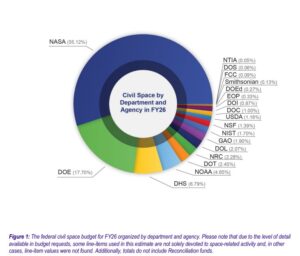
DeMarchi then categorizes them into seven “national priorities” — American Leadership and Manufacturing; Fundamental Science; Infrastructure, Energy and Resiliency; Remote Sensing Applications; Homeland Security; Streamlining and Expansion; and Workforce Development.
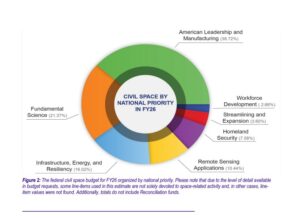
The report compares FY2025 and FY2026, where funding is finalized, and the FY2027 request. The bottom line, not surprisingly, is that the budget for space across civil government “is experiencing a period of significant uncertainty.”
FY2026 encompassed the longest government shutdown in history, but Congress ultimately appropriated much more than the President’s Budget Request (PBR) and added billions more in a separate reconciliation bill — the One Big, Beautiful Bill Act, OBBBA (also called the Working Families Tax Cut Act, WFTC). Nonetheless, the $42.6 billion in civil space appropriations last year was down $1.6 billion from FY2025. The Infrastructure, Energy and Resiliency category bore the brunt of the reductions, down 29 percent from FY2025 per DeMarchi’s calculations.
For FY2027, the PBR once again calls for deep cuts to civil space, but the outcome is in limbo as the government operates on a Continuing Resolution through December 11. Of DeMarchi’s seven national priority areas, all face substantial cuts in the request compared to FY2026. Workforce Development tops the list with a proposed reduction of $470 million (52 percent) including all $143 million from NASA’s STEM Engagement program and $16.4 million each in two Department of Education programs.
With the midterm elections looming, all 12 FY2027 appropriations bills have cleared the House Appropriations Committee and they seem poised to reject many of the Administration’s cuts again. But only three of those bills have passed the House — Agriculture, Military Construction-Veterans Affairs, and National Security-State. The Senate Appropriations Committee hasn’t finalized any of the bills.
DeMarchi provides a link to an Excel spreadsheet detailing her calculations for those who want to dig deeper. Her report from last year is also available.
User Comments
SpacePolicyOnline.com has the right (but not the obligation) to monitor the comments and to remove any materials it deems inappropriate. We do not post comments that include links to other websites since we have no control over that content nor can we verify the security of such links.