China Plans “Two Launches, Lunar Orbit Rendezvous” to Land Taikonauts on Moon
China is sharing more information about how it plans to land taikonauts on the Moon by 2030. Development of the Long March-10 rocket, Mengzhou crew spacecraft, and Lanyue lunar lander have been underway for some time, but how they expect to execute the landing is just being shared now.
The overall plan was explained at the 7th Manned Space Symposium in Beijing this weekend by Wang Xiang, chief designer of the lunar exploration program and reported by Chinese news outlets including Xinhua and CCTV and on social media.
They’ll use a “two launches, lunar orbit rendezvous” strategy where Mengzhou (“dream vessel”) and Lanyue (“embracing the Moon”) will be launched separately and dock in lunar orbit. Two of the three taikonauts will transfer from Mengzhou into Lanyue for the trip down to and back from the surface and transfer back into Mengzhou for the return to Earth.
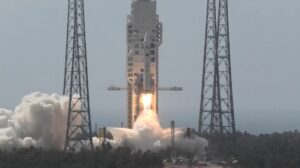
China has been saying since 2023 that they’ll put taikonauts on the Moon before 2030. CNSpaceflight posted on X a slide from Wang’s presentation showing three uncrewed test flights will precede the 2030 crewed landing: a Mengzhou test flight to earth orbit in 2027, a Lanyue lunar landing test in 2028, and a dress rehearsal of the entire launch and landing sequence with two rocket launches and a lunar landing in 2029.
NASA Administrator Jared Isaacman is intent on returning American astronauts to the Moon before Chinese taikonauts arrive. President Trump initiated the Artemis program during his first term with a goal of landing in 2024, but that deadline has slipped repeatedly. Isaacman stresses that China’s space program is advancing rapidly and this “space race” is closer than it needed to be. At the October 23, 2026 Artemis Acceleration news conference, he argued it’s “the weight of institutional inertia and misplaced priorities and decades of decisions, some imposed upon us and others of our own making, that have held America’s space program back.”
NASA contracted with SpaceX in 2021 and Blue Origin in 2023 to build the U.S. landers and Isaacman is intent that both companies put astronauts on the Moon in 2028. Blue Origin will use a similar approach to China’s, with the Blue Moon MK2 lander launching on a New Glenn rocket and making its way to lunar orbit by itself. NASA’s Orion spacecraft with four astronauts will launch separately on NASA’s Space Launch System rocket and dock with the lander in lunar orbit. By contrast, SpaceX’s Starship will dock with Orion in earth orbit and push Orion to lunar orbit. In both cases, two astronauts will enter the landers for the journey down to the surface and back, returning to Earth in Orion.
Several countries, including China, have put robotic landers on the Moon, but only the United States has put people there.
The United States won the Moon Race against the Soviet Union on July 20, 1969 when Neil Armstrong and Buzz Aldrin landed in the Sea of Tranquility. Five more U.S. crews landed over the next three years, ending with Apollo 17 in December 1972.

Four crewed test flights preceded the lunar landings: Apollo 7 was an earth orbital test flight of the Apollo capsule, Apollo 8 orbited the Moon without the lander, Apollo 9 tested undocking and redocking with the lander in earth orbit, and Apollo 10 tested undocking and redocking with the lander in lunar orbit while flying very close to the surface.
Two crewed test flights will precede the first Artemis landings: Artemis II already sent four astronauts around the Moon in April, and Artemis III is an earth orbital mission similar to Apollo 9 to test rendezvous and docking between Orion and the two landers next year.
China apparently isn’t planning similar crewed tests.
User Comments
SpacePolicyOnline.com has the right (but not the obligation) to monitor the comments and to remove any materials it deems inappropriate. We do not post comments that include links to other websites since we have no control over that content nor can we verify the security of such links.