Voyager 1 Reaches New Milestone: One Light-Day from Earth
NASA’s Voyager 1 spacecraft achieved another milestone this morning. Launched in 1977, it became the first human object to pass into interstellar space in August 2012 and is so far from Earth now that it takes one entire day for a radio signal to get there — one light-day. It also takes one light-day for Voyager 1 to send back the data it is still acquiring after all these decades.
Voyager 1 passed the one light-day threshold at 5:16:07 am ET this morning at a distance of 16.094 billion miles (25.902 billion kilometers). That means it takes two days to communicate with Voyager — one day for the signal to get there and another day for the answer to come back.
The spacecraft sent back stunning images of Jupiter in 1979 and Saturn in 1980. Since then it’s been on a quest to find whatever is out there beyond and report back to NASA’s Jet Propulsion Laboratory in Pasadena, CA. Its twin, Voyager 2, flew past Jupiter, Saturn, Uranus and Neptune and also now is in interstellar space, but exited in a different direction.
Voyager 1’s cameras were turned off to save power in February 1990 just after taking the iconic “Pale Blue Dot” image of Earth. The tiny dot in the middle of the gray streak is Earth as seen from a distance 3.7 billion miles (6 billion kilometers).

Voyager 1 is now 4.35 times that distance. It continues to send back data using three instruments that are still operating, but what it’s seeing is left to the imagination. The Planetary Society commissioned space artist Don Davis to create an illustration as part of the celebration of this milestone and released his digital painting during a virtual event this evening.
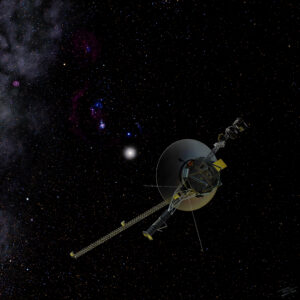
Voyagers 1 and 2 will celebrate their 50th anniversaries next year. Voyager 1 was on a fast path to Jupiter and Saturn while Voyager 2 was on a longer, slower path to visit all four outer planets, so Voyager 2 actually launched first on August 20, 1977, with Voyager 1 on September 5.
Although they will continue out into the galaxy perpetually, communications are expected to end about 2029 for Voyager 1 and 2031 for Voyager 2 as their power sources degrade. They use Radioisotope Thermal Generators (RTGs) that lose about 4 watts of electrical power per year.
Both Voyagers have “Golden Records” aboard, with sounds, music, spoken greetings, and encoded images of Earth that were curated by a committee chaired by famed astronomer Carl Sagan and Ann Druyan, later his wife. During tonight’s Planetary Society event, Suzanne Dodd, Voyager project manager, and Linda Spilker, project scientist, pointed out that “even when it stops communicating with us, it’s still got that Golden Record on it, and that’s going to go out and circle around the center of our Milky Way galaxy for a billion years or more.”
NASA’s Voyager website has a live chart tracking the location of Voyager 1 and Voyager 2.
NASA will hold its own event to mark this milestone tomorrow at noon.
User Comments
SpacePolicyOnline.com has the right (but not the obligation) to monitor the comments and to remove any materials it deems inappropriate. We do not post comments that include links to other websites since we have no control over that content nor can we verify the security of such links.