Artemis II Ready to Go on April 1, Weather Permitting
The Artemis II crew, rocket, and spacecraft are ready for liftoff on Wednesday, April 1, 2026 at 6:24 pm ET. No technical issues are currently being worked, with weather the only potential constraint and even that is 80 percent favorable. Sending four human beings to the distance of the Moon for the first time since 1972 seems close at hand.
Following a Mission Management Team (MMT) meeting today, NASA Associate Administrator Amit Kshatriya said Artemis II is go for launch. The launch team “call to stations” began at 4:34 pm ET today, followed 10 minutes later by the first tick of the countdown clock.
The Space Launch System (SLS) rocket (Boeing) with its RS-25 engines (Aerojet Rocketdyne), two Solid Rocket Boosters (Northrop Grumman), Interim Cryogenic Propulsion Stage (United Launch Alliance), and Orion/Service Module (Lockheed Martin/Airbus) spacecraft are ready to go, as is the Exploration Ground Systems (Amentum) team.

At a 5:00 pm press briefing, Kshatriya, Launch Director Charlie Blackwell-Thompson, MMT chair John Honeycutt, and Chief Flight Director Emily Nelson conveyed confidence. “The team concluded that everything continues to look good and there are no issues preventing us from pressing ahead” to launch on April 1, Kshatriya said.

An intense solar flare that erupted today (EDT) poses no risk to the launch, Kshatriya said. Asked what would happen if a similar burst occurred while the crew is in-flight, Nelson said they already plan to set up the radiation shelter inside Orion anyway, so it would give them a real-life opportunity to check it out. The shelter isn’t a permanent structure, but an area under the cabin floor where the crew will take safe haven, surrounding themselves with stowage bags filled with clothing and other items that have mass to shield them.
The crew has been in quarantine at Johnson Space Center since March 18 and arrived at Kennedy Space Center on Friday. Yesterday they spoke with reporters remotely from their quarters expressing excitement, but tempered with a reality check that with a complex system like SLS/Orion and factors like weather, the launch could be delayed by a day or two or even a month or more. The Earth and Moon must be properly aligned for these launches to take place. Opportunities are available every month. This one is every day from April 1 to April 6. The next opens on April 30.

The crew wants everyone to know they will launch whenever the rocket and the team — including themselves — are ready to go and they’re fine whenever that is.
“I want to add one quick thing to just remind everyone, this is a tough flight. This is the first time we’re going to try. This is the first time we’re loading humans on board. And I will tell you the four of us, we are ready to go. The team is ready to go, and the vehicle is ready to go. But not for one second do we have an expectation that we are going.
We will go when this vehicle tells us it’s ready, when the team is ready to go. So we might go out to the pad, and we might have to try again a few more times, and we are 100% ready for that.” — Artemis II Commander Reid Wiseman
Timelines for countdown to launch, and from liftoff to orbit, are posted on NASA’s website. The crew will spend about a day in earth orbit testing out the Orion spacecraft and Service Module (SM) that will be their home for the next 10 days. If all goes according to plan, they then will fire the SM engines for the Trans-Lunar Injection (TLI) burn to send them towards the Moon. This is a test flight and they will not orbit the Moon, much less land, but fly past the Moon and back to Earth on a “free-return” trajectory that brings them home even if the propulsion system doesn’t perform as expected. If they launch on April 1, they will reach a distance of 252,799 statute miles (406,841 kilometers) from Earth, about 4,000 miles (6,400 km) further than any human has gone before.

SLS/Orion has only flown once before — Artemis I in 2022 — and no crew was aboard, so this is the first test of the life support system. Koch pointed out on Sunday that their spacesuits can sustain them for 144 hours (six days) if the Orion system fails. They can make an early return to Earth during the first part of the mission if necessary. Later they’d just continue on the free-return trajectory.
NASA’s Orion program manager, Howard Hu, explained at a separate briefing yesterday that if a problem develops in the first 36 hours after TLI they’d do a “turn and burn” maneuver using the SM engines to turn them around without going to the Moon. After that “it’s probably safer, from a time perspective, to fly around the Moon and come back and take that free-return trajectory. You’re not getting any more time savings and you don’t have to do another big burn.” NASA has run “hundreds of thousands” of trajectories to ensure they can get home safely.
Weather is 80 percent “go” for Wednesday, with the Cumulus Cloud Rule and Ground Winds as the primary concerns.

The weather has to be good not only at the launch site, but along the trajectory to the east over the Atlantic Ocean. Like the U.S. spacecraft that deliver crews to the International Space Station, Orion has a Launch Abort System (LAS) that can pull the capsule away from the rocket in an emergency with the crew landing in the ocean.
NASA’s Exploration Ground Systems program manager Shawn Quinn said yesterday there are three launch abort options: a LAS abort where they’d land close to Kennedy Space Center (the LAS is jettisoned about three minutes after liftoff), an “untargeted Atlantic abort” where they’d land near Africa, and an “abort-once-around” when they’d do almost one orbit of Earth and splashdown near San Diego.
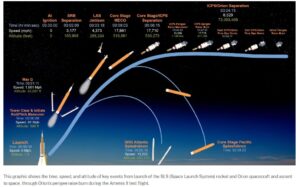
NASA will have another pre-launch briefing tomorrow (Tuesday) at 1:00 pm ET. NASA coverage of “tanking” when they load propellant into the SLS and ICPS tanks begins on Wednesday at 7:45 am ET and full launch coverage at 12:50 pm ET. The launch window on Wednesday is open for two hours. A post-launch press conference is scheduled for about 2.5 hours after liftoff. If there’s a scrub for any reason, they may be able to recycle in either 24 or 48 hours depending on the cause.
The United States is the only country to send people to the Moon. Nine three-person crews went there between 1968 and 1972. Two were test flights (Apollo 8 and Apollo 10) that entered orbit, six landed (Apollo 11, 12, 14, 15, 16, and 17), and one (Apollo 13) intended to land, but an explosion in the Service Module enroute to the Moon imperiled the crew. Mission Control in Houston was able to use the Lunar Module’s descent engine to redirect the capsule onto a free-return trajectory that brought them safely home. The Apollo 13 crew currently holds the record for traveling furthest from Earth: 248,655 miles (400,171 km).
For Apollo, the lunar module engine was available because the LM was attached to the Apollo spacecraft. In the new Artemis program, the lunar landers will be launched separately and dock with Orion in lunar orbit.
Artemis is the twin sister of Apollo in Greek mythology.
User Comments
SpacePolicyOnline.com has the right (but not the obligation) to monitor the comments and to remove any materials it deems inappropriate. We do not post comments that include links to other websites since we have no control over that content nor can we verify the security of such links.