Artemis II WDR Test Postponed by Frigid Weather, Could Affect Crew-12 Launch Date
The Wet Dress Rehearsal (WDR) required before the launch of Artemis II has been postponed from January 31 to February 2 because of bitter cold weather in Florida. NASA’s strict weather rules prohibit both the test and launch in frigid temperatures. Now the earliest possible launch date for Artemis II is February 8 and the actual date could affect when NASA sends the next crew to the International Space Station.
Artemis II will send four astronauts around the Moon for the first time since the Apollo era. NASA’s Reid Wiseman, Victor Glover and Christina Koch and the Canadian Space Agency’s Jeremy Hansen are already in their 14-day pre-launch quarantine.

The “call to stations” to begin a 49-hour long series of test runs would have begun last night about 8:00 pm ET. Reporters on site at Kennedy Space Center posted on social media that it was apparent it wasn’t starting, but NASA would not confirm the delay until this morning. NASA Administrator Jared Isaacman made the announcement on Fox News at 7:41 am ET and NASA posted an update on its Artemis blog at 8:04 am ET.
In the 1960s, we achieved the near-impossible by sending American astronauts to the Moon and bringing them back safely. President Trump’s vision, outlined in his national space policy, calls on us to go even further.
America’s mission to the Moon won’t end with a handful of… pic.twitter.com/kfyOekY2h4
— NASA Administrator Jared Isaacman (@NASAAdmin) January 30, 2026
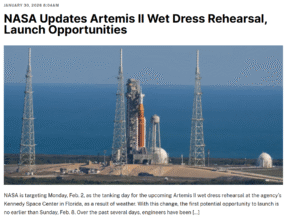
The test involves a practice countdown that includes “tanking” — filling the Space Launch System (SLS) rocket with liquid oxygen and liquid hydrogen propellant. NASA requires that tanking cannot begin if the 24-hour average temperature is less than 41.4ºF at two locations (132.5 feet and 257.5 feet) on support structures, or “below a defined temperature constraint for 30 consecutive minutes. The temperature constraints range from 38 degrees Fahrenheit to 49 degrees Fahrenheit, depending upon the wind and relative humidity. Higher wind and relative humidity result in a colder temperature constraint.”
Temperatures are forecast to drop to 27ºF Saturday night accompanied by a wind advisory beginning that afternoon.
The 1986 Space Shuttle Challenger tragedy 40 years ago this week killed seven astronauts when an O-ring in one of the two Solid Rocket Boosters (SBRs) failed due to unusually cold weather. The failure of that O-ring caused the failure of the External Tank and the other SRB. The shuttle was torn apart by aerodynamic forces. Although this test does not involve firing SLS’s two SRBs, which are derived from those used by the shuttle, NASA is applying lessons learned to avoid future catastrophes.
NASA now plans to try on Monday, February 2.
At the same time, NASA needs to launch its next crew to the ISS, Crew-12, on SpaceX’s Crew Dragon Freedom. They were scheduled to launch on February 15, but NASA wants to accelerate that if possible because Crew-11 had to return earlier than planned because one of the astronauts experienced a “medical concern.” Only one NASA astronaut, Chris Williams, is aboard the ISS right now along with two Russian colleagues. They arrived on Soyuz MS-28 in November. The U.S. and Russian segments of ISS are interdependent so at least one person from each country must be on board.
Interweaving the Artemis II and Crew-12 launches presents challenges in terms of both ground and space facilities. During a Crew-12 pre-launch news conference this morning, NASA Commercial Crew Program Manager Steve Stich noted, for example, that the DOD rescue vehicles needed to recover the crews if either launch aborts after liftoff are the same. The Artemis II Orion crew capsule and SpaceX’s Crew Dragon capsule can separate from their rockets in an emergency and safely land in the ocean until ships or helicopters arrive to rescue them. NASA and DOD don’t want the two launches occurring too close to each other so the vessels have time to reposition themselves.
NASA’s Tracking and Data Relay Satellite (TDRS) system also will be used by both missions. The earth-orbiting ISS and Crew Dragon use TDRS, and Artemis II will use it during the first day while they remain in earth orbit to check out Orion’s systems. They’ll switch to the Deep Space Network (DSN) as they travel around the Moon, but even then NASA needs to make sure the TDRS and DSN beams don’t overlap while Crew Dragon is in free flight making its way to the ISS. That’s why they don’t want the two missions in-flight at the same time, according to Stich.
Stich laid out three scenarios:
- If the WDR goes well on February 2, NASA proceeds with plans to launch Artemis II on February 8, and the launch takes place, then Crew-12 will not launch until February 19 after the Artemis II crew returns.
- If the WDR goes well on February 2, NASA proceeds with plans to launch Artemis II on February 8, but the launch is delayed for any reason, then Crew-12 could launch on February 13.
- If the WDR does not go well and February 8 is no longer under consideration, then Crew-11 can launch on February 11.
The Earth and Moon must be properly aligned for spacecraft to make the journey there. NASA has published a table of launch opportunities for February, March, and April.
Like Artemis II, the Crew-12 crew also is in quarantine awaiting launch. NASA will have a better idea of the respective launch dates after the WDR.

User Comments
SpacePolicyOnline.com has the right (but not the obligation) to monitor the comments and to remove any materials it deems inappropriate. We do not post comments that include links to other websites since we have no control over that content nor can we verify the security of such links.