Crew-11 Back on Earth So Ailing Crew Member Can Get Treatment
Four astronauts splashed down near San Diego this morning, four weeks earlier than planned. One of the four is experiencing a “medical concern.” NASA declines to specify the person or the malady for privacy reasons. All four appeared healthy as they exited the spacecraft onboard SpaceX’s recovery vehicle.
Crew-11 arrived back on Earth at 3:41 am ET, about 10.5 hours after undocking from the International Space Station (ISS). NASA and SpaceX characterized the splashdown weather conditions as “pristine” with winds less than 3 knots and 2.5 foot waves.
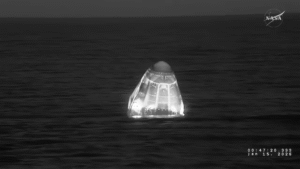
Crew-11 launched on August 1, 2025 and spent 167 days in space. Mission Commander Zena Cardman (NASA), Pilot Mike Fincke (NASA), and Mission Specialists Kimiya Yui (JAXA) and Oleg Platonov (Roscosmos) all appeared quite well as they were helped out of SpaceX’s Crew Dragon Endeavour onto SpaceX’s recovery ship SHANNON. All astronauts and cosmonauts are a bit unsteady as they begin to readapt to gravity after a long period of weightlessness.
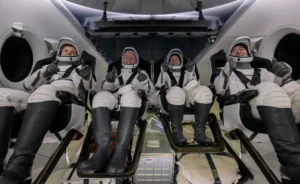
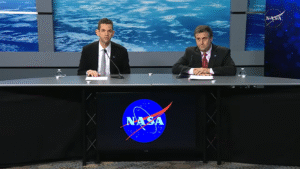
In this case, however, one of them is ill, which is why they returned earlier than planned, and instead of flying directly back to Houston, all four will go to a nearby hospital for additional medical checks. During a post-splashdown press conference, NASA Administrator Jared Isaacman and Deputy Associate Administrator for Space Operations Joel Montalbano said the crew will spend the night at the hospital before returning to Houston. They expect all four to be released together. [UPDATE: NASA said on January 16 at 4:46 pm ET that all four were now in Houston.)
That’s somewhat different from the procedure NASA used on Crew-8 in 2024 when a crew member apparently became sick during reentry or immediately after splashdown. As is the case now, NASA did not say who it was and all the crew members went to the hospital so the person’s identity would not become apparent, but three of the four soon returned to Houston while the fourth remained in the hospital overnight for observation. NASA said at the time they would reveal the details “in the fullness of time,” but no more information has been forthcoming yet.
Crew-11’s situation was first revealed a week ago when NASA announced that a spacewalk scheduled for January 8 by NASA astronauts Mike Fincke and Zena Cardman would be postponed due to a medical concern. For privacy reasons they didn’t say who, but soon thereafter said it would bring Crew-11 home early. They stressed it was not an “emergency,” but a “medical evacuation” so the astronaut’s condition could be properly evaluated and treated. JAXA said the ill astronaut is not Yui, but whether it is Cardman, Fincke or Platonov is publicly unknown.

Whatever it is, the medications and diagnostic tools aboard ISS are not sufficient to diagnose and treat the individual. During a January 8 news conference, NASA Chief Health and Medical Officer JD Polk acknowledged that many medical situations have arisen over the 25 years ISS has been permanently occupied that could be handled with onboard solutions, but not this time.
While this is the first time NASA has ended a space mission early due to illness, it is not the first time someone in space had to come home early for medical reasons. Russia has been operating space stations much longer than the United States and at least three Russian cosmonauts reportedly were brought home sooner than planned for medical reasons from the Salyut 5 space station in 1976, from Salyut 7 in 1985, and from Mir in 1987.
This was Cardman’s first spaceflight and she is no stranger to sudden changes. She was slated to command Crew-9 in 2024, but NASA’s decision to keep the two Starliner Crew Flight Test astronauts on the ISS instead of returning on Starliner meant she had to give up her seat along with NASA astronaut Stephanie Wilson so Starliner’s Butch Wilmore and Suni Williams could use them to return home.
She was reassigned to command Crew-11, with NASA astronaut Mike Fincke as pilot. Fincke had been in training for several years for the next Starliner flight, but with Boeing and NASA still working out problems with the propulsion system, he was reassigned to Crew-11. This was his fourth spaceflight, bringing his total time in space to 549 days.
JAXA’s Kimiya Yui now has 309 days in space over two spaceflights. Like Cardman, Roscosmos cosmonaut Oleg Platonov was on his first flight. They both accumulated 167 days in space, of which 165 were on the ISS.
Crew-11’s replacements on Crew-12 were scheduled to launch on February 15. NASA is trying to accelerate that by a few days. Usually a new crew is aboard before a returning crew departs to allow a few days of handover, but that wasn’t possible this time.
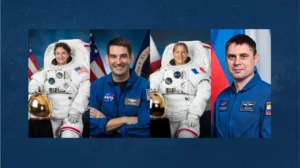
While waiting for Crew-12, the ISS will be operated by NASA astronaut Chris Williams and Russian cosmonauts Sergey Kud-Sverchkov and Sergei Mikaev, all of whom arrived on Russia’s Soyuz MS-28 in November.

The ISS regular crew complement since 2020 is seven, but it has been operated by as few as two (one American, one Russian) in the past.
The ISS is an international partnership among the United States, Russia, Japan, Canada, and 11 European countries operating through the European Space Agency. The Russian segment and the U.S. segment (including Japanese and European modules and Canada’s robotic Canadarm2) are interdependent, so at least one American and one Russian must be aboard at any time to operate the 420 Metric Ton facility. NASA and Roscosmos include a crew member from the other’s country on their spaceflights just for circumstances like this.
At the post-splashdown press conference, Isaacman stressed these are exactly the types of circumstances NASA trains for.
“While this was the first time we had to return a crew slightly ahead of schedule, NASA was ready. The team responded quickly and professionally as did the teams across the agency working closely with our commercial partners and executed a very safe return. This is exactly why we train, and this is NASA at its finest. … It’s why NASA prepares for the unexpected, so we are ready to respond decisively. And safely.” — NASA Administrator Jared Isaacman
He emphasizes that the crew was close to the end of its mission anyway, so this was an easy decision for him to make. They were scheduled to return on February 20.
Isaacman and other NASA officials make the distinction between this medical evacuation, which followed standard undocking and splashdown procedures, and an emergency deorbit that could have been done within hours. Weather is always a factor and while they had great conditions this morning, that might not always be the case. Montalbano said they “have the ability to land almost anywhere in the world” if necessary. NASA has “an agreement with the U.S. military to be there within 24 hours.” While not ideal if someone needed immediate medical attention, it would be an option.
This article was updated after the post-splashdown press conference.
User Comments
SpacePolicyOnline.com has the right (but not the obligation) to monitor the comments and to remove any materials it deems inappropriate. We do not post comments that include links to other websites since we have no control over that content nor can we verify the security of such links.