Artemis II Wet Dress Rehearsal As Early as January 31
NASA said this evening that the Wet Dress Rehearsal or WDR in advance of the launch of Artemis II is now planned for “as early as” Saturday, January 31. The WDR is a practice countdown including fully fueling the Space Launch System (SLS) rocket. Artemis II will send four astronauts around the Moon for the first time since the Apollo era. NASA will not decide on a launch date until after the WDR, but if everything goes perfectly, it could be as soon as February 6.
NASA rolled the SLS rocket with the Orion crew capsule and Launch Abort System on top out to Launch Complex-39B at Kennedy Space Center on January 17.

NASA said at the time they were targeting “no later than” February 2 for the WDR, so this fits within that timeframe. The WDR is intended to wring out any problems with the rocket or ground-support equipment so it wouldn’t be surprising if some were found, but if not, the next humans to fly around the Moon could lift off on February 6.
Weather is a factor for the WDR as well as launch. They cannot begin fueling (“tanking”) if the 24-hour average temperature is less than 41.4°F at two specific elevations on the rocket (132.5 feet and 257.5 feet). NASA noted today that lower than normal temperatures are expected in Florida tomorrow and technicians are taking steps to ensure environmental control systems are properly prepared. (Wednesday is the 40th anniversary of the Space Shuttle Challenger tragedy that killed seven astronauts because an O-ring on a Solid Rocket Booster failed due to unusually cold weather. SLS also has SRBs.)
The four astronauts — Reid Wiseman, Victor Glover, and Christina Koch from NASA and Jeremy Hansen from the Canadian Space Agency — entered a 14-day quarantine period on Friday at Johnson Space Center in Houston. That doesn’t imply NASA has settled on February 6 as a launch date, only that it’s a possibility: “Pending the outcome of the wet dress rehearsal or other operations considerations, the crew can come out of quarantine, and re-enter 14 days before any launch date.”

The crew will spend about one day in Earth orbit checking out Orion’s systems before setting off on a 9-day trip around the Moon. As a test flight, they will not try to orbit the Moon much less land, but will use a free-return trajectory around the Moon that will bring them back to Earth even if Orion’s propulsion system doesn’t perform as expected. The Earth and Moon must be correctly aligned for the trip, so they can launch only on certain days each month. NASA published a table showing what days are available in February, March, and April.
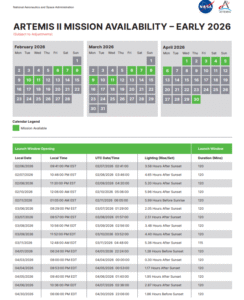
First, though, the WDR must be successful. Several WDRs over multiple months were needed for the uncrewed Artemis I test flight in 2022 and the rocket had to roll back to the Vehicle Assembly Building (VAB) twice for technical reasons plus another time due to a hurricane. In all, it was eight months between when Artemis I rolled to the pad the first time and when it actually launched. Charlie Blackwell-Thompson, Launch Director for both Artemis I and Artemis II, said during a January 16 press conference that they’ve incorporated many lessons learned into planning for Artemis II, but the agency is careful to remind everyone that they may need to roll back to the VAB this time, too.
This article has been updated.
User Comments
SpacePolicyOnline.com has the right (but not the obligation) to monitor the comments and to remove any materials it deems inappropriate. We do not post comments that include links to other websites since we have no control over that content nor can we verify the security of such links.