Category: Civil

ISS Crew Recreates Spacesuit Leak, Cause Still a Mystery

ISS Crew Recreates Spacesuit Leak, Cause Still a Mystery

Astronauts aboard the International Space Station (ISS) recreated the spacesuit leak that endangered European Space Agency astronaut Luca Parmitano last month, but the root cause of the leak remains undetermined.

As shown in a NASA video released as part of its Space Station Live recap today, water collecting in the helmet is clearly visible.  The suit was powered up — with no one in it — to see if the problem still exists.   It does.  Some of the spacesuit parts will be returned to Earth for further study since engineers have been unable to discover exactly what went wrong.  They know the leak came from the spacesuit’s cooling system, but that’s all.

Parmitano shared the chilling details of what he experienced on July 16 in a blog post last week.  About an hour into a planned 6.5 hour spacewalk, he began feeling water behind his head.  The amount grew and grew until eventually it surrounded his head, impairing his ability to see, hear and speak, and, almost, to breath.  The spacewalk was terminated and he returned to the airlock and was helped out of his suit by crewmates just in time.

Space Policy Events for the Weeks of August 26-September 6, 2013

Space Policy Events for the Weeks of August 26-September 6, 2013

Space policy events are not likely to interfere in back-to-school activities in the coming week — there is nothing on the schedule as of today (though that can always change).  The pace picks up a bit next week and will almost certainly resume with vigor the week of September 9 when Congress returns.

August 26-30 (Monday-Friday)

  • Not a thing at the moment

Tuesday, September 3

Wednesday-Friday, September 4-6

Thursday, September 5


Kennel: Decadal Surveys Still Important Despite Challenges

Kennel: Decadal Surveys Still Important Despite Challenges

Charles Kennel, chair of the National Research Council’s (NRC’s) Space Studies Board (SSB), believes that Decadal Surveys are still valuable strategy tools for the space and earth sciences communities despite the challenges of developing and implementing the most recent set.   Kennel’s views are summarized in a new report from the SSB on lessons learned from the Decadal Survey process.

The NRC conducts Decadal Surveys approximately every 10 years laying out priorities for several scientific disciplines for the next 10 years — hence the term “decadal.”   The SSB has led or co-led five Decadal Surveys published over the past several years:  Earth science and applications from space (2007), astronomy and astrophysics (2011), planetary exploration (2011), life and physical sciences in space (2011), and heliophysics (2012). 

NASA’s Science Mission Directorate (SMD) was the sponsor or co-sponsor of all those studies except life and physical sciences in space (which was sponsored by NASA’s former Exploration Systems Mission Directorate).  The four SMD studies were the subject of an SSB workshop last year assessing what improvements might be made when the next set of surveys is prepared.   A summary of the workshop was published today.   

NRC workshop summaries do not contain findings or recommendations, but this recounting of the 2-day workshop is rich with views of the scientists who were members of the Decadal Survey committees, NASA officials, and members of the international earth and space science communities.   Kennel’s concluding remarks lay out the highlights that he heard, or, as he says, did not hear.  Chief among them was that “Nobody said we shouldn’t have another decadal survey.”  

That being said, Kennel identified several key points that could be useful for future surveys.  Kennel’s observations as summarized in the report include the following:

  • Decadal Surveys necessarily take the length of time they do (about two years), but should not “be made complex or elaborate than it already is”;
  • the Statement of Task (SoT) for each study must be carefully negotiated between the NRC and the sponsor because the SoT defines the nature and scope of the study — Kennel paraphrased Steven Squyres, chair of the planetary science Decadal Survey, as saying “It’s the Statement of Task, stupid”;
  • more international and interagency collaboration before a Decadal Survey begins would be helpful, and while that is an area where NASA must lead, the NRC could encourage NASA to “bring about an enhanced level of collaboration”;
  • the language used to describe missions recommended in Decadal Surveys must be chosen carefully to accurately convey the level of detail (or lack thereof) that was available at the time the study took place and assessed by the survey committees using the Cost and Technical Evaluation (CATE) process;
  • the CATE process itself must be carefully described “because the CATE estimates are so probabilistic …. that including a description of the uncertainty in cost would better illustrate that the CATE numbers are notional at best, thus conveying cost and risk at the same time”;
  • future surveys could “explicitly assign a risk acceptance level” to the recommended missions especially since large missions may demand a higher risk management commitment than smaller missions.

The NRC has published Decadal Surveys in astronomy and astrophysics since 1964.   Surveys for the other space and earth science disciplines began early in this century.  Historically, they are referred to as “bibles” for NASA’s science program since they represent a consensus of the top experts in each of the scientific disciplines and NASA endeavors to execute the missions prioritized in the surveys.   At the beginning of each study, NASA provides an estimate of how much money will be available for new missions during the decade under study. The NRC survey committee sets its priorities based on scientific value and estimated mission cost and risk. 

For this recent round of surveys, however, the actual amount of money available to implement recommended missions is much less than NASA — and therefore the survey committees — expected.  The discrepancy is due either to cost overruns on existing programs that leaves less for new starts or to overall constraints on NASA’s budget.  Thus, the top priority missions recommended in several of the surveys cannot, in fact, be implemented in the near future, leading many in the space and earth science communities exasperated.    Individuals who serve on NRC committees are not compensated, yet they must take time away from their research and personal lives to volunteer for these intense efforts and some question whether it is worthwhile.  In Kennel’s view, the answer clearly is yes.

Orbital's COTS Demonstration Launch Slips to September 17

Orbital's COTS Demonstration Launch Slips to September 17

Orbital Sciences Corporation announced today that the test launch of its Antares rocket with a Cygnus spacecraft to the International Space Station (ISS) is now targeted for September 17 instead of September 15.

Orbital says on its website that the decision to wait two more days came after a planning and coordination meeting with NASA.   The launch time is 11:16 am Eastern Daylight Time with a 15 minute launch window.  Launch is from the Mid-Atlantic Regional Spaceport (MARS) at NASA’s Wallops Flight Facility, VA.

This is Orbital’s demonstration flight under NASA’s Commercial Orbital Transportation System (COTS) program wherein the government is facilitating two companies, Orbital and SpaceX, to develop systems to take cargo to the ISS.  SpaceX’s Falcon 9/Dragon system became operational last year.   Orbital was selected for the COTS program a year-and-a-half after SpaceX so its program is on a different schedule.

Speaking of the Moon–Stunning Photo of Blue Moon Over DC As LADEE Gets Ready to Launch

Speaking of the Moon–Stunning Photo of Blue Moon Over DC As LADEE Gets Ready to Launch

A day before NASA holds a pre-launch press briefing about its latest Moon probe, the Washington Post’s Capital Weather Gang (CWG) has posted a stunning photograph of the “Blue Moon” over the reflecting pool and the Washington Monument taken last night.  The Monument is looking resplendent these days surrounded by scaffolding that is lighted at night.  The photo was taken at the “Blue Hour.”  The CWG’s website offers an excellent explanation of the “blue” terminology.   

Photo Credit:  Washington Post/Kevin Ambrose

As we reported yesterday, the idea of sending humans back to the surface of the Moon got a boost with the release of the latest version of the Global Exploration Roadmap.

Although NASA stressed that it has no plans to send astronauts to the lunar surface regardless of what others may do, it is getting ready to launch another robotic probe to orbit the Moon — the Lunar Atmosphere and Dust Experiment Explorer (LADEE).  NASA will hold a press conference about the mission tomorrow (Thursday, August 22) at 3:00 pm Eastern Daylight Time (EDT).

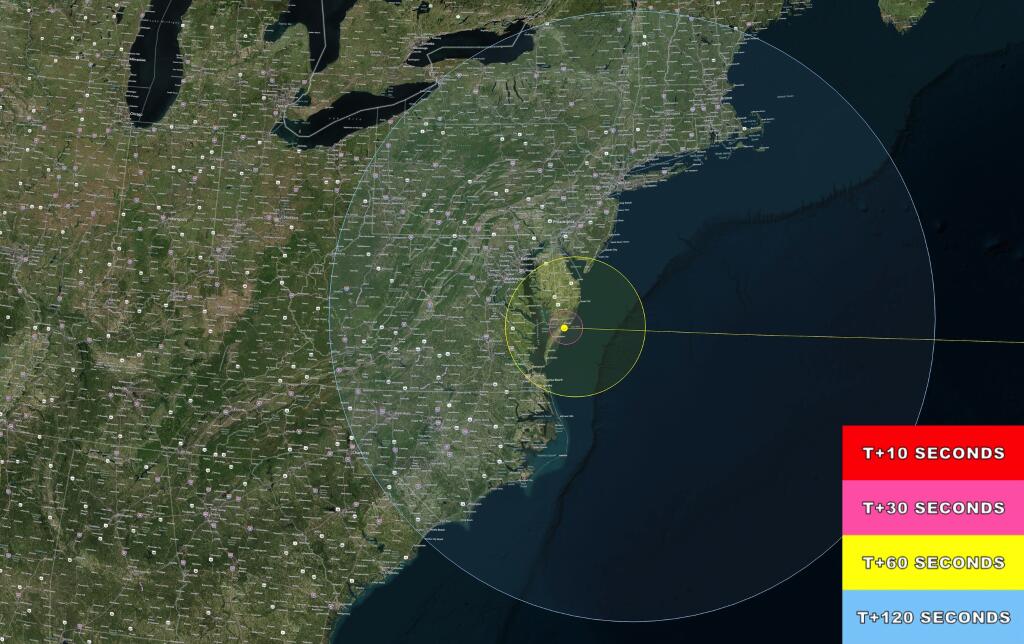
The launch itself is scheduled from Wallops Island, VA on September 6 just before midnight (11:27 pm) EDT.   The launch should be visible, weather permitting, from Washington, DC and elsewhere in mid-Atlantic area.   NASA’s Wallops Flight Facility (@NASA_Wallops) tweeted this map showing the potential visibility areas.

 Credit:  NASA Wallops Flight Facility tweet (@NASA_Wallops)  

Human Missions to Moon Get Boost in New Global Roadmap, But NASA Still a "No"

Human Missions to Moon Get Boost in New Global Roadmap, But NASA Still a "No"

NASA and 11 other space agencies released an updated Global Exploration Roadmap (GER) today that quite prominently includes human missions to the surface of the Moon as part of a steppingstone strategy to send people to Mars.  But in an op-ed also published today, NASA Administrator Charlie Bolden makes clear that NASA has no such plans.

Whether lunar surface missions are a prerequisite to, or a diversion from, the long-term goal of setting foot on Mars has been a topic of intense debate since the Obama Administration cancelled the Constellation program in 2010.  Its position was that Constellation was unaffordable and returning to the lunar surface unnecessary.  The GER report released today disagrees on the latter point.

“Human missions to the lunar surface will allow critical demonstrations of planetary exploration capabilities and techniques, while pursuing the highest priority lunar science objectives,” the report concludes.

Lunar surface missions are only one aspect of the roadmap, developed by the International Space Exploration Coordination Group (ISECG).  The International Space Station is highlighted as an “excellent platform” for activities in preparation for human exploration beyond low Earth orbit.  Robotic missions, advanced technology development, development of new space systems and infrastructure, analogue activities, and managing health and human performance risks are other elements of the roadmap.

ISEGC is a forum for discussion of space objectives and plans.  It comprises space agencies from Australia, Canada, China, France, Germany, India, Italy, Japan, Russia, South Korea, Ukraine, the United Kingdom and the United States, as well as the European Space Agency.   All but China and Australia are listed in the credits for this report.  ISEGC reports are non-binding.

Although NASA helped formulated the roadmap, the endorsement of human lunar surface missions does not signal a change of stance for the United States.

The report states that “[a]ll nations will not necessarily participate in every element of mission depicted in this roadmap.”  To emphasize that point, NASA Administrator Charlie Bolden wrote an op-ed for the Houston Chronicle, published today, in which he clarifies that the United States still has no plans to send humans to the lunar surface.

Reminding everyone that the United States is the only country that has already sent people to the Moon, not to mention many robotic spacecraft, Bolden says “as we plan for the wisest use of our limited resources, NASA chooses to do something new, as it always has.”   However, NASA supports “our commercial and international partners as they chart their own paths to the moon.”

The op-ed coincided with NASA introducing to the media its latest class of astronauts.   Bolden begins the op-ed by saying that the new astronauts will “carry America’s hopes, dreams and curiosity first to an asteroid and one day to Mars.”  Later he says the GER “demonstrates the important role of NASA’s asteroid mission in advancing capabilities for exploring Mars and the economic and societal values generated by exploration.” 

In 2007, ISECG released a Global Exploration Strategy.  In 2011, it published an initial version of this Global Exploration Roadmap.   Today’s iternation is an update that merges the two pathways to Mars discussed in the 2011 report — “Asteroid First” and “Moon First.”   The United States appears to be the only ISECG member interested in sending humans to asteroids, although today’s report does not preclude it.   Asteroids are one of many potential intemediate destinations outlined.   The key difference between today’s roadmap and U.S. plans is that it includes human missions to the lunar surface.

Luca Shares Chilling Details of Spacesuit Leak Ordeal – "Like a Goldfish in a Fishbowl"

Luca Shares Chilling Details of Spacesuit Leak Ordeal – "Like a Goldfish in a Fishbowl"

European Space Agency (ESA) astronaut Luca Parmitano shares chilling details of what transpired on July 16, 2013  when his spacesuit helmet filled with water during a spacewalk in a blog entry today.   ESA released a video to accompany it with an interview with Luca (as he is commonly called) and his spacewalk partner NASA astronaut Chris Cassidy.

In his riveting blog post, Luca begins by talking about the excitement of exiting the hatch and beginning the spacewalk — or extravehicular activity (EVA).  After completing some of the tasks, he senses water building up behind his head.   Cassidy comes to take a look and it becomes clear this is not just sweat or a leak from the water bottle inside the suit, but something worse.   Ground controllers decide to terminate the EVA and Luca heads back to the airlock while Cassidy must take a different route back because of the location of his tether.   As the amount of water inside Luca’s helmet increases, it sticks to the inside of his visor, limiting his sight, and covers his ears, hampering his ability to hear.   Just then, he must turn his body to avoid an obstacle.  This is what happens next:

“At that moment, as I turn ‘upside down’, two things happen: the Sun sets, and my ability to see — already compromised by the water — completely vanishes, making my eyes useless; but worse than that, the water covers my nose — a really awful sensation that I make worse by my vain attempts to move the water by shaking my head.  By now, the upper part of the helmet is full of water and I can’t be sure that the next time I breathe I will fill my lungs with air and not liquid.”

Fortunately, this story has a happy ending, but his account is compelling and underscores just how risky human spaceflight can be — and what the “right stuff” is.

The ESA video intersperses audio and video from the events that day with an interview with Luca, Cassidy and NASA astronaut Karen Nyberg (though she does not speak in the segment ESA released).   Cassidy shows the helmet and where the water accumulated.  

As Luca says, he experienced what it was like “to be a goldfish in a fishbowl from the point of view of the goldfish.”

NASA is still trying to determine exactly what went wrong.  It knows that the source of the liquid was the spacesuit’s cooling system, but has not found the root cause.


Nifty NOAA Video Highlights GOES-12's Decade of Service

Nifty NOAA Video Highlights GOES-12's Decade of Service

The dizzying images of swirling clouds in NOAA’s fast-paced video may make you wish you’d taken some Dramamine first, but it is a nifty salute to the GOES-12 weather satellite upon its retirement.

Geostationary Operational Environmental Satellite 12 (GOES-12) was launched in 2001 and served as the “GOES-East” satellite from April 2003-May 2010.   Thruster control issues then relegated it to a secondary status, but it continued to provide coverage of the Southern Hemisphere. 

NOAA created a video using one image from each day of the satellite’s life to show the weather patterns it observed over North and South America and the adjacent oceans during those years.  (NOAA says the satellite was in service for 3,788 days, but then says there are 3,641 images, so it is not quite exactly one for each day, but it’s close enough.)   Among the major weather events were Hurricane Katrina in 2005 and the crippling snowstorm — Snowmageddon — in 2009.

The decommissioning process involves boosting GOES-12 into a higher orbit, using up all its fuel, and disabling its batteries and transmitters.  That way it is out of the way of other geostationary satellites, is unlikely to explode and create space debris, and cannot inadvertently transmit signals that cause interference.

NOAA operates companion systems of weather satellites in polar orbit (circling over the North and South poles) and geostationary orbit (35,800 kilometers above the equator where they maintain a stationary position relative to a point on Earth).   Two geostationary satellites are operational at any one time positioned to observe weather over the Eastern (GOES-East) and Western (GOES-West) United States and adjacent waters.  At least one on-orbit spare also usually is available.  Currently, GOES-13 is in the GOES East position, GOES-15 is GOES-West, and GOES-14 is the on-orbit spare.   Troubles with GOES-13 during the past year caused NOAA to bring GOES-14 temporarily into service twice, but the problems were remedied and GOES-13 is operational now.

After 2010 when GOES-12 was providing data only on South America, NOAA called it “GOES-South,” the first to have that designation.

NOAA is building a new version of the satellites, the GOES-R series, with the first launch expected in 2015.   (The satellites are designated with letters before launch and redesignated with numbers once in orbit.  GOES-R is the first of the new series, which includes three additional satellites, S, T and U).  NOAA’s “fly-out” chart showing when the various GOES satellites are expected to be in service is shown below, current as of April 2013.

NOAA Fly-Out Schedule for GOES Weather Satellites, April 2013.   Source:  NOAA website.

Space Policy Events of Interest August 19-30, 2013

Space Policy Events of Interest August 19-30, 2013

The following space policy events may be of interest in the weeks ahead.  It’s a quiet time in the space policy world as many people squeeze in last minute vacations or get ready for school to resume.  Congress returns on September 9.

Tuesday, August 20

Thursday, August 22

Much at Stake for Proton, Antares as September 15 Nears

Much at Stake for Proton, Antares as September 15 Nears

Purely by coincidence, if all goes according to plan September 15 will be a big day for a venerable Russian rocket recovering from a recent spectacular failure as well as a new U.S. rocket that is powered by Russian engines. A lot is at stake for both.

International Launch Services (ILS), the U.S.-based company that markets commercial launches aboard Russia’s Proton rocket, has completed its review of the July failure that doomed three Russian GLONASS navigation satellites. ILS said that it concurred with findings by a Russian investigation board that the failure was the result of improper installation of three attitude control sensors and set September 15 as the date for its next launch. The payload is an SES satellite, Astra 2E.

The Proton failure on July 1 Eastern Daylight Time (July 2 local time at the launch site in Kazakhstan) was the latest in a string of Russian rocket failures that has exasperated Russian government and industry officials from the Prime Minister on down. This failure was especially embarrassing not only because the dramatic crash 17 seconds after launch was aired live on Russian television, but because it was due to worker error in what was considered a virtually foolproof installation task. The head of the Russian space agency, Vladimir Popovkin, was publicly reprimanded by Russian Prime Minister Dmitry Medvedev, but not fired, essentially for dereliction of duty in properly overseeing the Russian launch industry.  Popokvin’s predecessor, Anatoly Perminov, lost his job when this succession of various rocket failures began with the loss of another Proton rocket carrying GLONASS satellites in December 2010. GLONASS is Russia’s equivalent of the U.S. GPS system.

A successful Proton launch could help restore confidence in the Russian space launch industry. A failure would add to the gloom and potentially drive commercial customers to competitors like Ariane, Sea Launch, and SpaceX.

Quite separately, the U.S. company Orbital Sciences Corporation is targeting September 15 for the first launch of its new Antares rocket to the International Space Station (ISS). Antares will launch Orbital’s Cygnus cargo spacecraft to the ISS as part of NASA’s commercial cargo program. Orbital and SpaceX are the two companies competing in that program. SpaceX cargo flights to the ISS already are operational. Orbital is still in the demonstration phase. The September 15 launch will be only the second of its Antares rocket and the first for the Cygnus cargo spacecraft. (An Antares test launch earlier this year carried a Cygnus mass simulator.)

NASA is counting on Orbital to succeed with the Antares/Cygnus system to ensure adequate capability to resupply ISS crews. A failure would be a significant setback. NASA initiated the commercial cargo effort in 2006 after the George W. Bush Administration decided to terminate the space shuttle program once ISS construction was completed. The ISS was designed to be resupplied by the shuttle throughout its operational lifetime, so an alternative was needed. Commercial cargo is premised on the idea that NASA would provide partial funding for two companies to develop new cargo space transportation systems and guarantee to purchase a certain amount of services from those companies. Competition between the two companies presumably keeps prices in check. SpaceX completed its demonstration phase with the Falcon 9/Dragon system last year and has launched two operational missions since then. The next is scheduled for January 2014.

Antares is powered by Russian NK-33 rocket engines built more than four decades ago for the Soviet Union’s unsuccessful effort to send cosmonauts to the Moon.   The NK-33s were designed for the Soviet N-1 rocket that failed during its four test launches in the late 1960s and early 1970s.  No new engines have been built since then.  The engines are refurbished by Aerojet Rocketdyne and redesignated AJ-26.    Because there is a finite supply, a debate is underway about future engines for Antares pitting the NK-33s against another Russian engine, the RD-180, and Orbital against United Launch Alliance (ULA). ULA has an exclusive license with Russia’s RD Amross to use RD-180 engines for ULA’s Atlas 5 rocket, but Orbital wants to be able to consider them for Antares. The Federal Trade Commission is investigating whether the RD Amross-ULA agreement violates U.S. antitrust laws.  Meanwhile, Russia’s Kuznetsov Design Bureau, which built the NK-33s, is considering restarting the production line to ensure a continuing supply and making them more competitive with the RD-180s.