Category: Civil

Really Amazing Video of BOOM from Russian Meteor

Really Amazing Video of BOOM from Russian Meteor

Even if you think you’ve seen enough video of the meteor that exploded over the Russian city of Chelyabinsk, you ought to watch this.

This compilation of images from offices, schools and factories on YouTube makes you feel like you were there.  [With thanks to @B612foundation retweeting @stevesilberman.]

Space Leadership Preservation Act To Get Hearing Next Week

Space Leadership Preservation Act To Get Hearing Next Week

The Space Subcommittee of the House Science, Space and Technology Committee has scheduled a hearing next week on the Space Leadership Preservation Act, a bill introduced in the 112th Congress by Rep. John Culberson (R-TX) and Rep. Frank Wolf (R-VA) among others.

Then-full committee chairman Rep. Ralph Hall (R-TX) reportedly promised his colleagues he would hold a hearing on the legislation and the promise is being kept by his successor as chairman, Rep. Lamar Smith (R-TX).  The hearing is at 10:00 am on February 27 in 2318 Rayburn House Office Building.  Witnesses have not been announced.

When they introduced the bill last year, Culberson and Wolf said the intent of the bill is to depoliticize NASA by making the NASA Administrator a 10-year appointed position and creating a Board of Directors similar to the National Science Board that governs the National Science Foundation (NSF).  The NSF Director has a 6-year appointed term. The proposed new NASA board would, among other things, recommend candidates for the NASA Administrator, Deputy Administrator and Chief Financial Officer.

Mars Curiosity's Rock Drilling Reveals that Underneath It All the Red Planet is Grey

Mars Curiosity's Rock Drilling Reveals that Underneath It All the Red Planet is Grey

Mars may be the Red Planet, but results from the Mars Curiosity rover suggest that it’s all a veneer.  Underneath, grey may be the norm.

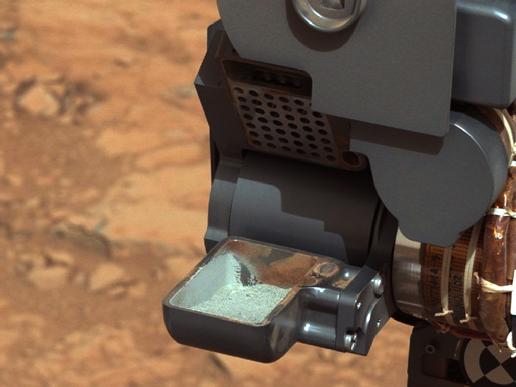
For the first time, a robotic drill has pieced a Martian rock and the sample extracted from the rock is grey.   At a media teleconference today, Joel Hurowitz, sampling system scientist at the Jet Propulsion Laboratory (JPL), said that the planet is red on the surface because of oxidized dust strewn across the planet by winds, but that underneath what they are finding is grey.

Curiosity is trying to determine if Mars was habitable — capable of supporting life — in the past and Curiosity project scientist John Grotzinger said from that perspective grey is better than red.  “Oxidation destroys organic compounds,” he explained, but, just to keep everything in perspective, he added that it is “still an accident of fate to preserve organics.”

The sample taken from the rock has not yet been analyzed by instruments on Curiosity.  The media teleconference today announced only that a sample was successfully obtained.  The photo below shows the dust extracted from the rock sitting in the rover’s scoop.

Image credit:  NASA/JPL-Caltech/MSSS

The next step is to put the sample through a sieve to make certain the particles are the right size to be analyzed by Curiosity’s Sample Analysis at Mars (SAM) and Chemistry and Mineralogy (CheMin) instruments.   The sieved particles will be transferred to SAM and CheMin in coming days after which more will be known about the sample’s composition.

Curiosity’s project team will move cautiously with the sieving process because of a problem that developed with the sieve on an Earth-based twin using for testing.   There are two test units on Earth and welds are popping along the side of the sieve where it attaches to the primary structure on one of them.  The other is fine.   Engineers do not know if the unit on Curiosity might have the same issue so will limit use of the sieve as much as possible.   Daniel Limonadi, lead systems engineer for Curiosity’s surface sampling and science system, was optimistic that the problem will not affect the rover’s scientific operations.

NASA Briefing on Curiosity's First Sample From Inside a Martian Rock

NASA Briefing on Curiosity's First Sample From Inside a Martian Rock

NASA will hold a media teleconference this afternoon, February 20, 2013, at 3:00 pm ET, to discuss the Mars Curiosity rover’s latest scientific activities.  Scientists confirmed this morning that Curiosity has collected the first-ever sample from inside a rock on Mars.

The teleconference will be streamed live at http://www.nasa.gov/newsaudio and http://www.ustream.tv/nasajpl.  Visuals will be available at http://go.nasa.gov/curiositytelecon


Sequester Brinksmanship Ratchets Up as DOD Notifies Congress of Furlough Plans

Sequester Brinksmanship Ratchets Up as DOD Notifies Congress of Furlough Plans

With the days ticking down to March 1, the Obama Administration is ratcheting up its rhetoric and actions to convey the implications of letting the across-the-board budget cuts known as a sequester go into effect.  The sequester would require $85 billion in government spending cuts in the current fiscal year, which ends on September 30.

Yesterday, President Obama made remarks at the White House warning of the consequences.  The litany of agencies and programs that would suffer under sequestration — including Border Control agents, emergency responders, air traffic controllers and so forth — has become all too familiar as congressional Republicans and congressional Democrats and the White House continue to battle against the Faustian bargain they made in August 2011.   Each side blames the other, but Congress passed and the President signed into law the Budget Control Act that created the sequester; they all agreed to it.

The sequester was the poison pill, an outcome so dire — the theory went — that Republicans and Democrats would be forced to find an alternative way to reduce the deficit.   They have not.   Instead, they postponed the deadline for when it would take effect from January 2 to March 1, and now the new deadline is fast approaching with no sign of either side relenting.  Republicans want to reduce the deficit only through spending cuts.  The Democrats want a combination of spending cuts and tax increases.

The stakes rose higher today as the Department of Defense (DOD) formally notified Congress that it would have to furlough all of its 800,000 civilian employees if the sequester takes effect.   Pentagon officials previously had warned that each civil servant could be furloughed for as many as 22 days through the end of the fiscal year, a roughly 20 percent decrease in their income.  President Obama exempted military personnel from the cuts.  Presidential appointees also are not affected, but Deputy Secretary of Defense Ashton Carter has said that he will give back that percentage of his salary in solidarity with his workforce.

The cutbacks in government spending would cascade through the contractor workforce causing more layoffs or terminations. 

Virginia’s Republican Governor, Bob McDonnell, sent a letter to President Obama and the Virginia congressional delegation yesterday urging them “to repeal this blunt and unnecessary instrument and embark on the shaping of a responsible legislative alternative to meet our nation’s fiscal crises.”  Northern Virginia is the location of many Pentagon offices and non-defense government agencies, as well as contractors.   Other parts of the state have significant defense installations, such as Naval Station Norfolk that is the Navy’s logistics hub for U.S. European Command, U.S. Central Command, and certain areas under U.S. Southern Command.  One of the members of Virginia’s congressional delegation is House Majority Leader Eric Cantor, second-in-command to House Speaker John Boehner (R-OH).  

Boehner published an op-ed in the Wall Street Journal yesterday blaming the budget crisis on the President and insisting that House Republicans already have twice passed legislation to reduce the deficit through additional cuts to non-defense spending instead of the sequester.  Democrats reject those cuts, however.

Viriginia would hardly be the only state affected.  Poliltico reports this morning that a number of Senators are trying to protect defense installations in their states.  Politico quotes Sen. Lindsey Graham (R-SC) as saying his fellow Senators’ attempts to protect their states is “like BRAC on steroids,” a reference to the Base Realignment and Closure (BRAC) process that led to the closing of many military installations around the country.

Some pundits are referring to the current situation as a game of political chicken with each side hoping voters will blame the other when the effects of the cuts are felt.

Daniels Replaces Perry as Co-Chair of NRC Human Spaceflight Study

Daniels Replaces Perry as Co-Chair of NRC Human Spaceflight Study

Former Indiana Governor Mitch Daniels has replaced Bill Perry as co-chair of the National Research Council’s (NRC’s) human spaceflight study.

Michael Moloney, director of the NRC’s Space Studies Board and its Aeronautics and Space Engineering Board said that Perry “made the difficult decision to step aside for personal reasons.”   A mathematician by training, Perry served as Secretary of Defense for four years under President Clinton after holding other senior defense positions, including Director of Defense Research and Engineering.  He is now at Stanford University.

Daniels is a lawyer, corporate executive, and politician.   After working for then-Senator Richard Lugar and later in the Reagan White House, he joined pharmaceutical firm Eli Lilly & Co. in 1990 and rose to become Senior Vice President of Corporate Strategy and Policy.   In 2001, he joined the George W. Bush administration as Director of the Office of Management and Budget (OMB).  Four years later he was elected Governor of Indiana and served two terms, which just ended last month.   Purdue picked him to be its new President last summer, but he just assumed the position in recent weeks after completing his gubernatorial term.

The NRC appointed co-chairs for this congressionally-requested study.   The other co-chair is Cornell space scientist Jonathan Lunine.  The committee held its first public meeting in December 2012 and its report is expected to be released in 2014.   The study was requested by Congress in the 2010 NASA Authorization Act.   The committee’s task is to describe the value proposition of the human spaceflight program and provide findings, rationale, prioritized recommendations and decision rules to enable and guide future U.S. human space exploration.  Its next meeting is scheduled for April 22-24 in Washington, D.C. 

The committee has a panel on Technical Feasibility which held its first meeting on Febuary 4-5.  That panel is chaired by John Sommerer, head of the space sector at Johns Hopkins University’s Applied Physics Lab, and he is also a member of the full committee.  The panel’s vice-chair is former NASA Associate Administrator for Exploration Systems Doug Cooke.  The panel has meetings scheduled for March 27-28, June 19-21, and October 15-16.

Meteorites Found, But Beware Offers to Sell

Meteorites Found, But Beware Offers to Sell

Divers may have come up empty handed from their search in icy Lake Cherbarkul for a large chunk of the meteor that exploded near the Ural Mountains on Friday, but a team of scientists reportedly found small remnants (meteorites) in the vicinity.    Offers to sell the meteorites are popping up already — but buyer beware.

On Saturday, Russian news sources like RIA Novosti reported that the divers did not find any signs of a large core of the meteor in the lake.  Witnesses had reported seeing the fireball go into the lake and a large hole was found in the ice covering it.  

Yesterday, however, RIA Novosti quoted a scientist at the Urals Federal University as confirming that “the particulate matters, found by our expedition in the area of Lake Cherbarkul indeed have meteorite nature.”  The scientist, Victor Grohovsky, said it was an ordinary stony chondrite meteor and about 10 percent iron.  Russia Today added that Grohovsky’s team was not allowed to inspect the crater that the meteor made in the lake, but they found several dozen meteorites around the hole.  The meteorites are between 0.5 and 1 centimeter in diameter, it continued, and “so far the researchers were able to confirm the samples’ celestial origin out of the 53 small particles sampled.”


Meteorite found in Russian lake, per Russia’s RIA Novosti, February 17, 2013

Offers to sell the meteorites reportedly are appearing on social media outlets and the Internet, with prices as high as $4,000.  Russian authorities are warning potential buyers not to be taken in.  They reportedly have created a task force that is working 24 hours a day to verify all online offers for sales of the meteorites.

Meanwhile, Russia’s Itar-Tass news service puts the final count of those who sought medical attention after the meteor exploded over the city of Chelyabinsk at 9:20 am local time on Friday at 1,158, including 289 children; 52 people were hospitalized.  Also, a “total of 4,715 buildings, including 3,700 apartment buildings, were damaged,” it reported.  The damage and injuries were caused by a shock wave created as the meteor descended through the atmosphere.   Most injuries were from flying glass from broken windows.

Space Policy Events for the Week of February 18-22, 2013

Space Policy Events for the Week of February 18-22, 2013

The following events may be of interest in the week ahead.  The House and Senate are in recess this week for the President’s Day holiday.

During the Week

Perhaps the most interesting aspect of the coming week is what is NOT happening.   Congress is in recess rather than trying to solve the issue of whether the sequester will go into effect on March 1 or not.   Nothing seems to have changed on that front.  Both parties and both ends of Pennsylvania Avenue warn about the dire consequences if it goes into effect, assert they they have a reasonable alternative plan, and then put forward the same plans that have failed to garner sufficient support in the past.  Republicans continue to insist on reducing the deficit by spending cuts alone while Democrats continue to insist on a combination of spending cuts and tax increases.  The most recent plan, by Senate Democrats, would cut $110 billion from the deficit — $55 billion through spending cuts, $55 billion through tax increases on the wealthiest taxpayers — through the beginning of 2014.

Last week a number of hearings were held spelling out the effects of the sequester on defense and non-defense agencies.   The Senate Appropriations Committee published a series of letters from a large number of agencies (including NASA, NOAA’s parent Department of Commerce, and the Department of Defense) while the Democrats on the House Appropriations Committee circulated their own analysis.  There is no good news in any of it, but no solution is evident and the betting inside the beltway is that the $85 billion in cuts for FY2013 alone will, in fact, take place.  Those cuts would have to be absorbed by September 30 of this year making them particularly difficult.

Very little is ever certain in Washington, however, and perhaps with the week’s break, an alternative plan that can win support from all parties will yet emerge.

At the same time, Senate Republicans successfully blocked the nomination of Chuck Hagel to be the new Secretary of Defense last week through a procedural move that prevented the nomination from being brought to the Senate floor for consideration.  The Senate will return to the issue next week.  After a week’s delay, it may be that a sufficient number of Republicans will join with Democrats in allowing the nomination to be considered on an up or down vote wherein he would need only 51 votes (instead of 60) to win.   With 53 Democrats and two Independents who usually vote with the Democrats, he is very likely to win that vote. 

Meanwhile, this week — while Congress hopefully is working behind the scenes instead of in front of the cameras — there are four space policy-related meetings that may be of interest.

Tuesday, February 19

 Wednesday, February 20

Russians Still Searching for Meteorite Fragments, Scientists Raise Estimates of Size, Mass and Energy Release

Russians Still Searching for Meteorite Fragments, Scientists Raise Estimates of Size, Mass and Energy Release

Russian authorities continue to search for fragments from the meteor that exploded over the Russian city of Chelyabinsk yesterday, but with no luck so far.  In the meantime, scientists at the Jet Propulsion Laboratory (JPL) are revising upwards their estimates of the meteor’s size, mass and energy release based on additional data.

Witnesses believe that part of the meteor landed in Lake Cherbarkul, but divers found no trace of it today according to Russia’s RIA Novosti.   Russian media reports vary on the number of people injured by the effects of the shock wave created as the meteor streaked across the sky at about 9:20 am local time yesterday.   Most agree that it was between 1,000 and 1,200, mostly injured by broken glass.  Many residents apparently ran to windows to see what was happening as the meteor streaked by.   The New York Times quoted a woman as describing the light as “unreal” and “a light which never happens in life; it happens only in the end of the world.”

The shock wave came next and since many people were standing next to windows, breaking glass caused a host of injuries. 

Meanwhile, JPL scientists now believe it was 17 meters instead of 15 meters in diameter, had a mass of 10,000 tons rather than 7,000 tons, and released 500 kilotons of energy instead of 300 kilotons.   The earlier data, reported in a media teleconference yesterday, was based on data from four Infrasound stations that are part of a global network of sensors that monitors compliance with the Comprehensive Nuclear Test Ban Treaty.  Data from five more stations are now available, allowing the refined estimates.

Blast from Russian Meteor Similar to Nuclear Explosion

Blast from Russian Meteor Similar to Nuclear Explosion

The atmospheric blast from the meteor that struck near the Russian city of Chelyabinsk this morning released 300 kilotons of energy, similar to a nuclear explosion according to a NASA expert.   The resulting shock wave broke windows and collapsed walls, injuring more than 1,000 people.

Bill Cooke of NASA’s Marshall Space Flight Center said in a media teleconference this afternoon that the force of the blast was determined by measurements from a global network of sensor arrays called Infrasound.  The Infrasound system of 60 sensor arrays around the world was designed to detect nuclear explosions as part of monitoring compliance with the Comprehensive Nuclear Test Ban Treaty.  He said NASA used data from four of the sensor stations to determine the amount of energy released by the blast.  He expects other sensor arrays also picked it up, but did not know how many.

Videos of the meteor taken by cell phone and dashboard cameras by many of those who witnessed the event are posted on the Internet and tell more of the meteor’s story, according to Cooke and Paul Chodas of the Jet Propulsion Laboratory (JPL).  

Asteroids are rocks in space. Those that enter Earth’s atmosphere are called meteors and if they reach the ground they are meteorites.

This meteor is estimated to have been 15 meters in diameter with a mass of 7,000 metric tons and travelling at 18 kilometers per second (40,000 miles per hour).   It penetrated the atmosphere at an angle of 20 degrees and streaked through the sky for 30 seconds before breaking apart 20-25 kilometers (12-15 miles) above the surface of Earth. 

Chodas said this was a “tiny” asteroid and could not have been detected in advance not only because of its size, but because it came from the daylight side of Earth.  Using Earth-based telescopes, asteroids can only be detected against the black background of space — at night.  Asteroids the size of this one reach the surface about once every 100 years, he said.  Cooke said the Earth actually intercepts 80 tons of meteoritic material every day, with “millions of millimeter size meteors striking Earth per day.”   Chodas added that meteors the size of basketballs hit Earth every day on average, while those the size of a car hit every month or two.

The fact that an asteroid hit Russia on the same day as asteroid 2012 DA14 made a close pass of Earth was a rare coincidence, Chodas said, but the two were not related to each other.   Asteroid 2012 DA14 travels in an Earth-like orbit, while the asteroid that hit Russia came from the asteroid belt.   The Russian meteor came from the opposite direction and its velocity was “much, much greater” than DA14, he stressed.  No verified fragments from the meteor have been located so far, but Cooke expects that it was a common stony asteroid, not one made of iron.

Rep. Lamar Smith (R-TX), chairman of the House Science, Space and Technology Committee, issued a press release saying the two events today “are a stark reminder of the need to invest in space science,” and promised to hold a hearing on ways to “better identify and address asteroids that pose a potential threat to Earth.”  A date for the hearing was not announced, only that it will be “in the coming weeks.”

Correction:  An earlier version of this article incorrectly stated that the energy released was 300 megatons, rather than 300 kilotons, of energy.