Duffy: “I’ll Be Damned” If U.S. Doesn’t Beat China Back to the Moon
Reacting to comments at yesterday’s Senate hearing on the space race with China, acting NASA Administrator Sean Duffy forcefully exclaimed today that he fully expects the United States to get astronauts back on the Moon before China gets there. Amit Kshatriya, Duffy’s choice to be the top civil servant at the agency, will ensure that happens. Duffy also said he will remain as acting Administrator for the “foreseeable future” and is not wasting any time while waiting for a permanent administrator to arrive.

During a “town hall” meeting today where questions were submitted in advance, Duffy thanked Kshatriya for taking on the assignment as Associate Administrator. He succeeds Vanessa Wyche who was acting AA and is returning to her position as Director of Johnson Space Center (JSC).
At yesterday’s Senate Commerce Committee hearing, former NASA Administrator Jim Bridenstine, who led the agency during most of President Trump’s first term, cast doubt on whether SpaceX’s Starship Human Landing System will be ready in time for astronauts to get back to the Moon before Chinese taikonauts get there. Listing all the milestones Starship has yet to demonstrate, Bridenstine said “it is highly unlikely that we will land on the Moon before China.” SpaceX is testing Starship right now, but it has not reached Earth orbit, demonstrated in-orbit cryogenic propellant transfer, or obtained human-rating. China says it will put taikonauts on the Moon by 2030.
Bridenstine’s comments clearly struck a nerve. Duffy didn’t mention him by name, but made it clear he thoroughly disagrees.
“Maybe I’m competitive. I was angry about it because — I don’t want to use inappropriate language — but I can tell you what, I’ll be damned if that is the story that we write.
“We are going to beat the Chinese to the Moon. We are going to make sure that we do this safely. We’re going to do it fast. We’re going to do it right.” — Sean Duffy
Safety is a painful topic at NASA after the Apollo 1, Space Shuttle Challenger, and Space Shuttle Columbia tragedies that killed seventeen astronauts. After saying NASA will “do this safely,” however, he added that sometimes safety can be “the enemy of making progress.”
“We are safety driven and we should be safety driven … but sometimes we can let safety be the enemy of making progress. We have to be able to … take some leaps. We have to be able to jump forward in our innovation and drive this mission. And there’s always a balance to that, but we can’t side on the side of doing nothing because we’re afraid of any risk. We have to be able to push forward.” — Sean Duffy
As for the budget, which the Trump Administration wants to cut from $24.8 billion to $18.8 billion, Duffy said he thinks that’s enough since space exploration gets more money even if everything else is less. “At this point, I think we have enough money to accomplish our mission,” but if that’s not the case “I guarantee you 100% I will go to the President, I will go to OMB, I’ll go to the House, I’ll go to the Senate” and ask for more.
Kshatriya now has to make it happen. He’s been at NASA since 2003, spending many of those years at JSC working with the International Space Station (ISS) program including serving as an ISS flight director. He was deputy and then acting manager of the ISS Vehicle Office at JSC before moving to the Exploration Systems Development Mission Directorate (ESDMD) at NASA Headquarters in 2021. After Congress directed NASA to create a Moon-to-Mars program office to better coordinate all the different pieces of the mission, Kshatriya was made Deputy Associate Administrator of ESDMD for the Moon-to-Mars Program.
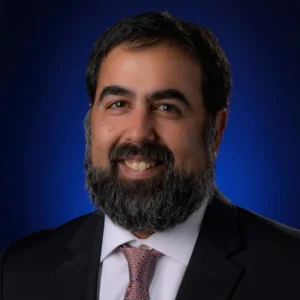
Moon-to-Mars is now the defining mission of the agency and Kshatriya is in charge in his much higher-level position as the agency’s Associate Administrator.
Duffy is dual-hatted as acting NASA Administrator and Secretary of Transportation, so is not there full time. He said today he’ll be there for the “foreseeable future” and whether he is there one day, one month or one year, he is not waiting to act. “We are under a time crunch and I am not going to waste time” until a permanent administrator is in place. President Trump withdrew his nomination of Jared Isaacman to be NASA Administrator after a falling out with Elon Musk, who recommended Isaacman. A replacement has not been named.
The agency does not have a Deputy Administrator either. Chief of Staff Brian Hughes headed the Florida arm of President Trump’s 2024 campaign and has a long history in Florida politics, but not space.
Kshatriya was upbeat about the task ahead, but called it “humbling.” Right now he wants to get the right people in the right places.
“We have a lot of discussions about processes and organizations and how we do things at the agency and making sure that we make those things right. And I’ll tell you right now that I don’t think that’s as important as making sure we have the right people in the right places.
“People are the ones that win. Organizations don’t win. People win. And what the Secretary [Duffy] is asking to do is to make sure that we find the best people to lead this agency.” — Amit Kshatriya
Winning is on Duffy’s mind, too.
“We are not going to let this storied history of NASA be written that we lost the second space race. No, we’re going to win it.” — Sean Duffy
NASA is getting ready to fly Artemis II next spring, a crewed flight test around the Moon. The four-person American-Canadian crew will not try to orbit the Moon, much less land, but will fly a free-return trajectory that will take them beyond the Moon and back to Earth even if the Orion propulsion system doesn’t perform as planned.

Artemis III is the mission that will put astronauts back on the lunar surface. No one can beat America to the Moon — we did that six times between 1969 and 1972 — but getting back before China does it next is the goal. Right now that mission is planned for mid-2027.
What happens after that is unclear. The White House and Congress are at odds. The White House wants to terminate NASA’s Space Launch System (SLS) rocket and Orion spacecraft and replace them with less expensive commercial alternatives. Congress, however, pointed out there are no commercial alternatives today and included $4.1 billion in the reconciliation bill to keep SLS/Orion through Artemis V. The White House also wants to eliminate the international Gateway lunar space station, but Congress included full funding for it in that bill, which Trump signed into law on July 4.
Duffy shed no new light on the path forward today. The only post-Artemis III mission he talks about is putting a nuclear fission reactor on the Moon in 2030, not when astronauts will be there to use it. His only comment today was that the $4 billion cost per launch of SLS — a 2022 estimate from NASA’s Office of Inspector General — is too much and NASA must work with its partners to “figure out a way that we can do more missions with the same amount of dollars.”
The town hall was not open to the public, but a recording was posted by NASAWatch.
This article has been updated.
User Comments
SpacePolicyOnline.com has the right (but not the obligation) to monitor the comments and to remove any materials it deems inappropriate. We do not post comments that include links to other websites since we have no control over that content nor can we verify the security of such links.