NASA Awards Initial Moon Base Rover and Lander Contracts
Pressing forward with plans to build a Moon Base as part of the Artemis program, today NASA announced awards of several service contracts to build and/or deliver landers and rovers to the Moon by 2028 as well as a “MoonFall” set of drones. The awards continue NASA’s recent practice of awarding firm fixed-price contracts where the companies design, build and launch spacecraft and NASA buys services from them.
NASA’s “Ignition” event on March 24 telegraphed that the agency is ramping up efforts to return American astronauts to the Moon and begin establishing a Moon Base for sustained operations. The accelerated pace was in evidence today with announcements of several contract awards with deliveries due no later than 2028. That’s NASA’s current target date to get astronauts back on the lunar surface for the first time since 1972.
Ignition laid out a 10-year plan in three phases. Everything announced today is in Phase 1. The three “Moon Base” landers are expected to launch this year, and the two Lunar Terrain Vehicles (LTVs) and MoonFall in 2028.
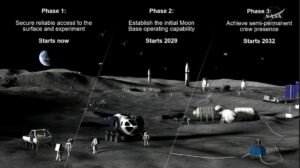
At NASA Headquarters today, the major focus was the announcement of the first Moon Base landers and/or rovers from Blue Origin, Astrobotic and Intuitive Machines; contract awards to Astrolab and Lunar Outpost for LTVs that can operate with or without astronauts, with Blue Origin delivering them to the Moon; and to Firefly Aerospace to deliver JPL’s MoonFall drones. But two other aspects are also interesting: NASA is referring to each robotic lander as a Moon Base rather than the more traditional concept of a “base” involving infrastructure and astronauts who are present at least part of the time, and NASA described a “perimeter” that will be established by the MoonFall drones.
Moon Base 1 is the first flight of Blue Origin’s cargo-only Mark I (MK1) lander already planned for launch in 2026. NASA Administrator Jared Isaacman pointed out it will be “the first privately funded lunar lander mission in history.” Named Endurance, it will land at Shackleton Crater near the Moon’s South Pole carrying two NASA payloads through the agency’s existing Commercial Lunar Payload Services (CLPS) program. The CLPS program began in 2018 to incentivize companies to design, build and launch lunar landers themselves, with NASA buying services to deliver NASA payloads. The companies are expected to find non-NASA customers to close the business case. Blue Origin’s MK1 is a precursor to the crewed MK2 lander that it will use to put astronauts on the surface under a different NASA contract awarded in 2023.
Moon Base 2 is Astrobotic’s Griffin lander. Astrobotic’s first CLPS mission on the Peregrine lander didn’t reach the Moon after its January 2024 launch. Before that, in 2020, NASA had awarded a contract to Astrobotic to deliver a very important and expensive agency rover, VIPER, using Astrobotic’s larger Griffin lander. In July 2024, following Peregrine’s failure and associated delays affecting Griffin, NASA concluded Astrobotic couldn’t deliver VIPER to the Moon. Instead of cancelling the $323 million contract with Astrobotic, however, it cancelled the VIPER mission even though the rover by then already was built and going through final pre-launch testing. NASA told Congress it kept the Astrobotic contract because Griffin eventually would launch and benefit the agency. Astrobotic found other customers for Griffin, including Astrolab’s FLIP rover, so this mission will have both a lander (Griffin) and a rover (FLIP). The launch was planned for 2025, but slipped to July 2026. NASA reportedly has a lunar retroreflector array on Griffin, as it does on most of the landers. (NASA changed its mind about cancelling VIPER. It’s now expected to launch on Blue Origin’s second MK1 mission next year.)
Moon Base 3 is an Intuitive Machines mission delivering NASA’s Lunar Vertex experiment to study lunar swirls, the first payload selected through NASA’s Payloads and Research Investigation on the Surface of the Moon (PRISM) program. This mission, Trinity or IM-3, will also carry payloads from the European Space Agency and the Korea Astronomy and Space Science Institute. Intuitive Machines launched missions to the Moon in 2024 (Odysseus) and 2025 (Athena) that were partial successes. They landed, but tipped over, so not all objectives were met. IM-3 originally was planned for landing in 2024.
NASA awarded a fourth CLPS mission to Intuitive Machines in 2024 and a fifth in March. More CLPS missions are coming. Isaacman wants 10 CLPS missions a year for three years starting in 2027. Moon Base Program Manager Carlos Garcia-Galán said more CLPS-1 missions will be announced in June and companies can make proposals for next-generation landers through the CLPS-2 solicitation until the end of June.
In an emailed statement this evening, Sen. Maria Cantwell (D-Washington) Ranking Member of the Senate Commerce, Science, and Transportation Committee, praised the selections. Blue Origin is headquartered in her State.
“Today’s announcement is another major step forward for America’s return to the Moon and highlights the strength of Washington state’s commercial space sector. NASA is moving quickly to build the infrastructure needed for sustained lunar operations, and these investments will help create high-skilled jobs and drive innovation here at home as the Artemis program advances toward a long-term human presence on the lunar surface.” — Sen. Maria Cantwell
The selection of Astrolab and Lunar Outpost to develop Lunar Terrain Vehicles (LTVs) follows NASA’s 2024 decision to open a competition to build vehicles that can roam across the lunar surface either autonomously or driven by astronauts. The vehicles are somewhat reminiscent of those used by the last three Apollo crews and aren’t pressurized. The astronauts will need to wear spacesuits and the duration of the trips will be limited. (Separately, Japan is developing a pressurized rover in partnership with NASA where they will be able to doff their spacesuits and remain in the vehicle for extended periods of time.)
Astrolab, Lunar Outpost and Intuitive Machines competed for what NASA said at the time would be one award, but Isaacman said today building one exquisite LTV does nothing to stimulate a lunar economy. He wants multiples of just about everything that can be produced faster. The two LTVs chosen today are just the first and they are expected to be on the Moon waiting for the Artemis IV crew. Astrolab’s FLEX and Lunar Outpost’s Pegasus will be able to travel up to 10 kilometers (6 miles) an hour and handle slopes of up to 20 degrees, traversing as many as 200 kilometers (124 miles).
Astrolab is teamed with Axiom Space, Interlune and Odyssey Space Research. Lunar Outpost is partnering with General Motors, Goodyear Tire & Rubber, and Leidos. Astrolab’s contract is for $219 million and Lunar Outpost’s for $220 million.
In addition, NASA selected Blue Origin to deliver the two LTVs to the Moon. NASA’s press release says the contract is for $188 million with an option period worth $280.4 million for two task orders.
Another announcement today is that the Jet Propulsion Laboratory (JPL) selected Firefly Aerospace to deliver the three or four MoonFall drones to the Moon. Firefly’s press release says four, but Garcia-Galán said a decision on the exact number hasn’t been made yet. That contract value, $75 million, does not include launch. JPL will acquire that separately. Firefly flew the fully successful Blue Ghost Mission-1 (BGM-1) lander to the Moon last year.
JPL’s MoonFall drones will be attached to Firefly’s Elytra Dark spacecraft during the trip to the Moon and as descent begins, but separate from it 50 kilometers (31 miles) above the lunar surface. They’ll land separately, about 1.6 kilometers (1 mile) apart, and make multiple flights during one lunar day — 14 Earth days. When the 14-day lunar night arrives, the fuel will freeze and additional flights will no longer be possible, but the drones will be able to wake up and communicate with Earth when daytime returns.
Powered flight on another celestial body was first achieved on Mars with NASA’s Ingenuity helicopter, designed and built by JPL. Expected to make five flights at most, Ingenuity made 72 between 2021 and 2024, paving the way for MoonFall as well as the Mars Skyfall mission planned for 2028 as part of the SR-1 Freedom demonstration.
An interesting aspect of the MoonFall mission is that after their flights are over, NASA plans to park each of them on corners of an area it’s calling a “perimeter.”

Isaacman was asked if NASA is essentially creating a “safety zone” meant only for Artemis Accords signatories, but didn’t fully answer the question. The Artemis Accords principles have a number of references to safety zones.
I think the idea that there are areas of great interest on the lunar surface, we do want to get there and explore them, and we also obviously want to be very mindful of the Outer Space Treaty, so that we are respectful of other nations that are putting assets on the lunar surface, we would expect that to be reciprocal, but I think that’s just one objective of many that the MoonFall drones intend to accomplish. — Jared Isaacman
The 1967 Outer Space Treaty addresses use of the Moon and other celestial bodies. Article I, for example, states that “Outer space, including the moon and other celestial bodies, shall be free for exploration and use by all States without discrimination of any kind and in accordance with international law, and there shall be free access to all areas of celestial bodies.” Article II adds that “Outer space, including the moon and other celestial bodies, is not subject to national appropriation by claim of sovereignty, by means of use or occupation, or by any other means.” The U.S.-led Artemis Accords, which now have 67 signatories, “acknowledge and reaffirm their commitment to the Outer Space Treaty,” but also establish a mechanism for “deconfliction of space activities” to avoid harmful interference.
User Comments
SpacePolicyOnline.com has the right (but not the obligation) to monitor the comments and to remove any materials it deems inappropriate. We do not post comments that include links to other websites since we have no control over that content nor can we verify the security of such links.