NASA DECIDES TO BRING CREW-11 HOME EARLY, BUT NOT AN EMERGENCY
NASA Administrator Jared Isaacman has decided to bring Crew-11 home early because of a medical concern affecting one of the crew members. NASA is not revealing who it is to protect their privacy, but stresses this is not an emergency, only a prudent step so the person can get proper diagnosis and treatment. Crew-11 is close to the end of its mission in any case and NASA is evaluating whether Crew-12 can launch earlier than currently planned.
The first sign of a problem came just after 5:00 pm ET yesterday afternoon when NASA said a spacewalk scheduled for today would be postponed because of a “medical concern with a crew member.” A few hours later, just after midnight today, they expanded that to say they were considering bringing Crew-11 home early. Crew-11 launched on August 1 with Commander Zena Cardman (NASA), Pilot Mike Fincke (NASA), and Mission Specialists Kimiya Yui (JAXA) and Oleg Platonov (Roscosmos). Cardman and Fincke were assigned to the spacewalk, but that doesn’t mean either is the person with the medical condition.

Isaacman, who was just sworn in on December 18, opened a press conference at NASA Headquarters at 5:00 pm ET this afternoon by saying astronaut safety is always paramount.
“For over 60 years, NASA has set the standard for safety and security of a crewed spaceflight. In these endeavors, including the 25 years of continuous human presence on board the International Space Station, the health and well being of our astronauts is always and will be our highest priority. Yesterday, January 7, a single crew member on board the station experienced a medical situation that is now stable. After discussions with Chief Health and Medical Officer Dr. JD Polk and leadership across the agency, I’ve come to the decision that it’s in the best interest of our astronauts to return Crew-11 ahead of their planned departure.” — Jared Isaacman
NASA plans to provide more information in about 48 hours as to the timing of their return after taking weather and other factors into account.
Isaacman, NASA Associate Administrator Amit Kshatriya, and NASA Chief Health and Medical Officer James “JD” Polk repeatedly emphasized the astronaut’s condition is stable and this is not an emergency deorbit. That can be done in hours. Instead, this is a “controlled medical evacuation” using standard procedures for departure, reentry, splashdown and recovery.
It’s a first for NASA and rare throughout the history of the Space Age, but not unprecedented. In November 1985 after about two months in space, Soviet Salyut 7 Commander Vladimir Vasyutin became seriously ill and returned to Earth early with his crewmates. One of them, Viktor Savinykh, wrote a diary that was later released detailing the difficult situation. As with NASA, the Soviets declined to identify the problem for privacy reasons, but is generally thought to have been a prostate infection. Anatoly Zak of RussianSpaceWeb.com tells SpacePolicyOnline.com he’s aware of two others, but acknowledges details are scarce. One involved cosmonaut Vitaly Zholobov on Salyut 5 in 1976, and in 1987 Aleksandr Laveikin returned early from a mission to the Mir space station due to a heart problem.

Getting ill in space is not uncommon, just the need to return to Earth for diagnosis and treatment. Polk pointed out they’ve had a “host of things that we’ve treated on orbit” and the necessary equipment and medications were on board, from toothaches to ear pain.
This time is different, though. They wouldn’t say anything about what is wrong with the astronaut other than it was not related to the spacewalk preparations. Today’s spacewalk and another planned for next week will have to wait for another crew to perform them.
NASA is evaluating whether Crew-12 can launch sooner, but they don’t seem concerned about a period of time when only one NASA astronaut is aboard. Chris Williams is part of the Soyuz MS-28 crew and will remain there to operate the U.S. segment. NASA and Roscosmos include a crew member from each other’s country on every launch exactly for this type of situation. The U.S. and Russian segments are interdependent so at least one person from each country must be aboard to operate it. ISS has been continually occupied for more than 25 years and there have been times — like after the 2003 space shuttle Columbia tragedy — when as few as one Russian and one American were aboard.
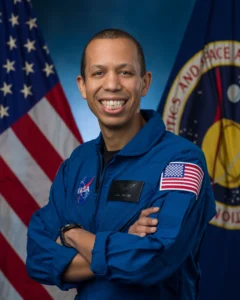
The ISS was smaller back then, but Kshatriya doesn’t foresee any problems with Williams holding the fort until Crew-12 arrives.
“Chris is trained to do every task that we would ask him to do. Of course we also do a lot of operations of the vehicle from our various control centers all over the world, including commercial control centers that operate a lot of our research payloads. So you will have thousands of people looking over his shoulder, like our crews do all the time.” — Amit Kshatriya
Williams’ two Russian colleagues, Sergey Kud-Sverchkov and Sergey Mikaev, also can help out. They trained together for years and “they’re a great team” who “work really well together.”
Crew-12 was targeting launch in mid-February and NASA is assessing whether that date can be moved up. Asked if a change in the Crew-12 launch date could affect the Artemis II mission to the Moon that could launch as early as February 6, Isaacman flatly said no. The two are “totally separate campaigns.”
Artemis missions to the Moon are intended to lead to a sustained presence there and eventual human missions to Mars. Medical concerns will have to be dealt with in all those expeditions and the astronauts will be much further from home. In that respect, this could be viewed as a valuable learning opportunity. Asked whether AI might help in the future as a diagnostic tool, Polk was enthusiastic.
“We’re looking at all potential technologies, including AI, to augment the crew’s health and safety especially as we get to the Moon and Mars. And that will be the advantage [of] the Moon … to use it as a test bed for many of these technologies on our way to Mars.” — JD Polk
This article has been updated.
User Comments
SpacePolicyOnline.com has the right (but not the obligation) to monitor the comments and to remove any materials it deems inappropriate. We do not post comments that include links to other websites since we have no control over that content nor can we verify the security of such links.