NASA Now Targeting April 1 for Artemis II’s Launch Around The Moon
NASA announced today they are targeting April 1 at 6:24 pm Eastern Daylight Time for sending the Artemis II crew around the Moon. In preparation, their Space Launch System rocket and Orion spacecraft will roll back out to the launch pad from the Vehicle Assembly Building on March 19. The launch date is somewhat tentative pending close-out of a few remaining tasks in the VAB, but following a Flight Readiness Review officials sounded confident. Artemis II will not land on the Moon, but the four crew members will be the first humans to reach that distance since the Apollo era.
Lori Glaze, NASA Associate Administrator for the Exploration Systems Development Mission Directorate that oversees the Artemis program, told reporters they’ve added April 2 as a possible launch date, making six other potential days in April if something delays the launch on April 1. The Earth and Moon must be properly aligned for spacecraft to travel back and forth. Opportunities are available every month, but Glaze declined to say what they are beyond April. She wants to keep the focus on next month.

This morning the agency completed a day-and-a-half Flight Readiness Review to assess the status of the rocket, spacecraft, and launch team. SLS and Orion were rolled back to the VAB two weeks ago following the second of two Wet Dress Rehearsals (WDRs). The WDR itself went fine, but a helium flow problem was detected later when they were using helium to purge propellant lines in the Interim Cryogenic Propulsion Stage (ICPS), SLS’s upper stage. The fault could only be diagnosed and fixed in the VAB.


The problem turned out to be a bad seal that’s now been replaced and tested. NASA also replaced batteries in the Flight Termination System and changed them in the Launch Abort System. A few more tasks remain, but are expected to be done in time for rollout on March 19.
Glaze said they will not perform another WDR. During a WDR, or “tanking test,” the SLS and ICPS tanks are filled with propellant — liquid oxygen and liquid hydrogen — and the launch team practices the countdown. Every time they fill the propellant tanks it takes life out of them, she said. Instead, she wants the next time the tanks are filled to be on launch day. Hydrogen leaks marred the first Artemis II tanking test on February 2-3, but were resolved for the second on February 19. “If we successfully are able to fully tank the vehicle, I want to be able to poll go to launch.”
The helium flow issue that required the SLS/Orion stack to return to the VAB was a completely separate problem after the WDR was over.
Glaze said the Artemis II crew — NASA’s Reid Wiseman, Victor Glover and Christina Koch and the Canadian Space Agency’s Jeremy Hansen — participated in the Flight Readiness Review (FRR) virtually. The FRR took place at Kennedy Space Center and the crew is at Johnson Space Center in Houston. They must be in quarantine for 14 days before launch. They’ll enter quarantine at JSC on March 18, then fly to KSC on March 27, remaining in quarantine until liftoff.

Artemis II is a test flight that will fly around the Moon, not land or even go into orbit. They will fly a “free-return” trajectory that will bring them back to Earth even if the Orion propulsion system doesn’t perform as planned.

Following a reformulation of the Artemis program on February 27, the first U.S. lunar landing since the Apollo era will be Artemis IV in 2028 (Artemis III now will be an earth-orbital test flight). A report from the NASA Office of Inspector General about Artemis lunar landing missions earlier this week mentioned a Loss of Crew threshold of 1 in 40 for lunar operations and 1 in 30 for Artemis missions overall.

That prompted questions today about the Loss of Crew/Loss of Mission probabilistic assessments for this mission. Glaze and Mission Management Team Chair John Honeycutt, a former SLS program manager, explained the difficulty in making that type of evaluation. SLS has only launched once before, on the uncrewed Artemis I test flight in 2022. Insufficient data exists to make a realistic assessment of the probability of success of the vehicle overall even though they’ve been done for individual components, subsystems and systems. “I think we’re being really careful not to really lay probabilistic numbers on the table for this mission … given the small amount of data,” Honeycutt said.
The news conference focused on readiness of the SLS rocket to get the crew into orbit, not the rest of the 10-day journey. SLS itself will detach from the ICPS about 8 minutes after launch when its propellant is exhausted. ICPS gets Orion the rest of the way to orbit and separates about an hour and a half later. Thereafter the crew is dependent on Lockheed Martin’s Orion spacecraft and its Service Module, built by Airbus through a NASA/ESA agreement.
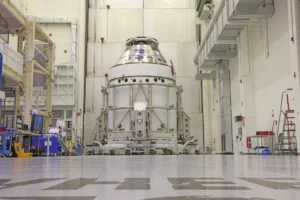
The Service Module’s propulsion system will make all necessary maneuvers, including putting Orion onto a Trans-lunar Injection (TLI) trajectory and pointing it to reenter Earth’s atmosphere at the correct angle at the end of trip. The speakers today weren’t able to answer when those systems were last tested. (SpacePolicyOnline.com requested additional information from NASA immediately after the March 12 press conference, but none was forthcoming by close of business on March 13. We will update this article if we get an answer.)
The United States is the only country to send people to the Moon. Two test flights in 1968 and 1969 entered orbit but did not land (Apollo 8 and 10), six crews landed (Apollo 11, 12, 14, 15, 16 and 17) between 1969 and 1972, and one crew in 1970 intended to land (Apollo 13) but an explosion in the Service Module enroute to the Moon severely damaged the Service Module and the spacecraft. Mission controllers at JSC were able to use the Lunar Module’s descent engine to put Apollo 13 on a free-return trajectory that brought them safely back to Earth. Artemis II will use a similar trajectory.
User Comments
SpacePolicyOnline.com has the right (but not the obligation) to monitor the comments and to remove any materials it deems inappropriate. We do not post comments that include links to other websites since we have no control over that content nor can we verify the security of such links.