NASA Will Conduct Second Artemis II WDR on Thursday
NASA will conduct a second Wet Dress Rehearsal (WDR) on Thursday in preparation for the launch of Artemis II. The nearly 50-hour test actually begins Tuesday evening as launch teams conduct tests and fill the Space Launch System rocket with propellant. The simulated launch window opens at 8:30 pm ET on Thursday. The first Artemis II WDR on February 2 ended early because of hydrogen leaks, but NASA has replaced seals and is ready to try again.
Artemis II will take astronauts around the Moon for the first time since the Apollo era. NASA’s Reid Wiseman, Victor Glover and Christina Koch and Canadian Space Agency astronaut Jeremy Hansen will loop around the Moon, but not go into orbit or land. This is a test flight and their “free-return” trajectory will bring them back to Earth even if the Orion spacecraft’s propulsion system doesn’t perform as planned.

First, NASA needs to conduct a practice countdown that includes filling the SLS rocket and its upper stage, the Interim Cryogenic Propulsion Stage (ICPS), with super-cold liquid hydrogen and liquid oxygen — called “tanking.” Once the tanks are full, launch controllers will conduct two test runs of the final 10 minutes before liftoff, called terminal count. They will count down to T-1:30 and pause for three minutes, then resume to T-33 seconds. They’ll then recycle back to T-10 minutes and count down to about T-30 seconds and stop.

During the February 2 WDR, hydrogen leaks at an interface called the Tail Service Mast Umbilical (TSMU) slowed the process of filling the tanks, but they eventually reached the required limit. During the terminal count phase of the test, however, an automatic system detected leaks again just under the 6 minute mark and stopped the countdown. NASA had been hoping to launch the crew in February, but decided to wait until March.
Artemis II Launch Director Charlie Blackwell-Thompson said on February 3 they were not able to test three key milestones: a three-minute hold with all cryogenic systems in a launch-ready state; recycling to a new launch time within the same launch window; and getting to the T-33 second mark where operators hand off to the Automated Launch Sequencer (ALS) and then cutting off the launch.
Hydrogen leaks and other technical challenges delayed the launch of Artemis I in 2022 for several months. That uncrewed flight test finally launched on November 16, 2022, eight months after the rocket was first rolled out to the launch pad. Several WDRs over multiple months were needed and the rocket had to roll back to the Vehicle Assembly Building (VAB) twice for technical reasons plus another time due to a hurricane.

The Earth and Moon must be properly aligned for lunar missions to take place. Dates are available every month and NASA published a chart with those in February, March and April.
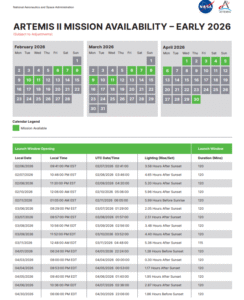
March 6 is the first opportunity now. During a news conference last Friday following the launch of Crew-12 to the International Space Station, NASA Administrator Jared Isaacman confirmed they were looking at the possibility of March 3: “You are correct that we are considering if there are earlier opportunities … that could potentially include the 3rd.” NASA told SpacePolicyOnline.com today, however, that the decision is to stick with March 6.
NASA will provide a livestream of the test on Thursday. During the first test, the livestream provided no audio, but updates scrolled along the bottom of the screen and occasional graphic displays would illustrate how full the tanks were.
NASA is currently targeting 2028 for Artemis III, the mission that will land American astronauts on the Moon for the first time since Apollo 17 left in December 1972.

User Comments
SpacePolicyOnline.com has the right (but not the obligation) to monitor the comments and to remove any materials it deems inappropriate. We do not post comments that include links to other websites since we have no control over that content nor can we verify the security of such links.