Serbia, Mauritius Bring Artemis Accords to 70
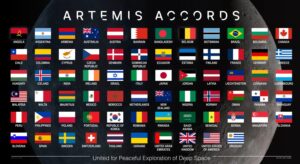
Serbia and Mauritius have joined the Artemis Accords in the past two days, bringing the number of signatories to 70. Governments of any country are welcome to join the U.S.-led principles for responsible behavior on the Moon whether or not they have space programs or aspire to conduct operations on the Moon, although many do. Countries on all six continents that have governments are members.
President Trump initiated the Artemis program during his first term. NASA and the U.S. State Department led development of the Artemis Accords together with Australia, Canada, Japan, Italy, Luxembourg, the United Arab Emirates, and the United Kingdom. Those eight countries became the inaugural members on October 13, 2020 during the International Astronautical Congress, held virtually that year due to COVID-19. In less than six years, the number has grown to 70, with 11 this year alone.
The 10 core principles are: peaceful purposes, transparency, interoperability, emergency assistance, registration of space objects, release of scientific data, preserving outer space heritage, space resources, deconfliction of space activities, and orbital debris. They only apply to governments, not the commercial sector, and only to civil activities, not national security.
Serbia signed yesterday at NASA Headquarters in Washington, DC, at a ceremony with NASA Deputy Administrator Matt Anderson and Serbia’s Minister of Foreign Affairs Marko Đurić. The event preceded the first U.S.-Serbia Strategic Dialogue that took place today at the State Department.
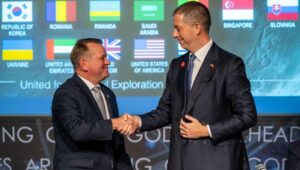
Anderson remarked that Serbian engineers played an important role in the Apollo program and Milojko ‘Mike’ Vučelić was awarded the Presidential Medal of Freedom for his role in bringing the Apollo 13 crew safely home. Đurić heralded other renowned Serbian scientists and engineers including the “Serbian Seven” who worked on Apollo.
“We come from a nation of great minds like Nikola Tesla and Milutin Milanković, but also from the legacy of David Vujic, one of the pioneers of the Apollo missions and a member of the ‘Serbian Seven,’ a group of engineers and technicians whose contributions to NASA helped make the Moon landing possible. In that spirit, we owe it to both our brave ancestors and our children to keep pushing toward new frontiers — to explore, to inspire one another, and to dare even greater things.” — Marko Đurić
Today, Mauritius joined during a ceremony on that island nation in the Indian Ocean, east of Madagascar. Anderson provided video remarks while U.S. Deputy Assistant Secretary of State for African Affairs Sarah Troutman and U.S. Chargé d’Affaires to Mauritius Craig Halbmaier were present in person, joining Mauritius’ Permanent Secretary at the Ministry of Tertiary Education, Science and Research Navindsing Jugmohunsing.
The U.S. State Department said the United States and Mauritius “share longstanding partnerships spanning diplomacy, science, education, security, trade, and economics. Both countries see growing commercial opportunities in space and technology, and the Artemis Accords create new avenues to strengthen collaboration in these emerging industries.” Jugmohunsing called it “a defining chapter in our New Space journey.”
“As a Small Island Developing State in the Indian Ocean, we are committed to ensuring that space serves humanity by protecting our oceans and coastlines and amplifying the voices of nations like ours. Mauritius stands ready to help shape the future of space governance while unlocking new opportunities for innovation and partnership.” — Navindsing Jugmohunsing
Mike Gold, who played a pivotal role in crafting the Accords when he was NASA Associate Administrator for Space Policy and Partnerships in the first Trump term, told SpacePolicyOnline.com today that “Going from seven nations joining the U.S. signing the Accords in 2020 to seventy signatories in 2026 is a huge accomplishment. The success of the Accords demonstrates the inherent optimism and hope that the space program represents not only in America but around the world.” Now President of Redwire Space, he congratulated NASA’s leadership for “deeping participation” and “inviting every signatory to participate in Moon Base development.”
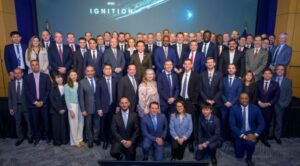
In March, NASA invited all 61 Artemis Accords members at the time to the Ignition event where Moon Base plans were announced. More than 40 attended.
The Secure World Foundation maintains a spreadsheet of all the Artemis Accords signatories and when they signed. The 11 who joined this year are Portugal, Oman, Latvia, Jordan, Morocco, Malta, Ireland, Paraguay, Botswana, Serbia, and Mauritius. All but Portugal and Oman joined after the Ignition event and after the Artemis II crew flew around the Moon.
China also plans to land humans and conduct operations on the Moon through its International Lunar Research Station (ILRS) in collaboration with Russia. Secure World also has a spreadsheet of the 13 countries in the ILRS effort, but notes that details of the ILRS principles are not publicly available.
Countries don’t have to choose between the Artemis Accords and the ILRS. In fact, three nations now belong to both: Senegal, Serbia, and Thailand.
Gold is supportive. “Through the Artemis Accords, we’re not just launching our astronauts, we’re launching our values to the Moon, which is why every ILRS nation, such as Serbia, that commits to the principles of the Artemis Accords is a special victory for a peaceful and prosperous future in space.”
User Comments
SpacePolicyOnline.com has the right (but not the obligation) to monitor the comments and to remove any materials it deems inappropriate. We do not post comments that include links to other websites since we have no control over that content nor can we verify the security of such links.