SpaceX Launches New Starship V3 For First Time
After a scrub yesterday, SpaceX successfully launched the new version of Starship today. It was the 12th launch in the series, but the first of Version 3, or V3, with completely redesigned Raptor engines and other significant upgrades. Not everything went as planned, but overall it appears to have been a success. [UPDATE, May 27: The FAA is requiring a mishap investigation.]
Liftoff of Starship’s Integrated Flight Test-12 (IFT-12) was on-time at 5:30 pm Central Time (6:30 pm Eastern) from Starbase, TX.
Liftoff of Starship! pic.twitter.com/LQLdjK5V6K
— SpaceX (@SpaceX) May 22, 2026
Yesterday’s scrub was primarily due to a hydraulic pin that holds the tower arm in place failing to retract.
Although the vehicle is usually referred to singly as Starship, it actually has two stages. The first stage, Super Heavy or “Booster,” has 33 Raptor engines to get the vehicle off the launch pad and on its way. Starship, or “Ship,” is the second stage with 6 Raptor engines. The two stages separate after about two-and-a-half minutes and Starship continues on to its destination, wherever that is. Booster is designed to make a soft splashdown in the Gulf off the coast of Starbase, or return to the launch pad for a “catch” where it maneuvers itself into the arms of “chopsticks” attached to the launch tower.
The preceding 11 IFT launches had a mixed record. SpaceX has a “fail fast, learn fast” philosophy with frequent launches: two in 2023, four in 2024, and five in 2025. Of the launches in 2025, two exploded over Caribbean islands (IFT-7 and IFT-8) and another (IFT-9) experienced fuel leaks, but IFT-10 and IFT-11 were successes. The 7-month gap between IFT-11 on October 13, 2025 and this flight of the new V3 is one of the longest. Both stages are reusable and SpaceX wowed the world with three catches of Booster back at the launch site on IFT-5, IFT-7 and IFT-8, even though the last two were mission failures.
SpaceX has a handy summary of the changes they made to V3. This also was the first flight from SpaceX’s new launch pad at Starbase.
Because of all the new hardware, they chose a Gulf splashdown for Booster instead of trying to bring it back to a catch at the launch site. As for Starship, like all the other IFTs so far, this was a suborbital mission. They do not go into orbit or even all the way around the Earth, but do travel through space on the way over to splashdown in the Indian Ocean.
Today, launch and stage separation went almost as planned, although one of the 33 Booster engines shut down early. More importantly, several Booster engines needed for a soft Gulf splashdown did not relight so it fell into the Gulf. SpaceX has not said where. In addition, one of Ship’s Raptor Vacuum (RVAC) engines shut down less than a minute after ignition. They’d planned to restart one of the RVAC engines while Ship was in space, but decided not to because of that failure.
UPDATE, May 27: The FAA said today it is requiring a mishap investigation because the Booster did not splash down as intended. As is customary, the FAA will oversee the SpaceX-led investigation and “A return to flight of the Starship-Super Heavy vehicle is based on the FAA determining that any system, process, or procedure related to the mishap does not affect public safety.”
When operational, Starship will launch a new Version 3 generation of Starlink satellites and this mission successfully deployed 20 simulated V3 Starlinks as well as two modified V2 satellites that took images of Starship’s heat shield. Since Starship didn’t go into orbit, neither did the satellites and they reentered.
Splashdown in the Indian Ocean was on target, with a landing burn using the operating Ship engines that enabled a comparatively soft ocean landing. As with previous splashdowns, Ship exploded after it tipped over because the pressurized tanks ruptured, igniting residual propellant.
Splashdown confirmed! Congratulations to the entire SpaceX team on the twelfth flight test of Starship! pic.twitter.com/XXBAtryPpL
— SpaceX (@SpaceX) May 22, 2026
SpaceX founder and CEO Elon Musk congratulated the SpaceX team “on an epic first Starship V3 launch & landing. You scored a goal for humanity.”
A lot is riding on the success of Starship V3 not just for SpaceX, but NASA. NASA Administrator Jared Isaacman was there for the launch.
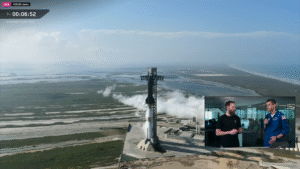
Starship is the foundation of SpaceX’s aspirations in Earth orbit and beyond. It’s needed to launch thousands of the company’s Starlink Version 3 satellites, which are too large to launch on Falcon rockets, and as many as one million data centers into Earth orbit, plus Musk’s new idea of putting a mass driver on the lunar surface shooting data centers and other spacecraft into deep space. Not to mention his long-standing passion to send millions of humans to Mars to establish a civilization there.
SpaceX’s S1 filing with the Securities and Exchange Commission earlier this week in advance of next month’s IPO outlines the company’s bold mission to “build systems and technologies necessary to make life interplanetary, to understand the true nature of the universe, and to extend the light of consciousness to the stars. To do this, we have formed the most ambitious, vertically integrated innovation engine on (and off) Earth with unmatched capabilities to rapidly manufacture and launch space-based communications that connect the world, to harness the Sun to power a truth-seeking artificial intelligence that advances scientific discovery, and ultimately to build a base on the Moon and cities on other planets.”
Starship is also key to NASA’s goal of getting American astronauts back on the Moon before Chinese taikonauts arrive. Isaacman is intent on doing that in 2028, before President Trump leaves office.
NASA awarded a contract to SpaceX in 2021 to build a Human Landing System (HLS) version of Starship with a goal of landing in 2024. Many considered that unrealistic, but as of today Starship has not even reached Earth orbit. Starship furthermore requires in-space cryogenic refueling to travel beyond Earth orbit. In-space fuel depots do not exist yet nor has in-space cryogenic refueling been demonstrated.
From the beginning, NASA wanted two HLS providers to ensure redundancy and competition, but Congress did not provide sufficient funds initially. Only in 2023 was NASA able to award a second contract to Jeff Bezos’s Blue Origin, but that first flight wasn’t expected until the end of the decade.
NASA now is trying to accelerate both Starship HLS and Blue Origin’s Blue Moon Mark 2 (Mark 1 is cargo only). Isaacman recently reconfigured the Artemis program so the next flight, Artemis III, is an earth-orbital test flight in 2027 to rendezvous and dock NASA’s Orion crew spacecraft with “pathfinder” versions of both Starship HLS and Blue Moon MK2.
While chatting with Dan Huot before the launch, Isaacman said NASA’s “looking forward to seeing this thing fly because hopefully at some point in the not too distant future we’re going to join up in Earth orbit.” Afterwards, he called it “a hell of a V3 Starship launch. One step closer to the Moon…one step closer to Mars.”
Congrats @SpaceX team and @elonmusk on a hell of a V3 Starship launch. One step closer to the Moon…one step closer to Mars 🇺🇸 pic.twitter.com/jjetQxnkiR
— NASA Administrator Jared Isaacman (@NASAAdmin) May 23, 2026
The path to astronauts stepping foot on the Moon still has a way to go even after the Artemis III rendezvous and docking tests, though. SpaceX needs to show Starship HLS can land on the Moon and lift off, even if not to attain lunar orbit, before NASA will commit to putting a crew aboard.
User Comments
SpacePolicyOnline.com has the right (but not the obligation) to monitor the comments and to remove any materials it deems inappropriate. We do not post comments that include links to other websites since we have no control over that content nor can we verify the security of such links.