What’s Happening in Space Policy May 9-16, 2026
Here is SpacePolicyOnline.com’s list of space policy events for the week of May 9-16, 2026 and any insight we can offer about them. The House and Senate are in session this week.
During the Week
SpaceX has not announced a date for next Starship Integrated Flight Test (IFT), but people who closely follow activities at Starbase and airspace closure advisories have been suggesting it could be as early as this coming Friday, May 15. We won’t add it to our Calendar until there’s an official date, but we’d be remiss not to give a heads up that it might be pretty soon. Having said that, NASASpaceflight.com posted on X that yesterday’s Wet Dress Rehearsal was aborted, so Friday may not be a good bet. [Update, May 12: SpaceX has officially announced they are targeting May 19.]
Whenever it does launch, it will be the 12th test flight (IFT-12) overall and the first of Version 3, or V3, with redesigned Raptor engines and other significant upgrades. The company posted photos on X of the V3 Super Heavy booster and Starship together for the first time. (Starship is the name of the second stage, but the Super Heavy-Starship combination is often called Starship, too.)
Starship and Super Heavy V3 together at the Starbase launch pad for the first time pic.twitter.com/YGs81Ud5xB
— SpaceX (@SpaceX) May 9, 2026
The launch will be amazing no matter what happens — excitement guaranteed as SpaceX says — but with the increased pressure on SpaceX to get the Human Landing System (HLS) version of Starship ready for a test flight next year to rendezvous and dock with Artemis III in earth orbit, a lot is riding on V3’s success. NASA Administrator Jared Isaacman is determined to get American astronauts on the lunar surface in 2028 before President Trump leaves office and before China puts taikonauts there. In a Bloomberg podcast last week, he sounded quite confident that both HLS systems — SpaceX’s Starship and Blue Origin’s Blue Moon MK2 — will be ready at the same time in 2027 so Artemis III can perform docking tests with both of them.
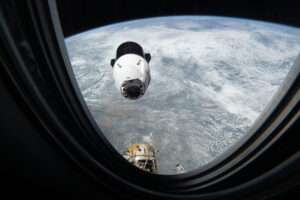
SpaceX does have three Falcon 9 launches this week. One is a cargo mission to the International Space Station on Tuesday evening. The pre-launch press conference is tomorrow morning (Monday). If launch is on time, docking is Thursday. This is SpaceX’s 34th Commercial Resupply Services (CRS-34) mission to the ISS.
Meanwhile, Congress is back from its week-long recess. On Tuesday, both the House and Senate Appropriations Defense subcommittees will hold hearings on DOD’s FY2027 budget request: the House at 8:00 am ET and the Senate at 10:30 am ET. The Trump Administration calls the Department of Defense (DOD) the Department of War (DOW), but only Congress can officially change the name and it hasn’t, so DOD is still DOD as far as Congress is concerned. Secretary of Defense Pete Hegseth and Chairman of the Joint Chiefs of Staff Gen. Dan Caine are witnesses at both hearings. The House subcommittee will also hear from Acting DOD Comptroller Jules W. Hurst III.
DOD is requesting a record $1.5 trillion for FY2027, compared to $1 trillion in FY2026 — the current record. The FY2026 funding is composed of about $840 billion through the appropriations process (the “base budget”) plus about $150 million through the One, Big Beautiful Bill Act (OBBBA), also known as reconciliation. For FY2027, the Administration is again splitting the money, with $1.15 trillion in the base budget and $350 billion through a planned reconciliation bill.
Most of the funding for the Golden Dome missile defense system is in the reconciliation portion as is some of the requested increase for the U.S. Space Force. If enacted, the USSF budget would grow from $40 billion in FY2026 to $71 billion in FY2027, with $59 billion in the base budget and $12 billion in reconciliation.
The idea of a third reconciliation bill in one Congress reportedly is encountering a bit of pushback from some Republicans, however. The first was the OBBBA last summer. The second is being readied right now to fund ICE and CBP. Reconciliation is a unique legislative process that requires only a simple majority in the Senate, avoiding filibusters and allowing passage on a partisan rather than bipartisan basis. It’s been used sparingly in the past. Appropriators have to stay within their own top-line budget limits and there are rumors about a possible supplemental to pay for the war in Iran that they’d have to accommodate. How all of this shakes out in the coming months should be interesting to watch. The two hearings on Tuesday may offer some clues.
NASA benefited from last year’s OBBBA, with an additional $10 billion over several years on top of base appropriations. We haven’t heard that NASA might be included in any reconciliation legislation this year, however. It likely will get only what the appropriators provide. The House Appropriations Commerce-Justice-Science (CJS) subcommittee that funds NASA is finished with hearings and the subcommittee marked up the bill on April 30.
Full committee markup of the CJS bill is this Wednesday. It cleared subcommittee on party lines with all Democrats voting no. Most of the controversy is over matters in the Department of Commerce and Department of Justice, but Democrats also voiced opposition to cuts in science funding at NASA, NOAA and the National Science Foundation. Although the subcommittee allocated more for NASA science than the Trump Administration requested ($6 billion versus $3.9 billion), it’s still a substantial cut from the $7.3 billion in FY2026. It parallels what the House did last year, with the final figure back to $7.3 billion after negotiations with the Senate.
Lots of other great events here and abroad this week. To name a few: the Mitchell Institute will have a webinar with Gen. Stephen Whiting, Commander of U.S. Space Command, on Tuesday, and another with Brig. Gen. Christopher “Trigger” Fernengel, USSF Director of Plans & Programs, on Thursday; the Satellite Industry Association releases its annual State of the Satellite Industry report in D.C. on Wednesday; and the Global Space Technology Convention & Exhibition (GSTCE) is in Singapore on Wednesday and Thursday.
Those and other events we know about as of Sunday morning are shown below. Check back throughout the week for others we learn about later and add to our Calendar or changes to these.
Monday, May 11
- Pre-launch Media Telecon for Launch of SpX-34 Cargo Mission to ISS, virtual, 11:00 am ET
Tuesday, May 12
- House Appropriations Defense Subcommittee Hearing on FY2027 DOD Budget Request, 2359 Rayburn House Office Building, 8:00 am ET (webcast)
- Senate Appropriations Defense Subcommittee Hearing on FY2027 DOD Budget Request, 192 Dirksen Senate Office Building, 10:30 am ET (webcast)
- Schriever Spacepower Series Webinar with Gen. Stephen Whiting, Commander, U.S. Space Command (Mitchell Inst), virtual, 1:30-2:30 pm ET
- Launch of SpX-34 Cargo Mission to ISS, Cape Canaveral Space Force Station, FL, 7:16 pm ET (NASA coverage begins 7:00 pm ET)
Tuesday-Wednesday, May 12-13
- Africa Tech Week 2026 (GSOA), Cape Town, South Africa
Tuesday-Thursday, May 12-14
- 3rd ESA Earth Observation Commercialisation Forum, Seville, Spain
Wednesday, May 13
- State of the Satellite Industry Report Release (SIA), Hogan Lovells, 555 13th St., NW, Washington, DC, 10:00 am ET
- House Appropriations Full Committee Markup CJS bill (NASA/NOAA), 2359 Rayburn House Office Building, 11:00 am ET (webcast)
- Software Integration & Strategic Missile Defense (Space News), virtual, 1:00 pm ET
Wednesday-Thursday, May 13-14
Wednesday-Friday, May 13-15
- 1st IAA Planetary Sunshade Workshop, Nottingham, UK
- 11th International Conference on Recent Advances in Air and Space Technologies (RAST 2026), Istanbul
Thursday, May 14
- Schriever Spacepower Series with USSF’s Brig. Gen. Christopher Fernengel, virtual, 2:30 pm ET
- Virgin Galactic 1st Quarter 2026 Financial Results Telecon, virtual, 5:00 pm ET
User Comments
SpacePolicyOnline.com has the right (but not the obligation) to monitor the comments and to remove any materials it deems inappropriate. We do not post comments that include links to other websites since we have no control over that content nor can we verify the security of such links.