What’s Happening in Space Policy September 6-12, 2026
Here is SpacePolicyOnline.com’s list of space policy events for the week of September 6-12, 2026 and any insight we can offer about them. The House and Senate are in recess this week except for pro forma sessions.
During the Week
The week begins tomorrow (Monday) with a holiday, Labor Day, and federal offices will be closed. Overall it’s a comparatively quiet week, but with a few really interesting events here and especially overseas.
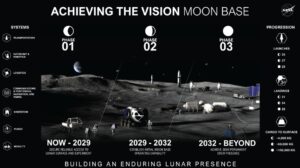
By happenstance, the events here in the D.C. area are clustered on Wednesday. Among them is one of the Johns Hopkins Bloomberg Center’s Discovery Series, “Building the Moon Base,” co-sponsored with Space News. It’s in the evening, in-person only, at the Bloomberg Center on Pennsylvania Avenue with NASA’s Shatel Bhakta, Johns Hopkins Applied Physics Lab’s (APL’s) Wes Fuhrman, Astrolab’s Jaret Matthews, and Firefly Aerospace’s Farah Zuberi.
According to its website, the event is sold out already so if you don’t have a ticket you’ll miss out on that one, but there are more to choose from. Earlier in the afternoon, SRI is having a PARC Forum at its Arlington, VA office on “Cyber Resilience in Space.” That one is in-person plus a virtual option. SRI’s Ulf Lindqvist will be joined by James Curbo from Johns Hopkins APL, Gregory Falco from Cornell, and Joseph “Dan” Trujillo from the Air Force Research Laboratory. They’ll discuss “What will it take to bridge today’s capabilities with tomorrow’s security demands in space?”.
To highlight just one more of the Wednesday events, CSIS is having a webinar to discuss President Trump’s new National Space Transportation Policy and its goal of 1,000 launches and reentries per year by 2030 in the context of competition with China. Participants are CSIS’s own Kari Bingen, Tom Karako, and Heather Williams.
Two overseas conferences may be of special interest. The United Nations Institute for Disarmament Research, UNIDIR, is having its annual Outer Space Security Conference on Tuesday-Wednesday in Geneva. Lots of great sessions, but one that caught our eye is Strategic Stability and the Security of Space Architecture with speakers from government or independent organizations from Russia, China, Sweden, Pakistan, and the U.S., moderated by Victoria Samson of the Secure World Foundation. They’ll discuss “how reliance on integrated space infrastructure for tactical and strategic operations impacts global stability.” An online option is available (Switzerland is 6 hours ahead of EDT).

The other is the International Space Summit sponsored by the President of France, Emmanuel Macron, taking place at the Grand Palais in Paris on Wednesday and Thursday. Macron himself is scheduled to speak on Thursday morning as well as Ursula von der Leyen, President of the European Commission. Politico reports this will be the first speech by a European Commission President entirely dedicated to space. Her speech will be followed by a live segment with French astronaut Sophie Adenot who’s aboard the International Space Station and just completed three spacewalks, the first French woman to do any EVAs.
Lots of other high level government and private sector speakers will be there from what organizers expect will be about 120 countries. That includes the U.S., although Politico separately reported that the White House contacted several U.S. companies (including SpaceX and Blue Origin) to encourage them to back out of the conference and that some did. Nonetheless, it looks like a great summit with very interesting participants. No virtual option unfortunately, but perhaps some of the speeches will be on social media in real time or afterwards.
We’ll also mention that Russia’s Progress MS-35 cargo spacecraft is set to lift off to the International Space Station on a Soyuz rocket from Baikonur on Wednesday at 12:15 pm EDT. NASA coverage begins at noon. A Ukrainian attack on a Soyuz rocket production facility in Samara last month raised questions about Russia’s future ability to send cargo and crews to the ISS. NASA told SpacePolicyOnline.com on August 27 that Russia confirmed no changes are needed to the 2026 flight plan (another Progress is scheduled in November), but those rockets likely were already at Baikonur or on the way. Time will tell if there are implications next year.
A quick update on what’s happening on Capitol Hill. The House and Senate are taking the week off. Both will be back in session on September 14, the first time they’ll be in town at the same time since late July. The Senate began its 5-week recess on Saturday, August 8, after passing its version of a Continuing Resolution (CR) to keep the government operating through December 11. FY2027 begins on October 1 and none of the FY2027 appropriations bills have cleared Congress. Both parties are eager to avoid another government shutdown like last year and the bill easily passed on a bipartisan vote of 90-6.
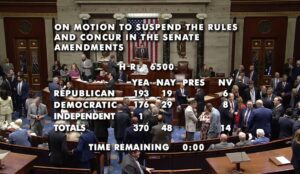
The House’s 5-week recess started two weeks earlier (July 23). They returned last Monday (August 31) with a plan to take this week off and then come back for three more weeks, through October 1, then recess until after the midterm elections on November 3. Although the Senate-passed CR was quite different from the version the House narrowly passed in July, on September 1 the House adopted the Senate bill on a bipartisan basis 370-48. President Trump signed it into law the next day.
With the issue of government funding settled for now, House Speaker Mike Johnson decided the House will truncate its September plans. They will be session only for the week of September 14 and then off until November 9. The Senate still plans to be in session from September 14-October 2 and Johnson said House members will get 48 hours notice to return if the Senate passes legislation that needs immediate House attention. The Senate schedule could also change, of course, though it has nominations pending in addition to legislation.
All of which is to say that not much is likely to clear Congress until after the midterms. Those awaiting action on appropriations bills, the FY2027 National Defense Authorization Act (NDAA), a NASA authorization act, or a third reconciliation bill with funding for Golden Dome and $12 billion for the Space Force, need to continue packing their patience. For the record, the House has passed three of the 12 FY2027 appropriations bills (Agriculture, Milcon-VA, and National Security-State) and the NDAA. The Senate has not passed any of those yet.
Those and other events we know about as of Sunday morning are shown below. Check back throughout the week for others we learn about later and add to our Calendar or changes to these.
Monday, September 7
- Labor Day (federal holiday)
Tuesday, September 8
- Star Trek at 60: A Celebration and a Discussion (Redwire), virtual, 4:30 pm ET
Tuesday-Wednesday, September 8-9
- Outer Space Security Conference 2026 (UNIDIR), Geneva, Switzerland
Tuesday-Friday, September 8-11
- 3rd Zero Debris Week, Seville, Spain
Wednesday, September 9
- MSBR Luncheon with Col. Pete Atkinson, Martin’s Crosswinds, Greenbelt, MD, 11:30 am-1:30 pm ET
- Progress MS-35 (96P) Cargo Launch to ISS, Baikonur Cosmodrome, Kazakhstan, 12:15 pm ET (NASA coverage begins 12:00 pm ET)
- Space Launch Capacity and Contenders (CSIS), virtual, 1:30-2:30 pm ET
- PARC Forum: Cyber Resilience in Space (SRI), 1000 Wilson Blvd., Arlington, VA/online, 3:00 pm ET
- Building the Moon Base (JHU Bloomberg Center/Space News), Johns Hopkins Bloomberg Center, 555 Pennsylvania Ave., NW, Washington, DC, 6:00-7:30 pm ET
Wednesday-Thursday, September 9-10
- International Space Summit, Paris, FR
Saturday-Sunday, September 12-13
- ISEC Space Elevator Conference, virtual, various times
This article has been updated.
User Comments
SpacePolicyOnline.com has the right (but not the obligation) to monitor the comments and to remove any materials it deems inappropriate. We do not post comments that include links to other websites since we have no control over that content nor can we verify the security of such links.