What’s Happening in Space Policy August 23-30, 2026
Here is SpacePolicyOnline.com’s list of space policy events for the week plus a day of August 23-30, 2026 and any insight we can offer about them. The House and Senate are in recess except for pro forma sessions. The House returns on August 31, the Senate on September 14 (after the Labor Day recess).
During the Week
We’re including an extra day, August 30, in today’s What’s Happening because the Nancy Grace Roman Space Telescope is scheduled for launch that morning before our next edition is published.
That’s one of several big events this week, but what was to be the first, launching as soon as this evening EDT, was just postponed. China is delaying the launch of the Chang’e-7 robotic lunar landing mission to Shackleton Crater at the Moon’s South Pole.
Indications of a delay began yesterday as Typhoon Narra began intensifying near the launch site on Hainan Island. China’s official announcement on Xinhua this morning didn’t specify the weather, however, saying the probe “does not meet launch conditions” and therefore “cannot take place during the planned window this year.”
“China’s Chang’e-7 lunar probe does not meet launch conditions, and its launch therefore cannot take place during the planned window this year, the China Manned Space Agency said Sunday.
The assessment was conducted following the principle of prudence, reliability and absolute mission success, the agency said.” — Xinhua News Agency
The wording it “cannot take place during the planned window this year” implies they won’t launch until 2027, but doesn’t make that explicit. If we find out anything definitive, we’ll update this article. A lot of factors are involved: spacecraft can only launch to the Moon at certain times due to orbital dynamics (this launch window is open through August 31), Chang’e-7 needs to land when lighting conditions on the edge of the crater are ideal, and it has to orbit the Moon for some period time to choose the specific landing site. Leonard David has a useful explanation on Space.com of what Chang’e-7 will be doing and the many instruments (Chinese and international) aboard.
The launch of the Roman Space Telescope is still on, though. NASA proudly reminds everyone that the telescope is ahead of schedule and under cost. Liftoff is scheduled for next Sunday, August 30, at 7:26 am ET from Kennedy Space Center on a Falcon Heavy rocket. We haven’t seen anything from NASA yet about when their livestream coverage begins. A mission dress rehearsal was completed on Thursday so everything seems to be proceeding according to plan. We’ll post any updates on our Calendar. [Update, August 24: NASA’s new press release has the schedule, starting on Saturday, Aug. 29.)
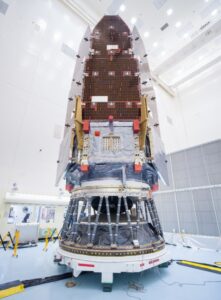
The telescope is named in honor of NASA’s first chief astronomer, Nancy Grace Roman, who was also the “mother” of the beloved Hubble Space Telescope that is still operating 36 years after launch. Hubble is in earth orbit, though, while Roman is headed out to the Sun-Earth Lagrange point-2 (SEL-2) where the James Webb Space Telescope resides. We’ll have more about Roman on launch day. In short, the two telescopes are complementary. Both look at the universe in the infrared bands, but JWST has a narrow field of view and Roman has a wide field of view allowing it to look more broadly at the universe and locate objects scientists want JWST to investigate more closely. Solving the mysteries of dark matter and dark energy — “dark” because they don’t emit, absorb or reflect light and scientists don’t understand what they are even though together they account for 96 percent of the mass-energy content of the universe — are among their goals.
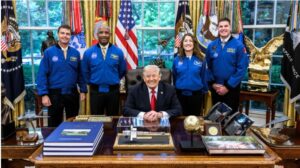
One other big event is on Friday when President Trump presents the Congressional Space Medal of Honor to the Artemis II crew at Johnson Space Center. In April, NASA’s Reid Wiseman, Victor Glover, and Christina Koch and the Canadian Space Agency’s Jeremy Hansen became the first humans to fly around the Moon since Apollo 17 in 1972 and flew further from Earth than anyone in history. They visited Trump at the White House soon after their return and were on stage with him (along with Apollo 17 astronaut Jack Schmitt) at the July 4th anniversary of America’s 250th birthday. Now he will present with them this honor, which has been bestowed on only 30 astronauts. Bob Behnken and Doug Hurley — “Bob and Doug” — were the most recent. They restored America’s ability to launch astronauts into space for the first time since the end of the space shuttle program in 2011 when they flew SpaceX’s Demo-2 mission to the ISS in 2020.
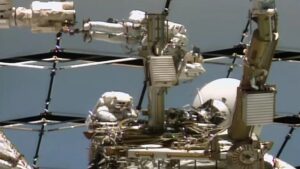
Several other very interesting events are on tap this week, too, including the 40th Small Satellite Conference that begins today in Salt Lake City, Utah and runs through Wednesday. The Washington Space Business Roundtable has a luncheon on Tuesday on “From Demo to Dollars: Why Promising Space Companies Still Hit a Wall on the Way to a Program of Record.” Also on Tuesday, NASA astronaut Anil Menon and ESA astronaut Sophie Adenot will take a second spacewalk to complete work they began last week on replacing a space-to-ground antenna.
Before we go, last week we promised to keep you up to date on the attempt by Katalyst Space to reboost NASA’s Swift space telescope, and any more information about whatever damage was inflicted on Russia’s Soyuz rocket manufacturing plant by Ukraine.
Unfortunately Katalyst and NASA had to give up on reboosting Swift because of attitude control problems with Katalyst’s LINK spacecraft. Swift will reenter later this year.
As for damage to Soyuz rocket production, NASA hasn’t yet answered the question we asked a week ago about potential impact on operations of the International Space Station. [Update, August 27: NASA replied today (in part) that “At this time, Roscosmos confirms no changes are needed to the 2026 calendar year flight plan.”] Anatoly Zak of RussianSpaceWeb.com tells us the next Progress cargo resupply launch, Progress MS-35, is still on track for September 9 on a Soyuz-2.1b. Rockets for any near-term missions almost certainly are at their respective launch sites so the attack on Samara wouldn’t affect them. Zak posted on X that Ukrainian Armed Forces claim their missiles hit the aircraft hardware servicing hall the hardest and the “second hit damaged the Soyuz rocket engine assembly hall.” (Separately, Zak posted that a drone was seen flying towards Russia’s Plesetsk launch site today “likely in a fresh attempt to attack the facility during final preparations for launch” of a military satellite.)
On another note, last week we mentioned an intriguing National Academies meeting on August 26 on “Designing Governance and Economic Frameworks for the Emerging Cislunar and Lunar Economy.” We’ve since learned that’s an internally funded study at the Academies and not open to the public. Darn.
Those and other events we know about as of Sunday morning are shown below. Check back throughout the week for others we learn about later and add to our Calendar or changes to these.
Sunday-Wednesday, August 23-26
- 40th Small Satellite Conference, Salt Lake City, UT
Monday, August 24
- Assessment of Technical and Scientific Capabilities at NASA Goddard, 13th mtg (Natl Acad), virtual, 1:00-3:00 pm ET (portions may be closed)
Tuesday, August 25
- NASA/ESA Spacewalk at ISS (Menon/Adenot), Earth orbit, 8:35 am ET (NASA coverage begins 7:00 am ET)
- WSBR Luncheon on “Demo-to-Program” Challenges, Hogan Lovells, 555 13th St., NW, Washington, DC, 11:30 am-1:30 pm ET
Wednesday, August 26
- Designing Governance and Economic Frameworks for the Emerging Cislunar and Lunar Economy (Natl Acad), closed to the public
Wednesday-Thursday, August 26-27
Wednesday-Friday, August 26-28 (local time)
- 3rd IAA Conference on AI for Space, Jeju, Republic of Korea
Sunday, August 30
- Launch of the Nancy Grace Roman Space Telescope, KSC, 7:26 am ET (details on NASA coverage TBA)
This article has been updated.
User Comments
SpacePolicyOnline.com has the right (but not the obligation) to monitor the comments and to remove any materials it deems inappropriate. We do not post comments that include links to other websites since we have no control over that content nor can we verify the security of such links.