Senators Insist Artemis Must Get America Back to the Moon Before China
NASA’s Artemis program to return American astronauts to the Moon won strong support from the Senate Commerce Committee today. Senators from both parties issued a clarion call to get Americans back on the Moon and establish a sustainable presence before China puts taikonauts there. That means staying the course with the program as it is, which is at odds with Trump Administration plans. Also today, NASA elevated the man in charge of the agency’s Moon-to-Mars program, Amit Kshatriya, to the highest level civil servant position at the agency.

Republicans and Democrats on both sides of Capitol Hill and the White House are united in their determination to get American astronauts back to the Moon before China puts taikonauts there, which it plans to do by 2030. The title of today’s hearing telegraphed that message: “There’s a Bad Moon on the Rise: Why Congress and NASA Must Thwart China in the Space Race.”
The challenge is that the White House has proposed drastic cuts to NASA. While human spaceflight fares better than any other part of the agency, the Administration is committed to the existing Artemis program only through the third flight, Artemis III. That’s the one that will put American boots back on the Moon for the first time since 1972.
What comes after that is unclear. The only post-Artemis III mission the Administration talks about is putting a nuclear fission reactor on the Moon by 2030, not when astronauts will be there to use it. The Trump Administration is focused on sending people to Mars. Exactly how the Moon fits into that plan hasn’t been shared.
Artemis began in the first Trump Administration as a program of sustained lunar exploration and utilization with international and commercial partners, deliberately not a “flags and footprints” repeat of the Apollo program. Congress remains committed to that vision — not just getting back to the Moon before China gets there, but staying.
The Administration’s FY2026 budget request calls for terminating NASA’s Space Launch System (SLS) rocket and Orion spacecraft after Artemis III and replacing them with commercial alternatives. It also proposes canceling a small lunar space station, Gateway, where the astronauts will transfer from Orion into a Human Landing System (HLS) to get down to and back from the surface. Gateway is being built jointly by the United States, Europe, Canada, Japan, and the United Arab Emirates.
In June and July, Commerce Committee chairman Sen. Ted Cruz (R-TX) led the charge to alter the Administration’s proposal by including $10 billion for NASA in the One, Big Beautiful Bill Act (OBBBA), also known as the reconciliation bill. About $6.5 billion of that is to continue SLS and Orion at least through Artemis V plus full funding for Gateway. Cruz said today it would be “folly” to terminate them now when much of the hardware is already purchased or delivered “with no commercial alternative readily available.”

Ranking Member Sen. Maria Cantwell (D-WA) fully agreed on the need to stay ahead of China. “Beating China back to the moon isn’t just about bragging rights, and it’s certainly not just about grabbing headlines,” but has strategic value. Cantwell warned the meeting in China right now among Chinese President Xi, Russian President Putin, Indian Prime Minister Modi, and North Korean leader Kim Jon Un, probably includes “a big national security and strategic discussion that could easily, easily include space and defense and security and defense implications. … We know we need to go back to the moon, and we know we need to go there before China establishes a permanent presence.”
Today’s witnesses agreed: Allen Cuter from the Coalition for Deep Space Exploration (CDSE), Mike Gold from Redwire, former NASA Administrator Jim Bridenstine now Managing Partner at The Artemis Group, and Lt. Gen. John Shaw (Ret.), former Deputy Commander of U.S. Space Command. Bridenstine and Gold worked together at NASA in the first Trump Administration when Artemis began.
Gold said he’s “confident that the nation that controls the Moon will ultimately control the Earth, and we stand on the precipice of ceding that control” to China. Artemis is the first time an effort to return to the Moon has survived presidential transitions, from Trump to Biden and back to Trump, and its “unprecedented bipartisan success” must be preserved and the program continued on its current path.
While at NASA, Gold led development of the Artemis Accords, a set of 10 non-binding principles for responsible behavior on the Moon that 56 countries have signed so far. Redwire is building the solar arrays for Gateway, but Gold looked more broadly at the international ramifications of NASA’s “waffling” on Gateway that has left the international partners “confused, frustrated and exploring alternatives to American partnerships” like China. He also cited benefits of having a space station in cislunar space — the area between the Earth and the Moon — to monitor what else is happening there.
Cutler characterized Artemis as a “statement of American leadership” that will ensure the United States “sets the rules for lunar exploration, resource utilization, and governance.” Artemis must be successful or the U.S. will cede that leadership to China, but the Administration’s budget proposal is injecting uncertainty into the companies CDSE represents. “These actions are particularly destructive to the smaller companies” NASA relies on “and could put them in financial jeopardy.” On top of staying ahead of China, Artemis is an “economic engine here at home. For every dollar invested, three dollars flow back into our economy….”
Bridenstine was equally adamant about the need to beat China, but deeply concerned NASA’s plan for doing that will fail. He specifically worries that SpaceX’s Starship Human Landing System (HLS), which is needed to take astronauts from lunar orbit down to and back from the surface, won’t be ready in time for Artemis III in mid-2027. SLS/Orion will ferry the astronauts between Earth and lunar orbit, but they must use SpaceX’s Starship HLS for the journey down to and back from the surface.
Liftoff of Starship! pic.twitter.com/d6d2hHgMa0
— SpaceX (@SpaceX) August 26, 2025
SpaceX is conducting tests of Starship, but it has yet to reach Earth orbit. Even once it can do that, unlike SLS, Starship cannot go directly to the Moon. It must be refueled in Earth orbit at a fuel depot that must itself be filled with cryogenic propellants (liquid oxygen and liquid methane). That requires many other Starship flights. Earth-orbiting fuel depots don’t exist yet and cryogenic in-space propellant transfer hasn’t been demonstrated. After Starship is fueled and travels to lunar orbit, propellant boil-off will be a limiting factor. “The complexity of the architecture precludes alacrity,” Bridenstine warned. Starship “could be an important capability for the country but is unlikely to beat China’s projected timeline to the lunar surface.”
NASA is determined to have two HLS systems to ensure redundancy and competition as it did on the commercial cargo and commercial crew systems for the International Space Station. It chose SpaceX in 2021, but funding challenges meant the second contract, with Blue Origin, wasn’t signed until two years later. NASA has been planning to use Blue Origin’s Blue Moon Mark 2 for Artemis V in 2030.
Shaw took a much broader view, not just getting American astronauts back on the Moon. What’s needed is a “unified grand strategy for our nation for the earth-moon system and beyond.” Artemis can be a “powerful driver” and a “beneficiary” of such a strategy, but more is needed. He’s convinced China has such a strategy already.
One example for the U.S. could be setting “the conditions, standards and proper incentives for the establishment of an orbital and lunar logistics infrastructure” for the Earth-Moon system that would benefit sustained human presence on the Moon as well as “Dynamic Space Operations for national security platforms as well as commercial endeavors.” A unified strategy for cislunar space domain awareness and a cislunar communications architecture also would be helpful.
Gold and Bridenstine also spoke extensively about the need to continue operations of the International Space Station until commercial space stations are available to replace it. Gold repeatedly cautioned that if funding for ISS is cut as proposed by the Trump Administration, the number of American astronauts on the ISS will drop from four to three to two, fewer than the number of Chinese taikonauts on China’s Tiangong-3 space station. The OBBBA includes $1.25 billion for the ISS to ensure there’s no gap between the ISS and when commercial replacements are available, of which no less than $250 million is to be spent this year, FY2025.
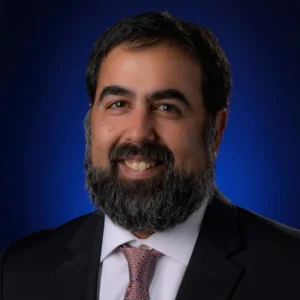
Word came during the hearing that NASA has promoted Amit Kshatriya to be Associate Administrator, the top civil servant position at the agency. He succeeds Vanessa Wyche, who was serving in the role on an acting basis and is returning to her position as Director of Johnson Space Center. Kshatriya headed the Moon-to-Mars program office in the Exploration Systems Development Mission Directorate.
Acting NASA Administrator Sean Duffy said under Kshatriya’s leadership “the agency will chart a bold vision to return to the Moon during President Trump’s term.” NASA’s press release said the move “exemplifies President Donald J. Trump and Duffy’s seriousness about returning Americans to the Moon and before China.”
At the hearing, Gold thanked Duffy for his “decisive action.”
“That sends an important message, not just to NASA, but to our international partners, even to China. We’re back! We’re reigniting the torch of Artemis and we’re going to go forward to the Moon. I can tell you, the NASA civil servants needed to hear that.” — Mike Gold
NASA also said Kshatriya’s promotion “signals how the Trump Administration sees the commercial space sector as an American economic engine,” but still did not outline what happens for the lunar program after Artemis III.
User Comments
SpacePolicyOnline.com has the right (but not the obligation) to monitor the comments and to remove any materials it deems inappropriate. We do not post comments that include links to other websites since we have no control over that content nor can we verify the security of such links.