SLS/Orion Ready to Roll for Artemis II
NASA is proceeding with plans to roll the Space Launch System rocket with the Orion crew capsule out to Launch Complex-39B at Kennedy Space Center tomorrow morning. The SLS/Orion combination soon will launch four astronauts around the Moon for the first time since the Apollo era, but the exact date depends on tests that can only be conducted after it is at the pad. The earliest is February 6, but everything would have to go exactly right for that to happen. [UPDATE: SLS/Orion did roll to the pad on January 17, settling in “hard down” at 6:42 pm ET.]
During a press conference today, John Honeycutt, head of the Artemis II Mission Management Team (MMT), made clear that his job is to get the four astronauts back to Earth safely. They will launch when everything is ready, not before: “crew safety is going to be our number 1 priority.”
An uncrewed test flight, Artemis I, took place in 2022. Honeycutt was Program Manager for the Space Launch System (SLS) during its development and through Artemis I. He was appointed chair of the Artemis II Mission Management Team in September 2025 (David Beaman is now acting SLS program manager).
Artemis II is a crewed test flight that will take NASA astronauts Reid Wiseman, Victor Glover, and Christina Koch, and Canadian Space Agency astronaut Jeremy Hansen around the Moon. As a test flight, they will not attempt to orbit the Moon, much less land, but will travel on a “free return” trajectory that will bring them back to Earth even if Orion’s propulsion system doesn’t perform as planned. They’ll spend about a day in Earth orbit checking out the propulsion system and Orion’s life support systems before departing for the Moon.

The United States is the only country that has sent astronauts to the Moon. The most recent was Apollo 17 in December 1972 with Gene Cernan, Ron Evans and Harrison “Jack” Schmitt. They were the sixth crew to land on the Moon and the ninth to fly to lunar distance. Apollo 8 and Apollo 10 were test flights that orbited the Moon. Apollo 11, 12, 14, 15, 16 and 17 landed. Apollo 13 suffered an in-flight explosion and made an emergency return to Earth after flying past the Moon on a trajectory similar to Artemis II’s.

The chances of a February 6 launch for Artemis II — just three weeks from now — seem pretty slim.
Tomorrow the Crawler-Transporter will slowly take SLS/Orion attached to the Mobile Launcher from the Vehicle Assembly Building (VAB) to Launch Complex 39B.
Launch Director Charlie Blackwell-Thompson said the 4-mile trip will take 8-10 hours. The first hour is simply exiting the VAB. The Crawler-Transporter’s top speed is 0.82 miles per hour, “a little slower around the turns and up the hill.” [UPDATE, January 17: SLS/Orion reached the pad and was “hard down” at 6:42 pm ET.]
Once it’s at the pad, the next major step is a Wet Dress Rehearsal (WDR) at the end of this month. The WDR is a practice countdown to just 29 seconds before liftoff, according to Blackwell-Thompson, that includes fully fueling the SLS tanks with liquid oxygen and liquid hydrogen (hence the term “wet”).
In 2022, several WDRs over multiple months were needed for Artemis I as the NASA and contractor teams gained experience with the systems. It was eight months between the first roll-out on March 17-18 and launch on November 16. The SLS/Orion stack had to roll back to the VAB in April and July for technical reasons and in September because of Hurricane Ian. The launch itself was scrubbed twice, on August 29 and September 3.

Blackwell-Thompson was Launch Director for Artemis I as well and said they’ve incorporated many lessons learned into planning for Artemis II. Pressed as to what the most likely launch date might be, she repeatedly said they have to wait for the WDR before they begin to have an answer.
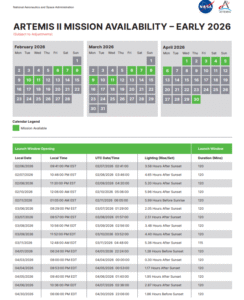
The launch can only take place on certain days each month when the Earth and Moon are correctly aligned. There are opportunities every month and NASA posted a chart of those in February, March, and April.
NASA will livestream the roll-out tomorrow on its YouTube channel starting at 7:00 am ET. At 9:00 am ET, the crew and NASA Administrator Jared Isaacman will answer questions from reporters standing next to KSC’s Countdown Clock. That also will air on NASA’s YouTube channel. NASA also released the Artemis II press kit today.
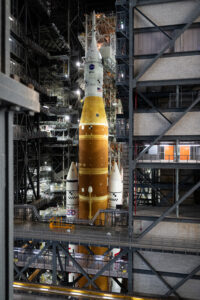
Boeing is the prime contractor for SLS (core stage), with Northrop Grumman providing Solid Rocket Boosters on each side and United Launch Alliance the upper stage, or Interim Cryogenic Propulsion Stage (ICPS). Lockheed Martin is the prime contractor for Orion and Europe’s Airbus Defence and Space provides Orion’s Service Module through a NASA/ESA arrangement. Amentum is the prime contractor for Exploration Ground Systems.
This article has been updated.
User Comments
SpacePolicyOnline.com has the right (but not the obligation) to monitor the comments and to remove any materials it deems inappropriate. We do not post comments that include links to other websites since we have no control over that content nor can we verify the security of such links.